Total Pageviews

Monday, January 10, 2022

Grappling with Graptolites: Paleozoic "Sawtooth" Index Fossils —Are you Jelly?

      Graptolites (or more precisely Graptolithina) are extinct colonial marine animals that are an excellent index fossil for parts of the Paleozoic period; individual species denote well-defined time frames within, especially, the Ordovician, Silurian and Devonian periods. The fossil remains present mostly as shiny, graphite-looking sawtoothed pieces. A big paleontology mystery up until the 1980’s was what these pieces represented. Early descriptors, including Linnaeus, were mystified by the “writing on the rock,” considering even hieroglyphics as a possible origin. He included them in “inorganic mineralizations and incrustations which resembled actual fossils.” In 1768’s, Systematic Naturae he included one species as a possible plant fossil. He also included a figure of a "fossil or graptolite of a strange kind.”


           These serrated, delicate, detailed fossils, represent about 200 million years from the Cambrian through the Pennsylvanian portion of the Carboniferous. 


           These useful Index fossils denote rocks to within a million year period within the Paleozoic.  The Ordovician was a particularly prolific time for graptolites, with rapid changes in morphology. In addition, early graptolites were sessile but rapidly evolved to be floating animals. Their fossil remains are found in shale and clay stone. Another prolific Ordovician index fossil, conodonts or conodont elements, are found mostly in limestone and other CaCO3-rich environments.{ More on conodonts during our next post.}


      Paleontologists use them to correlate the age of rocks, particularly mudstones or shales, based on changes in the serrated blades. Oil and gas geologists found graptolites particularly helpful in correlating borehole samples throughout a geologic basin. But, we didn’t have fossilized portions of the entire animal, just the shiny sawtooth bits.


            The rather shocking discovery of soft parts of the animal revealed graptolites resemble present-day jellyfish. These floating colonial animals had a proto-neural tube. But, only the floating strands of detailed serrated portions in the fossil record led to many incorrect hypotheses of their origin. Now, we believe graptolites looked like a an odd-shaped jellyfish as seen in these artists’ renderings:


              This rendering is even more bizarre:


      From long, shiny bit of graphite-looking straight shapes


  to the more elaborate swirling shapes, graptolites gave geologists a solid index fossil for use in oil and gas correlation between oil wells, long before we knew what the whole animals looked like.


The type 
locality for the Ordovician is located here in the U.K. As Ordovician. Note also, Silures, type locality for the Silurian, is located just to the south. {The Silurian was a time of great silence on the earth; almost no volcanic activity has been recorded during this Ordovician-adjacent time.}


Have you seen either graptolites or conodonts in rocks in the field? Odd that these two most unusual creatures would be the basis for so much geologic correlation, without knowing what the whole animals looked like. The Ordovician was a quite wild ride.

Happy New Year to all visitors to Partial Ellipsis of the Sun;we are glad you are here!

To 2022, with Great Expectations for Groundhog Day, 2/2/22! 
Steph

Bonus: Looking ahead: Here’s an image of  conodont elements in an SEM image as well as an artist rendering of the elements in the inside the mouth of that Ordovician beast, the stuff of nightmares. Conodonts, microfossils varied and extraordinaire, will be featured in our next post.





Tuesday, September 7, 2021

Codex of 15th and 16th Century Mexican Earthquakes (Tlalollin)


"The written chronology in a 16th century codex was created by a pre-Hispanic civilization.

 It is one of the oldest-known records of an earthquake which occurred in Mexico in 1507

(see below).


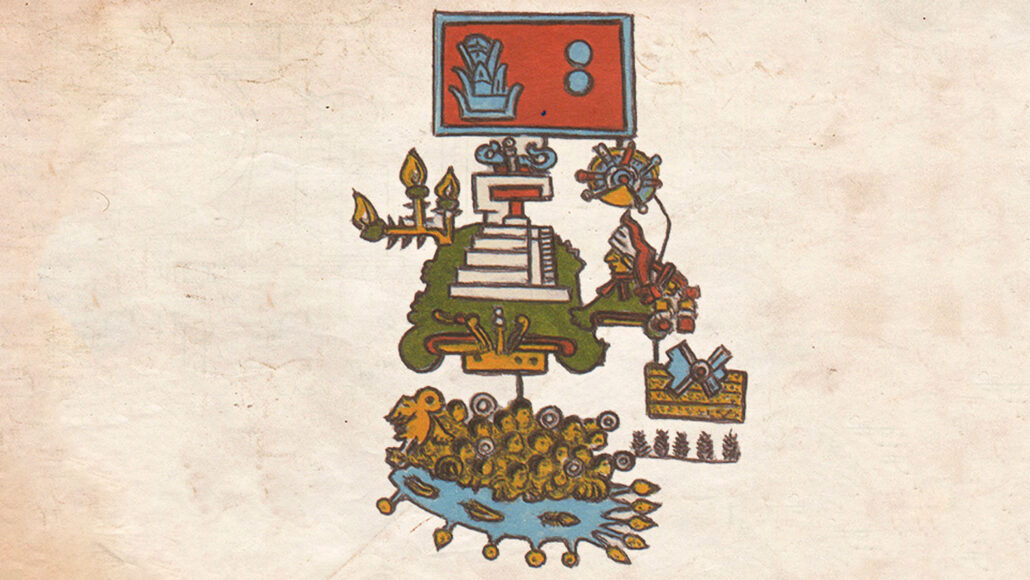
pictogram showing an earthquake and warriors in a river


       The earthquake is represented by the symbol (to the middle, right) 

composed of four dotted yellow rectangles representing the layers of 

the earth) overlain by four helices (in blue and white) with a red eye 

at the center. The pictogram also describes one impact of the quake

--the drowning of 1,800 warriors in a river (bottom).

          A 50-page codex of colorful, complex pictograms that dates to the early 16th century includes the most complete (and one of the oldest ) written chronologies of early earthquakes in the Americas.

      The Telleriano-Remensis, which was created by an unknown pre-Hispanic civilization, describes twelve separate earthquakes that shook in what is now Mexico and central America from 1460 to 1542 researchers report in the August 25, 2021 issue of Seismological Research Letters.       The famous codex was written by specialists called tlacuilos, meaning “those who write painting” in the Nahuatl language spoken byAztecs and other pre-Hispanic civilizations in the area (Science News, March 13, 2020).

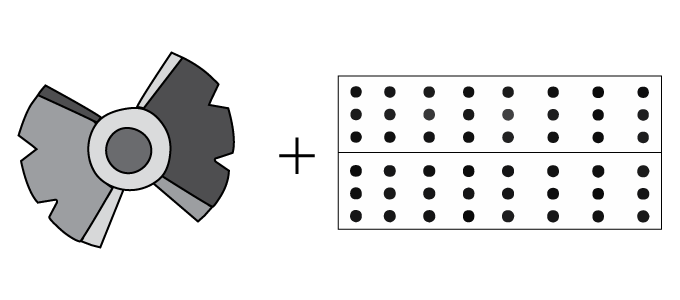
      Using other codices from the region, researchers had previously identified the combination of two pictographs that denotes an earthquake. One shows four helices around a central circle or eye, and stands for ollin, meaning “movement” in Nahuatl. The other pictograph shows one or more rectangular layers filled with dots, and means tlalli, or “earth.” For daytime earthquakes, the eye is open; for nighttime quakes, it’s closed.

pictograph showing a central eye followed by a plus sign and a pictograph showing a box with dots
In codices written by pre-Hispanic civilizations who spoke Nahuatl, such as the Aztecs, the combination of two symbols represents an earthquake, or tlalollin. One pictograph (left) shows four helices with a central eye and stands for ollin, or “movement.” The second (right) is a rectangular box filled with dots, often in layers, and represents tlalli, or “earth.”

      Seismologist Gerardo Suárez of the National Autonomous University of Mexico and social anthropologist Virginia García-Acosta of the Center for Research and Higher Studies in Social Anthropology, both in Mexico City, pored over the Telleriano-RemensisThe researchers were looking for representations of quakes, comparing what they found to accounts of quakes in other pre-Hispanic codices and texts written later by Spanish friars.


     The Telleriano-Remensis uses a pictorial representation of a 52-year cycle to roughly date the quakes. Years are represented by these four signs:

tecpatl (knife), 

calli (house),

 tochtli (rabbit) 

and acatl (reed) 

which are arranged in thirteen permutations. Those images helped the researchers match some pictorial accounts of quakes, including one in 1507, to later descriptions of the events.

     Little more is recounted about the precise locations of these quakes or the damage they caused, although one image suggests that a quake triggered flooding that drowned several warriors. Other codices may contain more clues, the researchers say, which could help create a more complete chronology of the quakes that shook this part of the Americas."


Knife, house, rabbit, reed?

Codex Steph

Saturday, May 8, 2021

Shoo, Shoo Shuvuuia: Nocturnal Owl-Like Dinosaur with Keen Eyesight and Acute Hearing


            A small  carnivorous dinosaur had superb low-light vision and hearing that was likely as good as an owl's. And like an owl, the tiny dinosaur probably used those exceptional abilities to stalk and catch its desert prey under the cover of darkness.


    The owl-like Shuvuuia (shu-VU-ya) was a theropod, a three-toed and bipedal carnivorous dinosaur. There's only one known species, Shuvuuia deserti, and it was smaller than a domestic cat, measuring 2 feet (0.6 meters) long. Shuvuuia lived about 75 million to 81 million years ago, during the late Cretaceous period in what is now the Gobi Desert in Mongolia.


      Prior analysis of Shuvuuia's fossilized eye bones revealed that it had large eyes that were specialized for seeing in dim light. But at the time, little was known about dinosaur adaptations for nocturnal activity. In a new study presented May 7, 2021 in Science, researchers looked at skulls from dozens of species of extinct theropods and modern birds, the only theropod lineage that survived to the present.


      By comparing dinosaurs' fossilized eye and ear structures with those in living animals that have nocturnal habits, the researchers were able to see if a dinosaur was adapted for day or night activity.

        Soft tissue is rarely preserved in the fossil record, but paleontologists can find clues about dinosaurs' eyes and vision in the bones that form a circle in the eye socket, known as the scleral ring. Scleral rings are found in many vertebrates (including extinct dinosaurs), and the diameter of this ring reveals the maximum width that an animal's pupil can dilate, hinting at their ability to see in low light, said lead study author Dr. Jonah Choiniere, University of the Witwatersrand in Johannesburg.  


     But nighttime hunting doesn't just depend on having good eyesight; specialized hearing is also key. So the researchers examined ear anatomy in 88 bird species and 17 extinct fossil theropods, using computed X-ray tomography (CT) scans to construct digital 3D models of the animals' skulls. They paid close attention to the cochlea, the part of the inner ear canal that holds sensory receptors for picking up sound waves. Decades of previous research had shown that the length of this canal is closely linked to how well animals can hear, and the length of Shuvuuia's ear canal suggested that its hearing would have been "off the charts," Dr. Choiniere said.


      "Shuvuuia had proportionally longer cochlear ducts than even the bird with the best hearing, the barn owl," Dr. Choiniere continued. What's more, the size of Shuvuuia's scleral rings showed that it also possessed "incredible night vision — better than any living bird we measured," he added. 


      The combination of light-sensitive eyes and superior hearing suggested that Shuvuuia would have been highly effective at detecting and ambushing prey at night, as owls do. By comparison, the theropod Velociraptor, which lived in the Gobi Desert alongside Shuvuuia, had an intermediate eye shape, "and was probably more twilight-active," said study co-author Dr. Lars Schmitz, W.M. Keck Science Department at Scripps College, CA. This is the first time that such extreme specializations for hearing and vision have been documented in an extinct dinosaur; in combining vision with hearing, the study also provides the best evidence for nocturnal behavior in dinosaurs, Dr. Schmitz said. 

     With a "hodgepodge body" Shuvuuia was an odd-looking dinosaur, and though it's related to fearsome meat-eating theropods such as Velociraptor and Tyrannosaurus rex, "it's totally unlike them," Dr. Choiniere said. "It's got a lightly built jaw, and its teeth look like tiny grains of basmati rice. It's got this massive eye, but the beak is very small," he said. Shuvuuia's forelimbs were powerful and bulky, tipped with a huge claw like an aardvark's. Capping off this hodgepodge of features was a pair of long, slender hind legs that were built for running. Shuvuuia deserti may have preyed on nocturnal desert insects. Shuvuuia deserti may have preyed on nocturnal desert insects. 


      However strange its body may have looked, these traits may have made Shuvuuia a better nighttime hunter. Some modern mammals that live in arid desert environments, as Shuvuuia did, combine lengthy hind limbs with digging forelimbs, "and they often have really good night vision and hearing," which helps them track and catch hard-to-find prey, Dr. Choiniere said. Burrowing desert prey would also be an easy meal for Shuvuuia to dig up with its powerful forearms. "This observation that Shuvuuia could have operated at night makes a lot of sense in light of the rest of the adaptations," he said. "It puts those into perspective and allows us to think it would have fit into a desert ecosystem today really well." 


      Animals that live together in the same geographical location often require the same resources in order to survive, but they can share them by being either night owls or early birds. Dinosaurs likely did this as well, and this study is just the beginning of paleontologists' discoveries of nocturnal and daytime preferences in these extinct animals and how those preferences might have affected their habits and behavior, Dr. Schmitz said. "That's something that we really don't understand well yet in the fossil record, but we know from looking at living species," he said. "I think there are some exciting discoveries waiting to be made."

         I wonder why we usually use birds to define early morning or late night behaviors. Which are you?

Thursday, December 31, 2020

Beginning of Plate Tectonics Was More Recent and More Gradual Than Expected Based on Northwest Australian Rocks


      Researchers from Cologne University present important new constraints showing that plate tectonics started relatively slowly, although the early earth's interior was much hotter.


       For this research, reported in the January 12, 2021 Proceedings of National Academy of Sciences, geologists and geophysicists led by Dr. Jonas Tusch  investigated up to 3.5 billion year old igneous rocks from northwest Australia that cover 800 million years of earth's early history.


      The analysis of these rock successions reveals that the oldest samples exhibit small anomalies in the isotope abundances of the element tungsten (W) that progressively diminish with time. 


     The origin of these anomalies, namely the relative abundance of 182W, relates to ancient heterogeneities in the terrestrial mantle that must have formed immediately after formation of the earth more than 4.5 billion years ago. The novel tool of high-precision 182W isotope measurements to rocks from the Pilbara Craton in Australia, that span an age range from 3.5 billion years to 2.7 billion years, was used in this study.


      The preservation of these 182W anomalies in the igneous rocks from northwest Australia demonstrate that pristine mantle reservoirs from the beginning of our planet were conserved over timescales exceeding more than one billion years during the Hadean time period.


      This finding is very surprising, because higher mantle temperatures in the early earth suggest that mantle convection was more extensive and much faster than today. Interestingly, the observed 182W anomalies start to diminish at around 3 billion years ago, within a geological era that is assumed to mark the beginning of modern plate tectonics. 


     The onset of modern plate tectonics, involving subduction processes and mountain uplift, has been shown to be a key event triggering the emergence of large continental masses and an oxygen-rich atmosphere, all of which set the stage for the origin of more complex life. This artist conception of earth during the Hadean time period (which predates "modern" plate tectonics).


Here's to our oxygen-rich atmosphere of 2021. Breathe deep and sense those plates moving!

Steph [aka WW (Tungsten Tungsten;-))]


Monday, November 30, 2020

Introducing Bruno!


      This is a good day to introduce Bruno, a Denver Dumb Friends League pup, rescued from the same place as Maizie, the night before election day.


     Bruno joined foster pup, Millie, and the two were hysterical romping, spooning, and whispering to each other. It made election night lots more fun. They had a blast together until Millie went to her furever home with a veteran and his parrot the day before Thanksgiving.


     Bruno is 4 years old and was surrendered with his 7 year old mom. He needed someone to pal around with for awhile. And in return, Bruno taught Millie, also 4, the art of house training. A win-win for everyone!


     I did consider adopting both of them but when this vet held Millie, close to tears of joy in his eyes, I knew Millie needed to be with him. He lost his dog at the same time that Maizie died. We are planning playdates so they will be together again.


       We are already looking forward to a Christmastime visit to the Great Sand Dunes to roam the dunes and let some of Maizie's ashes blow in that beautiful wind. I sure miss Maizie but Bruno's curious, slightly shy, and funny nature is helping me with grief.


         We'll get back to science topics next month, after the last 3 weeks of school. In the meantime, I would love to hear your dog tales, cat tales, gerbil tales, parrot tales...


With dogged determination,

Steph and Bruno