Total Pageviews

Wednesday, September 19, 2018

“Permafrost” and Thermokarst

     As temperatures rise in the arctic, “permafrost,” permanently frozen ground, is defrosting at an increased rate. 


     "However, permafrost isn't the only thing in the arctic that is disappearing. Exposed rock that was once covered in ice is dissolving, eaten away by acid. The effects of this acid bath could have far-reaching impacts on global climate, according to a new study.


     Icy permafrost is rich in minerals, which are released when the ice melts. The minerals then become vulnerable to chemical weathering, or the breakdown of rock through chemical reactions. Scientists investigated areas once covered by permafrost in the western Canadian arctic, finding evidence of weathering caused by sulfuric acid produced by sulfide minerals that were released when the permafrost melted.



     Another type of naturally occurring chemical erosion is caused by carbonic acid, and it also dissolves rock. But although carbonic-acid weathering locks carbon dioxide (CO2) in place, sulfuric-acid erosion releases CO2 into the atmosphere, and it does so in quantities that were not previously accounted for, researchers described.


      Dramatic changes are underway in the Arctic, which is warming about twice as fast as any other location on earth. Sea ice is rapidly dwindling, which reduces the ocean's heat-reflecting cover, accelerating the rise of ocean temperatures. And polar bears, which depend on sea-ice cover to hunt for seals, are losing their hunting grounds, and have a harder time finding enough to eat. 


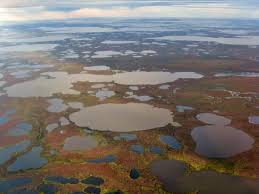
     On land, melting permafrost is shaping new landscapes, through a process called thermokarst — a term for thawing-driven erosion that originated in Russia, according to the U.S. Geological Survey (USGS).


     Thermokarst creates land formations such as lakes, pits, and sinkholes. It was not previously known how this process could affect weathering of exposed minerals, and how that might then impact CO2 release, according to the study.


     "These processes may influence the permafrost carbon-climate feedback, but have received little attention," the researchers reported.


     Over geologic time, weathering caused by carbonic acid can help to regulate climate, by trapping CO2 and restricting its transfer into the atmosphere. But the researchers found that thermokarst in regions that were rich in sulfides drove production of sulfuric acid, rather than carbonic acid, and thereby released quantities of CO2."


      These preliminary findings were published online 9/6/18 in the journal Geophysical Research Letters. (The "Plain Language" Abstract is something I've not seen before in professional journals; have you?)

       Thermokarst--easy enough for even kindergartners to understand, eh?
Steph


.

Tuesday, August 7, 2018

Forty-four More Planets Beyond Our Own Solar System: Four Have a Year of Less Than 24 Hours

Tuesday, July 17, 2018

Spin This News: Parental Chromosomes Develop Apart During Embryo's First Division

       Genetic researchers at the European Molecular Biology Lab (EMDL) have shown that mammalian life begins differently than originally suspected.

     It was long hypothesized that during a mammal embryo's first cell division, one spindle is responsible for segregating the embryo's chromosomes into two cells. Researchers now show that there are actually two spindles (as shown below), one for each set of parental chromosomes, meaning that the genetic information from each parent is kept apart throughout the first division.


     The publication Science published the results (which are likely to change biology textbooks) on 7/12/18. {Are there still textbooks?!}.


     This dual spindle formation may explain the high error rate in the early developmental stages of mammals, spanning the first few cell divisions. "The aim of this project was to find out why so many mistakes happen in those first divisions," says Dr. Jan (a guy!) Ellenberg, the group leader at EMBL who led the project. "We already knew about dual spindle formation in simpler organisms like insects, but we never thought (why not?!) this would be the case in mammals like mice. This finding was a big surprise, showing that you should always be prepared for the unexpected."


     Researchers have heretofore seen parental chromosomes occupying two half-moon-shaped parts in the nucleus of two-cell embryos, but it wasn't clear how this could be explained. "First, we were looking at the motion of parental chromosomes only, and we couldn't make sense of the cause of the separation," said Dr. Judith Reichmann. "Only when focusing on the microtubules -- the dynamic structures that spindles are made of -- could we see the dual spindles for the first time. This allowed us to provide an explanation for this 20-year-old mystery."


      Mitosis is the process of cell division, when one cell splits into two daughter cells. It occurs throughout the lifespan of multi-cellular organisms but is particularly important when the organism grows and develops. The key step of mitosis is to pass an identical copy of the genome to the next cell generation. For this to happen, DNA is duplicated and organised into dense thread-like structures known as chromosomes. The chromosomes are then attached to long protein fibres -- organised into a spindle -- which pulls the chromosomes apart and triggers the formation of two new cells. {The following diagram is one which will likely be updated in future embryology textbooks.}


     The spindle is made of thin, tube-like protein assemblies known as microtubules. During mitosis of animal cells, groups of such tubes grow dynamically and self-organize into a bi-polar spindle that surrounds the chromosomes. The microtubule fibres grow towards the chromosomes and connect with them, in preparation for chromosome separation to the daughter cells. Normally there is only one bi-polar spindle per cell, however, this research suggests that during the first cell division there are two: one each for the maternal and paternal chromosomes.


     "The dual spindles provide a previously unknown mechanism -- and thus a possible explanation -- for the common mistakes we see in the first divisions of mammalian embryos," Dr. Ellenberg explains. Such mistakes can result in cells with multiple nuclei, terminating development. "Now, we have a new mechanism to go after and identify new molecular targets. It will be important to find out if it works the same in humans, because that could provide valuable information for research on how to improve human infertility treatment, for example."


      In addition, the knowledge from this paper might impact legislation. In some countries, the law states that human life begins -- and is thus protected -- when the maternal and paternal nuclei fuse after fertilization. If it turns out that the dual spindle process works the same in humans, this definition is not fully accurate, as the union in one nucleus happens slightly later, after the first cell division.


     This discovery would have been impossible without the light-sheet microscopy technology (as seen above) developed at EMBL, which is now available through the spin-off company Luxendo. This allows for real-time and 3D imaging of the early stages of development, when embryos are very sensitive to light and would be damaged by conventional light microscopy methods. The high speed and spatial precision of light-sheet microscopy drastically reduce the amount of light that the embryo is exposed to, making a detailed analysis of these formerly hidden processes possible.


This is one spin we can stay with for awhile.
Steph

Earthquake experiment with brownies representing the stable craton of Canada and jello representing the tectonic plate boundary in Haiti.

The kids made "earthquake-proof" structures and observed the differences of the structures on "Canada" and "Haiti."


Wednesday, June 20, 2018

Precambrian Fossil Obama coronatus: Sessile Be De Millions?

     Earth's first complex animals were an eclectic group that lived in the shallow seas between 580-540 million years ago. 


     In great geologic irony, these more complex creatures are now classified as part of the very late Precambian ("Precambrian" means "before life.").


     The iconic Dickinsonia -- large, flat animals with a quilt-like appearance -- were joined by tube-shaped organisms, frond-like organisms that looked more like plants, and several dozen other varieties already characterized by geologists and biologists.


     We can add to that list two new animals discovered by a team of researchers:

     1) Obamus coronatus, a name that honors President Barack Obama's passion for science. This disc-shaped creature was between 0.5-2 centimeters. Obama coronatus is preserved in negative hyporelief and is defined by an overall torus shape produced by a series of arch-shaped spiral grooves. 


      Obamus coronatus (see below, left) was sessile or fixed, embedded to the ocean mat, a thick layer of organic benthic material that covered the early ocean floor. 


     2) Attenborites janeae, named after the English naturalist Sir David Attenborough for his science advocacy and support of paleontology (see above, right.) This tiny ovoid, less than a centimeter across, was adorned with internal grooves and ridges giving it a raisin-like appearance.


     The discovery of Obamus coronatus was published online on June 14, 2018, in the Australian Journal of Earth Sciences, or AJES, and the Attenborites janeae paper is forthcoming in the same journal. The studies were led by Dr. Mary Droser, a professor of paleontology at UC-Riverside.


     Both papers will be included in a 2019 AJES issue focusing on South Australia's Flinders Ranges region, where the discoveries were made.


     Part of the Ediacara biota, the soft-bodied animals are visible as fossils cast in fine-grained sandstone that have been preserved for hundreds of millions of years. These Precambrian lifeforms represent the dawn of animal life and are named after the Ediacara Hills in the Flinders Ranges, the first of several areas in the world where they have been found. Another suite of similar-age fossils was discovered in Sonora, Mexico, in 1995. (an area I worked in and described here).


     In the hierarchical taxonomic classification system, the Ediacara biota are not yet organized into families, and little is known about how they relate to modern animals. About 50 genera have been described, which often have only one species.


     "The two genera that we identified are a new body plan, unlike anything else that has been described," Droser said. "We have been seeing evidence for these animals for quite a long time, but it took us a while to verify that they are animals within their own rights and not part of another animal."

     The animals were seen in a particularly well-preserved fossil bed described in another paper published by Dr. Droser's group that will be included in the Flinders Ranges issue of AJES. The researchers dubbed this fossil bed "Alice's Restaurant Bed," a tribute to the Arlo Guthrie song and its lyric, "You can get anything you want at Alice's Restaurant."


     "I've been working in this region for 30 years, and I've never seen such a beautifully preserved bed with so many high quality and rare specimens, including Obamus and Attenborites," Dr. Droser said. "The AJES issue on the Flinders Ranges will support South Australia's effort to obtain World Heritage Site status for this area, and this new bed demonstrates the importance of protecting it."


You might say Ediacaran preservation is Flinders Keepers (for all).
Steph

Sunday, May 27, 2018

"Opposite Birds:" Why Being Grounded May Have Been the Counterintuitive Key to Survival


     The asteroid impact that caused a mass extinction 66 million years probably also triggered the collapse of forests worldwide, a new investigation of the plant fossil record concludes. 


     Needing trees and extensive plant cover for nesting or food could have been a fatal drawback for winged dinosaurs, including some ancient birds.


        Here is the caption for the diagram above: 

         "Ancestral Ecological Reconstructions Reveal Bias toward Non-arboreal Birds across the K-Pg:

      Bayesian ancestral ecological reconstructions (AERs) indicate that the most deeply diverging crown bird clades, including Neornithes (all crown birds), Neognathae (Galloanserae + Neoaves), and Neoaves, were ancestrally non-arboreal (pp > 0.99 for each node), with numerous independent transitions toward arboreality arising in the early Cenozoic, presumably after global forests had recovered from the Chicxulub impact. Concentric background rings demarcate geologic periods: the inner gray circle at the center indicates the Late Cretaceous, with the K-Pg boundary (66.02 Ma) indicated by the red dashed line; the white ring indicates the Paleogene (66.02–23.03 Ma), separated from the Neogene (23.03–2.58 Ma) by the dashed blue line. Tips extend to the present. Pie charts at the nodes indicate SIMMAP posterior probabilities for ancestral ecology, under our model. Branch colors represent a single randomly sampled stochastic character map from a posterior sample of 1,000 maps. The underlying phylogeny and taxonomy follow; qualitatively identical patterns are inferred using an alternative phylogenetic hypothesis."

       Reconstructing the ecology of ancient birds suggests that modern birds descended from species that survived because they could live on the ground, a research team proposes in the June 4, 2018, Current Biology.


      “You probably would have died anyway regardless of habitat,” says study coauthor Dr. Daniel Field, an evolutionary paleobiologist at the University of Bath in England. “But if you could get along on the ground, you at least had a shot at surviving across this devastated landscape.”

     The shock wave from the strike probably flattened trees within a radius of 1,500 kilometers, Dr. Field says. Wildfires ignited around the planet and then came the acid rain. Clouds of ash and dust may have darkened the sky for several years, and researchers suspect that photosynthesis waned. Yet some lucky birds, but no other dinosaurs, survived the hellscape.


     For clues to what made a survivor, researchers turned to fossilized pollen from before and after the fiery impact. Abundant kinds of flower-bearing and cone-bearing plants left pollen just before the asteroid hit and again starting about a thousand years afterward. In between those times of diversity, however, ferns dominated, the team notes. A kind of “disaster flora,” ferns (making spores instead of flowers and seeds) do well at recolonizing land. Seed plants, however, weren’t thriving.


     Analyzing evolutionary histories of modern birds supports the idea of tree dependence as a vulnerability for the earliest fowl, the researchers say. Specialists in bird evolution now generally agree on the lowest, oldest branches of the bird family tree, Field says. The bottommost one, for instance, includes such modern species as ground-dwelling ostriches and smaller, flight-capable birds called tinamous, which might be more like the ancient birds that dodged extinction.


     Working backward along these low branches, researchers used fossils and known bird traits to reconstruct the most likely lifestyles of the earliest survivors. These probably weren’t tree-dependent birds, the researchers conclude.


     The glory days of dinosaurs had had plenty of flying tree-dwellers. So far, paleontologists have identified at least 80 kinds of what are called “opposite birds,” the Enantiornithes. “If you saw one flying around today, you’d say, ‘Well, that’s a bird,’ ” Field explains. Their feet looked like those of birds that perch on tree limbs, so he’s not surprised that a fossil of an opposite bird from this probably arboreal group has never been found in rock formed after the dinosaur doomsday.


     What did happen, however, was that when trees and forests came back after the disaster, birds quickly evolved arboreal lifestyles, the team says.


     Many people don’t realize that birds almost died off during the mass extinction, too, says paleontologist Stephen Brusatte of the University of Edinburgh who has studied bird evolution but was not involved in the new study. What let the few survivors squeak through, he says, has been a mystery for a long time. The whole scenario of a ground-dweller’s advantage and then a return to the trees “makes a lot of intuitive sense.”

     Essentially, surviving on the ground, without much flying, for awhile may be what ultimately made the later arboreal environments so rich with modern-day birds.

No, er, YES, GROUSE about it!
Steph