Earth's first complex animals were an eclectic group that lived in the shallow seas between 580-540 million years ago.

In great geologic irony, these more complex creatures are now classified as part of the very late Precambian ("Precambrian" means "before life.").

The iconic Dickinsonia -- large, flat animals with a quilt-like appearance -- were joined by tube-shaped organisms, frond-like organisms that looked more like plants, and several dozen other varieties already characterized by geologists and biologists.

We can add to that list two new animals discovered by a team of researchers:
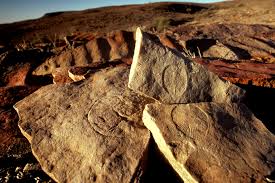
1) Obamus coronatus, a name that honors President Barack Obama's passion for science. This disc-shaped creature was between 0.5-2 centimeters. Obama coronatus is preserved in negative hyporelief and is defined by an overall torus shape produced by a series of arch-shaped spiral grooves.

Obamus coronatus (see below, left) was sessile or fixed, embedded to the ocean mat, a thick layer of organic benthic material that covered the early ocean floor.

2) Attenborites janeae, named after the English naturalist Sir David Attenborough for his science advocacy and support of paleontology (see above, right.) This tiny ovoid, less than a centimeter across, was adorned with internal grooves and ridges giving it a raisin-like appearance.

The discovery of Obamus coronatus was published online on June 14, 2018, in the Australian Journal of Earth Sciences, or AJES, and the Attenborites janeae paper is forthcoming in the same journal. The studies were led by Dr. Mary Droser, a professor of paleontology at UC-Riverside.

Both papers will be included in a 2019 AJES issue focusing on South Australia's Flinders Ranges region, where the discoveries were made.

Part of the Ediacara biota, the soft-bodied animals are visible as fossils cast in fine-grained sandstone that have been preserved for hundreds of millions of years. These Precambrian lifeforms represent the dawn of animal life and are named after the Ediacara Hills in the Flinders Ranges, the first of several areas in the world where they have been found. Another suite of similar-age fossils was discovered in Sonora, Mexico, in 1995. (an area I worked in and described here).

In the hierarchical taxonomic classification system, the Ediacara biota are not yet organized into families, and little is known about how they relate to modern animals. About 50 genera have been described, which often have only one species.
"The two genera that we identified are a new body plan, unlike anything else that has been described," Droser said. "We have been seeing evidence for these animals for quite a long time, but it took us a while to verify that they are animals within their own rights and not part of another animal."
The animals were seen in a particularly well-preserved fossil bed described in another paper published by Dr. Droser's group that will be included in the Flinders Ranges issue of AJES. The researchers dubbed this fossil bed "Alice's Restaurant Bed," a tribute to the Arlo Guthrie song and its lyric, "You can get anything you want at Alice's Restaurant."

"I've been working in this region for 30 years, and I've never seen such a beautifully preserved bed with so many high quality and rare specimens, including Obamus and Attenborites," Dr. Droser said. "The AJES issue on the Flinders Ranges will support South Australia's effort to obtain World Heritage Site status for this area, and this new bed demonstrates the importance of protecting it."

You might say Ediacaran preservation is Flinders Keepers (for all).
Steph

In great geologic irony, these more complex creatures are now classified as part of the very late Precambian ("Precambrian" means "before life.").

The iconic Dickinsonia -- large, flat animals with a quilt-like appearance -- were joined by tube-shaped organisms, frond-like organisms that looked more like plants, and several dozen other varieties already characterized by geologists and biologists.

We can add to that list two new animals discovered by a team of researchers:
1) Obamus coronatus, a name that honors President Barack Obama's passion for science. This disc-shaped creature was between 0.5-2 centimeters. Obama coronatus is preserved in negative hyporelief and is defined by an overall torus shape produced by a series of arch-shaped spiral grooves.

Obamus coronatus (see below, left) was sessile or fixed, embedded to the ocean mat, a thick layer of organic benthic material that covered the early ocean floor.

2) Attenborites janeae, named after the English naturalist Sir David Attenborough for his science advocacy and support of paleontology (see above, right.) This tiny ovoid, less than a centimeter across, was adorned with internal grooves and ridges giving it a raisin-like appearance.

The discovery of Obamus coronatus was published online on June 14, 2018, in the Australian Journal of Earth Sciences, or AJES, and the Attenborites janeae paper is forthcoming in the same journal. The studies were led by Dr. Mary Droser, a professor of paleontology at UC-Riverside.

Both papers will be included in a 2019 AJES issue focusing on South Australia's Flinders Ranges region, where the discoveries were made.

Part of the Ediacara biota, the soft-bodied animals are visible as fossils cast in fine-grained sandstone that have been preserved for hundreds of millions of years. These Precambrian lifeforms represent the dawn of animal life and are named after the Ediacara Hills in the Flinders Ranges, the first of several areas in the world where they have been found. Another suite of similar-age fossils was discovered in Sonora, Mexico, in 1995. (an area I worked in and described here).


"The two genera that we identified are a new body plan, unlike anything else that has been described," Droser said. "We have been seeing evidence for these animals for quite a long time, but it took us a while to verify that they are animals within their own rights and not part of another animal."
The animals were seen in a particularly well-preserved fossil bed described in another paper published by Dr. Droser's group that will be included in the Flinders Ranges issue of AJES. The researchers dubbed this fossil bed "Alice's Restaurant Bed," a tribute to the Arlo Guthrie song and its lyric, "You can get anything you want at Alice's Restaurant."

"I've been working in this region for 30 years, and I've never seen such a beautifully preserved bed with so many high quality and rare specimens, including Obamus and Attenborites," Dr. Droser said. "The AJES issue on the Flinders Ranges will support South Australia's effort to obtain World Heritage Site status for this area, and this new bed demonstrates the importance of protecting it."

You might say Ediacaran preservation is Flinders Keepers (for all).
Steph


