Total Pageviews

Tuesday, March 31, 2020

Diatoms and Diatomaceous Earth: Beer Filtration for What Ales You


      Diatomite is a generally light-colored sedimentary rock that is  composed mostly of the siliceous skeletons of diatoms. It is an extremely porous rock with a fine particle size and a low specific gravity. These properties make it useful as a filter media, especially for beer and wine. It is also used as an absorbent, and as a lightweight filler for paint and plastics. When diatomite is crushed into a very fine powder, it is called diatomaceous earth.


      Diatoms are members of a large, diverse group of algae that drift in the waters of both oceans and lakes. A few types of diatoms live on the bottom of these water bodies and in soils. Most diatoms are microscopic, although a few species are up to two (2) mm in length. As a group, diatoms are unique because they are single-celled organisms that produce an external cell wall composed of silica, called a frustule. These frustules are very thin and have a delicate structure.


      Most diatoms are photosynthetic and live in water less than thirty (30) feet deep, where sunlight can penetrate. Diatoms are prolific and are responsible for producing nearly half of the organic mass in the world’s oceans. Their abundance and tiny size places them at the base of the marine food chain. We have discussed the strength and Fibonacci ordering of diatoms before here at PEOTS.


     After diatoms die ("die, atoms, die!"-- sorry, I couldn't resist) their siliceous frustules sink. In some areas, the frustules are not incorporated into the bottom sediment because they dissolve as they sink or dissolve while on the sediment surface. If the sediment is composed of over 30% diatom frustules by weight, it is called diatomaceous ooze or siliceous ooze.


      Of course, all this ooze discussion leads to a talk of diatomaceous ooze filtering your booze. Freshwater ooze or earth must be used unless you like your booze salty (yuck for me!).    Diatomite from saltwater sources can contain salts that can produce objectionable or toxic effects. Although some beer crafters are, indeed, using salt in the brewing process. Enjoy the beer, skip the pretzels? Have a little diatomaceous ooze with your booze? Woe is mead?


     The four main uses of diatomite in the United States during 2019 were filtration (50%), light aggregate (30%), fillers (15%), and absorbents (5%).


      Diatomaceous earth is used as a lightweight, inert filler in some manufactured products. It is added to paint as a whitening agent and extender. Diatomite is added to plastics as a lightweight filler. 


     If dry diatomaceous earth is placed on a liquid spill, it can absorb and hold an amount of liquid equivalent to its own weight. This absorption facilitates containment, cleanup, and removal. Capillary action of liquids into diatomaceous earth is enhanced by its small particle size, high surface area, and its high porosity.


       These same properties make diatomaceous earth able to absorb skin oils when used in cosmetics and facial masks. Diatomaceous earth is an absorbent ingredient of some kitty litters. It is also used as a soil treatment to absorb and hold water.


     Diatomaceous earth is used as a mild abrasive in some toothpastes, facial scrubs, and metal polishes. Its silica particles are small, friable, have a high surface area, and are angular in shape. These are properties that help it perform well as a mild abrasive.


     Diatomaceous earth is used as a growing medium in hydroponic gardens. It is inert, holds water, and has a porosity that allows the soil to breathe. To help grain and other seeds from sticking together and remain dry, they are dusted with diatomaceous earth.


     The cost of diatomite depends on its quality, how it will be used, and the preparation effort that has been invested by the supplier. The cost of diatomite straight from the mine without processing for use in concrete starts at about $7/ton. Diatomite from high-grade deposits that has been crushed, sized, and sieved for use in cosmetics, art supplies, & DNA extraction markets can cost more than $400/ton.


     The extraordinary intricacy of diatoms in Scanning Electron Micrographs shown throughout this post is astounding. Do you have a favorite?
Hoping you are all well in this weirdest of times,
Steph
P.S. Begone, M a r c h, oh longest of months this year.

Wednesday, February 5, 2020

Many Grains of Truth: Sand Dunes "Communicating" with Each Other


Although they are an inanimate  collection of objects, sand dunes can 'communicate' with each other. Researchers from the UniversitCambridge have discovered that as they shift, sand dunes interact with and repel their sand dune neighbors downstream.


      Although they are an inanimate  collection of objects, sand dunes can 'communicate' with each other. Researchers from the University of Cambridge have discovered that as they shift, sand dunes interact with and repel their sand dune neighbors downstream.


         [Another sand dunes post?! Yes, it's true that Dunes hold a special place in my heart and in the heart of Maizie. On Sunday, on a blue-sky 75 degree F day, Maizie dug happily in a big sand pit on our walk as I thought "We need to get back to the Great Sand Dunes (above) in southern Colorado." Of course, today is not that day as it was -5 degrees F this morning. An 80 degree F swing? Yes, indeed. See above photo from the National Park Service.]


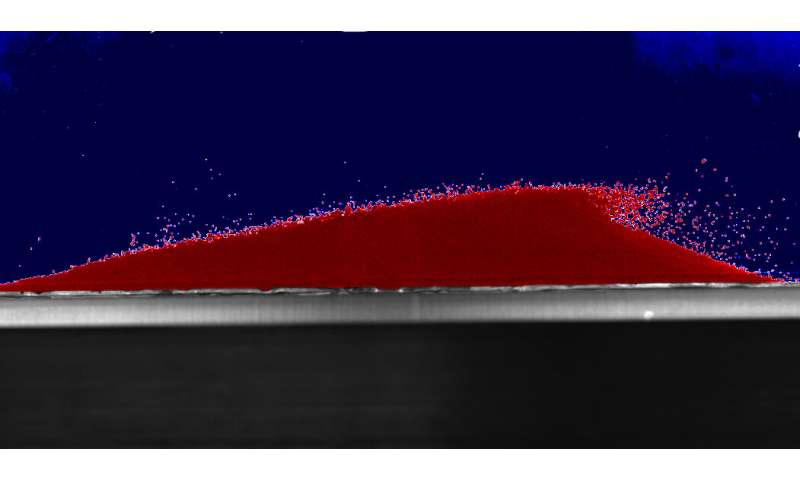
     "Using an experimental dune 'racetrack', the team observed that two identical dunes start out close together, but over time they get further and further apart. This interaction is controlled by turbulent swirls from the upstream dune, which push the downstream dune away. The results, reported in the journal Physical Review Letters, are key for the study of long-term dune migration, which threatens shipping channels, increases desertification, and can bury infrastructure such as highways.
When a pile of sand is exposed to wind or water flow, it forms a dune shape and starts moving downstream with the flow. Sand dunes, whether in deserts, on river bottoms or sea beds, rarely occur in isolation and instead usually appear in large groups, forming striking patterns known as dune fields or corridors."


     "Active sand dunes migrate. Generally speaking, the speed of a dune is inverse to its size: smaller dunes move faster and larger dunes move slower. What hasn't been understood is if and how dunes within a field interact with each other."


     "There are different theories on dune interaction: one is that dunes of different sizes will collide, and keep colliding, until they form one giant dune, although this phenomenon has not yet been observed in nature," said Dr. Karol Bacik of Cambridge's Department of Applied Mathematics and Theoretical Physics, and the paper's first author. "Another theory is that dunes might collide and exchange mass, sort of like billiard balls bouncing off one another, until they are the same size and move at the same speed, but we need to validate these theories experimentally."


     Now, Dr. Bacik and his Cambridge colleagues have shown results that question these explanations. "We've discovered physics that hasn't been part of the model before," said Dr. Nathalie Vriend, who led the research.


     "Most of the work in modelling the behavior of sand dunes is done numerically, but Dr. Vriend and the members of her lab designed and constructed a unique experimental facility which enables them to observe their long-term behaviour. Water-filled flumes are common tools for studying the movement of sand dunes in a lab setting, but the dunes can only be observed until they reach the end of the tank. Instead, the Cambridge researchers have built a circular flume so that the dunes can be observed for hours as the flume rotates, while high-speed cameras allow them to track the flow of individual particles in the dunes."


     Dr. Bacik hadn't originally meant to study the interaction between two dunes: "Originally, I put multiple dunes in the tank just to speed up data collection, but we didn't expect to see how they started to interact with each other," he said.


     "The two dunes started with the same volume and in the same shape. As the flow began to move across the two dunes, they started moving. "Since we know that the speed of a dune is related to its height, we expected that the two dunes would move at the same speed," said Vriend, who is based at the BP Institute for Multiphase Flow. "However, this is not what we observed."


     Initially, the front dune moved faster than the back dune, but as the experiment continued, the front dune began to slow down, until the two dunes were moving at almost the same speed.


     Crucially, the pattern of flow across the two dunes was observed to be different: the flow is deflected by the front dune, generating 'swirls' on the back dune and pushing it away. "The front dune generates the turbulence pattern which we see on the back dune," said Vriend. "The flow structure behind the front dune is like a wake behind a boat, and affects the properties of the next dune."


     As the experiment continued, the dunes got further and further apart, until they form an equilibrium on opposite sides of the circular flume, remaining 180 degrees apart.


     The next step for the research is to find quantitative evidence of large-scale and complex  migration in deserts, using observations and satellite images. By tracking clusters of dunes over long periods, we can observe whether measures to divert the migration of dunes are effective or not.


Here's hoping flumes don't look leave you flummoxed.

Steph

Wednesday, January 8, 2020

Trash Talking Early: Plastic "Continents" of Trash

     Plastic "continents" are not static. Based on the oceanic circulation modelling work conducted in the Pacific, the Institute de Recherche et Developpement (IRD) and the National Council for Scientific Rearch (CNRS) researchers have recently shown that there are exit currents for these areas of the sea where these piles of waste build up. This means that they are not caught in a never-ending whirlpool in the middle of the ocean, as had been previously thought. Although inappropriate given the actual estimated concentrations, this term highlights the awareness of the impact of human activity on the oceans.


.    Due to the winds on the surface of the oceans and the rotation of the earth (via the Coriolis force), huge vortexes, called "oceanic gyres," are formed in each of the five major basins: North and South Pacific, North and South Atlantic, and the Indian Ocean. These huge whirlpools slowly gather in their wake all the plastic objects and waste floating on the surface of the water, accumulating year after year.


      This pollution is now recognized as a global problem, representing a threat to marine biodiversity. In particular, this surface drift acts as a means of transport for the viruses and bacteria that the spread across the oceans.


      Nevertheless, these plastic "continents," as they are incorrectly christened, are not, in fact, static. The IRD and CNRS researchers have recently revealed the existence of "exit doors" leading away from these large surface current convergence zones. The scientists started by studying the oceanic circulation in the Pacific modelled with a much finer spatial resolution than that of the models generally used for this type of study (those typically used for climate research). They simulated the trajectories of several million particles, with currents defined on networks of 1/32° to 1/4° (meaning a range from a few kilometers to thirty or forty kilometers).


      The results obtained highlight currents, several hundred kilometers wide, which escape from the heart of the subtropical gyre and head eastwards instead. In addition to these currents there are physical processes such as the effects of the wind and waves, not taken into account in the models, which can also alter the trajectory and the transit time of the particles and waste.


     In the Pacific, the waste may not necessarily be trapped in the centre of the oceanic gyre and may be removed in the direction of the American coasts. Furthermore, these results are backed up by the work of the IRD's Chilean partners. They have observed an increase in the amount of waste collected on their coastlines.


     More detailed observations, modelling and analyses are needed to gain a better understanding of the ocean surface currents that regulate the slow routing of plastic waste on the surface of the seas and, in the medium-term, implement strategies for collecting and recycling all of this waste.

         I saw first-hand the dumping of all our waste aboard the Research Vessel Eastward in the Mediterranean Sea in 1978. The ship's captain laughed at me when I suggested that continual trash dumping would add up to eventually plug up the oceans. It was so devastating to see those empty cans of Spam floating in the sea.


Trash talking pre-LIV,
Steph

Tuesday, October 1, 2019

Machu Picchu: 15th Century Incan Sanctuary Purposely Built on Faults
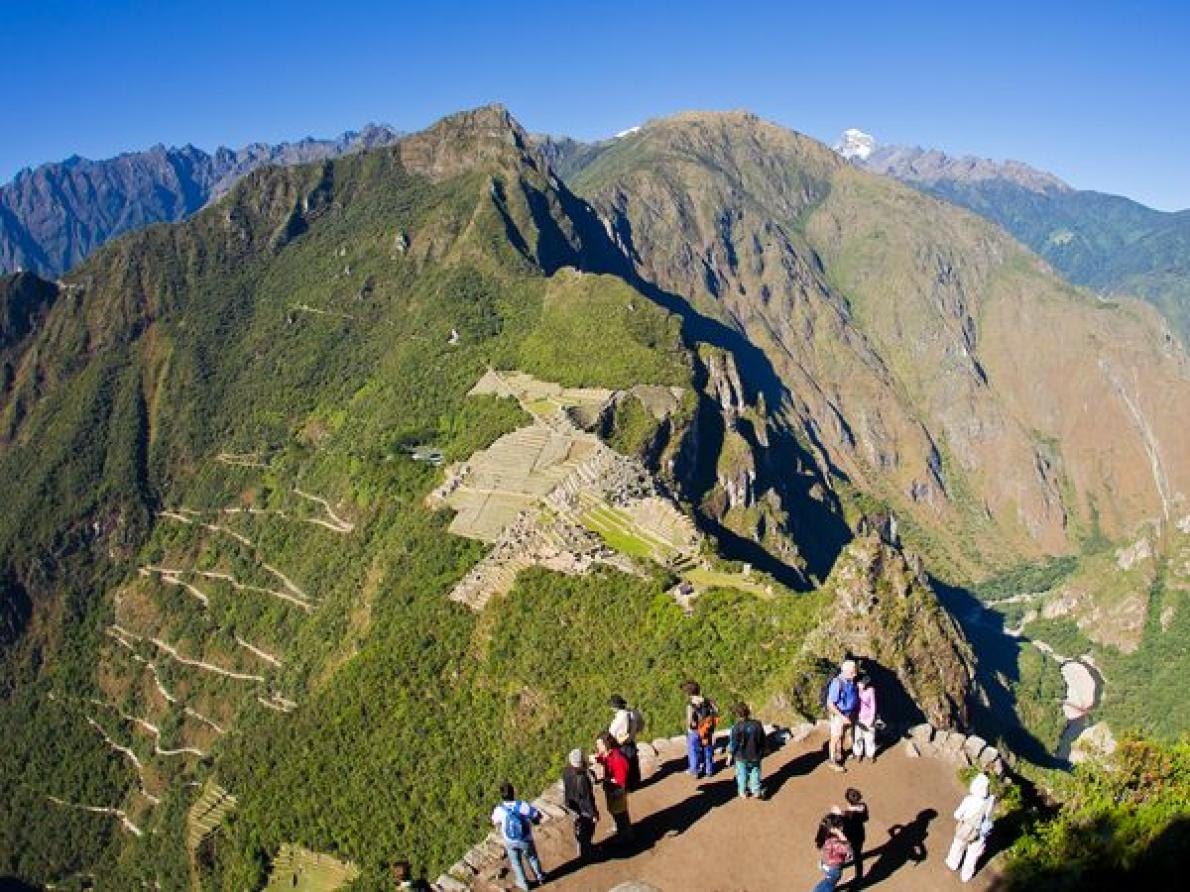


     "The ancient Incan sanctuary of Machu Picchu constructed in the mid to late 15th century, is considered one of humanity's greatest architectural achievements. Built in a remote Andean setting atop a narrow ridge high above a precipitous river canyon, the site is renowned for its perfect integration with the spectacular landscape. Yet the sanctuary's location has long puzzled scientists -- Why did the Incas build their masterpiece in such an inaccessible place? Research suggests the answer may be related to the geological faults that lie beneath the site."(Wow, ancient ecoarchitects meet ancient Scientific Stephs ;-)).

       "On September 23, 2019, at the Geological Society of America (GSA) Annual meeting Dr. Rualdo Menegat, a geologist at Brazil's Federal University of Rio Grande do Sul,  presented the results of a detailed geoarchaeological analysis that suggests the Incas intentionally built Machu Picchu -- as well as some of their cities -- in locations where tectonic faults meet. "Machu Pichu's location is not a coincidence," says Dr. Menegat. "It would be impossible to build such a site in the high mountains if the substrate was not fractured."


    " Using a combination of satellite imagery and field measurements, Menegat mapped a dense web of intersecting fractures and faults beneath the UNESCO World Heritage Site. His analysis indicates these features vary widely in scale, from tiny fractures visible in individual stones to major, 175-kilometer-long lineaments that control the orientation of some of the region's river valleys."


     "Dr. Menegat found that these faults and fractures occur in several sets, some of which correspond to the major fault zones responsible for uplifting the Central Andes Mountains during the past eight million years. Because some of these faults are oriented northeast-southwest and others trend northwest-southeast, they collectively create an "X" shape where they intersect beneath Machu Picchu. X marks the Machu Picchu spot.


     "Dr. Menegat's mapping suggests that the sanctuary's urban sectors and the surrounding agricultural fields, as well as individual buildings and stairs, are all oriented along the trends of these major faults. "The layout clearly reflects the fracture matrix underlying the site," says Dr. Menegat. Other ancient Incan cities, including Ollantaytambo, Pisac, and Cusco, are also located at the intersection of faults, says Menegat. "Each is precisely the expression of the main directions of the site's geological faults."


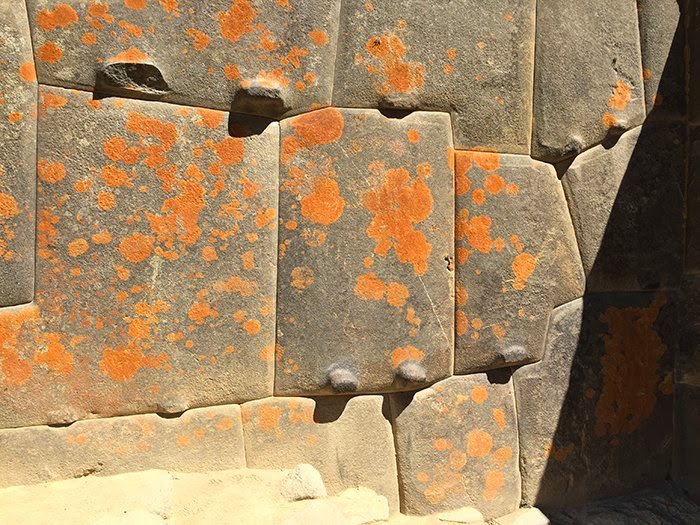
     Dr. Menegat's results indicate the underlying fault-and-fracture network is as integral to Machu Picchu's construction as its legendary stonework (as above). This mortar-free masonry features stones so perfectly fitted together that it's impossible to slide a credit card between them. Aside from the obvious aesthetic benefits of this building style, there are engineering advantages. Peru is a seismically unstable country; both Lima and Cusco have been leveled by earthquakes. When an earthquake occurs, the stones in an Inca building are said to “dance;” that is, they bounce through the tremors and then fall back into place. Without this building method, many of the best known buildings at Machu Picchu would have collapsed long ago.


       "As master stoneworkers, the Incas took advantage of the abundant building materials in the fault zone, says Dr. Menegat. "The intense fracturing there predisposed the rocks to breaking along these same planes of weakness, which greatly reduced the energy needed to carve them."


     "In addition to helping shape individual stones, the fault network at Machu Picchu likely offered the Incas other advantages, according to Dr. Menegat. Chief among these was a ready source of water. "The area's tectonic faults channeled meltwater and rainwater straight to the site," he says. Construction of the sanctuary in such a high perch also had the benefit of isolating the site from avalanches and landslides, all-too-common hazards in this alpine environment, Dr. Menegat explains."


     "The faults and fractures underlying Machu Picchu also helped drain the site during the intense rainstorms prevalent in the region. "About two-thirds of the effort to build the sanctuary involved constructing subsurface drainages," says Dr. Menegat. "The preexisting fractures aided this process and help account for its remarkable preservation," he says. "Machu Picchu clearly shows us that the Incan civilization was an built on well-fractured rocks. 

Have any PEOTS folks visited Machu Picchu? How was the experience?

And Happy 6 year anniversary to PEOTS! 


  • We had a Japanese cardiologist stay with us in March 2008. He took the leftover Colorado trail GORP with him to his next stop at MP and sent this image. So it's almost like I've been there...and it looks deserted.


Thursday, July 18, 2019

Who Nose? -- Nothing to Sniff at: Mammalian Brains and Distinguishing Odors


     "Neuroscientists have discovered that at least six types of mammals -- from mice to cats -- distinguish odors in roughly the same way, using circuitry in the brain that's evolutionarily preserved across species.


       The world is filled with millions distinct smells, but how mammals' brains evolved to tell them apart has been something of a mystery.


       Now, in a study published today, two neuroscientists from the Salk Institute and UC -- San Diego have discovered that at least six types of mammals distinguish odors in roughly the same way, using circuitry in the brain that's evolutionarily preserved across species.


      "The study yields insights into organizational principles underpinning brain circuitry for olfaction in mammals that may be applied to other parts of the brain and other species," says Dr. Charles Stevens, distinguished professor emeritus in the Salk Lab.


     In brief, the study reveals that the size of each of the three components of the neural network for olfaction scales about the same for each species, starting with receptors in the nose that transmit signals to a cluster of neurons in the front of the brain called the olfactory bulb which, in turn, relays the signals to a "higher functioning" region for odor identification called the piriform cortex.


     "These three stages scale with each other, with the relationship of the number of neurons in each stage the same across species," says Dr. Shyam Srinivasan, assistant project scientist with UC San Diego's Kavli Institute for Brain and Mind, and the paper's coauthor. "So, if you told me the number of neurons in the nose, I could predict the number in the piriform cortex or the bulb."


      The current study extends research by the same authors, published last year in which described how mouse brains process and distinguish odors using what's known as "distributed circuits." Unlike the visual system, for example, where information is transmitted in an orderly manner to specific parts of the visual cortex, the researchers discovered that the olfactory system in mice relies on a combination of connections distributed across the piriform cortex.


     Following that paper, the authors sought to determine if the distributed neural circuitry revealed in mice is similar in other mammals. For the current work, the researchers analyzed mammal brains of varying sizes and types. Their calculations, plus previous studies over the past few years, were used to estimate brain volumes. 


      The new study revealed that the average number of synapses connecting each functional unit of the olfactory bulb to neurons in the piriform cortex is invariant across species.

      "It was remarkable to see how these were conserved," says Dr. Stevens.


     Specifically, identification of individual odors is linked to the strength and combination of firing neurons in the circuit that can be likened to music from a piano whose notes spring from the depression of multiple keys to create chords, or the arrangement of letters that form the words on a page.


       "The discrimination of odors is based on the firing rate, the electric pulse that travels down the neuron's axon," says Srinivasan. "One odor, say for coffee, may elicit a slow response in a neuron while the same neuron may respond to chocolate at a faster rate."


      This code used for olfaction is different than other parts of the brain.

     "We showed that the connectivity parameters and the relationship between different stages of the olfactory circuit are conserved across mammals, suggesting that evolution has used the same design for the circuit across species, but just changed the size to fit the animals' environmental niche," says Dr. Stevens.


     In the future, Dr. Stevens plans to examine other regions of the brain in search of other distributed circuits whose function is based on similar coding found in this study.


     Dr. Srinivasan says he will focus on how noise or variability in odor coding determines the balance between discrimination and learning, explaining that the variability the duo is finding in their work might be a mechanism for distinguishing odors, which could be applied to making better machine learning or AI systems."


     Smell-o-vision, anyone?

Stay cool and not stinky,
Steph