Total Pageviews

Showing posts with label Cambridge. Show all posts

Wednesday, February 5, 2020

Many Grains of Truth: Sand Dunes "Communicating" with Each Other


Although they are an inanimate  collection of objects, sand dunes can 'communicate' with each other. Researchers from the UniversitCambridge have discovered that as they shift, sand dunes interact with and repel their sand dune neighbors downstream.


      Although they are an inanimate  collection of objects, sand dunes can 'communicate' with each other. Researchers from the University of Cambridge have discovered that as they shift, sand dunes interact with and repel their sand dune neighbors downstream.


         [Another sand dunes post?! Yes, it's true that Dunes hold a special place in my heart and in the heart of Maizie. On Sunday, on a blue-sky 75 degree F day, Maizie dug happily in a big sand pit on our walk as I thought "We need to get back to the Great Sand Dunes (above) in southern Colorado." Of course, today is not that day as it was -5 degrees F this morning. An 80 degree F swing? Yes, indeed. See above photo from the National Park Service.]


     "Using an experimental dune 'racetrack', the team observed that two identical dunes start out close together, but over time they get further and further apart. This interaction is controlled by turbulent swirls from the upstream dune, which push the downstream dune away. The results, reported in the journal Physical Review Letters, are key for the study of long-term dune migration, which threatens shipping channels, increases desertification, and can bury infrastructure such as highways.
When a pile of sand is exposed to wind or water flow, it forms a dune shape and starts moving downstream with the flow. Sand dunes, whether in deserts, on river bottoms or sea beds, rarely occur in isolation and instead usually appear in large groups, forming striking patterns known as dune fields or corridors."


     "Active sand dunes migrate. Generally speaking, the speed of a dune is inverse to its size: smaller dunes move faster and larger dunes move slower. What hasn't been understood is if and how dunes within a field interact with each other."


     "There are different theories on dune interaction: one is that dunes of different sizes will collide, and keep colliding, until they form one giant dune, although this phenomenon has not yet been observed in nature," said Dr. Karol Bacik of Cambridge's Department of Applied Mathematics and Theoretical Physics, and the paper's first author. "Another theory is that dunes might collide and exchange mass, sort of like billiard balls bouncing off one another, until they are the same size and move at the same speed, but we need to validate these theories experimentally."


     Now, Dr. Bacik and his Cambridge colleagues have shown results that question these explanations. "We've discovered physics that hasn't been part of the model before," said Dr. Nathalie Vriend, who led the research.


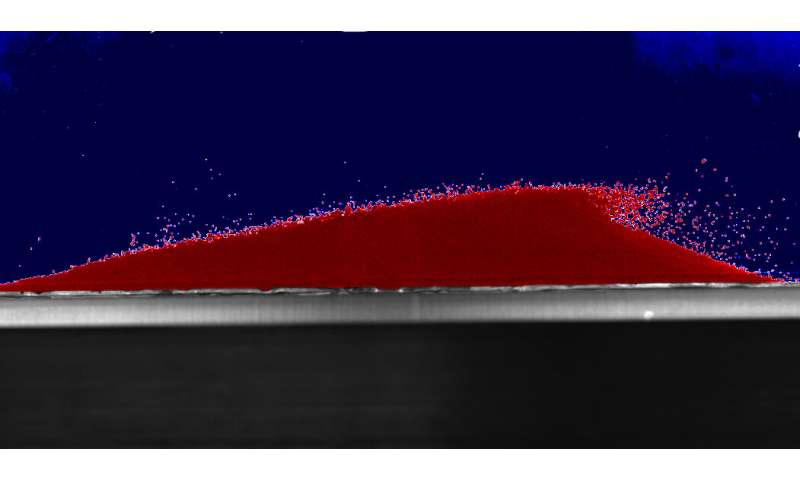
     "Most of the work in modelling the behavior of sand dunes is done numerically, but Dr. Vriend and the members of her lab designed and constructed a unique experimental facility which enables them to observe their long-term behaviour. Water-filled flumes are common tools for studying the movement of sand dunes in a lab setting, but the dunes can only be observed until they reach the end of the tank. Instead, the Cambridge researchers have built a circular flume so that the dunes can be observed for hours as the flume rotates, while high-speed cameras allow them to track the flow of individual particles in the dunes."


     Dr. Bacik hadn't originally meant to study the interaction between two dunes: "Originally, I put multiple dunes in the tank just to speed up data collection, but we didn't expect to see how they started to interact with each other," he said.


     "The two dunes started with the same volume and in the same shape. As the flow began to move across the two dunes, they started moving. "Since we know that the speed of a dune is related to its height, we expected that the two dunes would move at the same speed," said Vriend, who is based at the BP Institute for Multiphase Flow. "However, this is not what we observed."


     Initially, the front dune moved faster than the back dune, but as the experiment continued, the front dune began to slow down, until the two dunes were moving at almost the same speed.


     Crucially, the pattern of flow across the two dunes was observed to be different: the flow is deflected by the front dune, generating 'swirls' on the back dune and pushing it away. "The front dune generates the turbulence pattern which we see on the back dune," said Vriend. "The flow structure behind the front dune is like a wake behind a boat, and affects the properties of the next dune."


     As the experiment continued, the dunes got further and further apart, until they form an equilibrium on opposite sides of the circular flume, remaining 180 degrees apart.


     The next step for the research is to find quantitative evidence of large-scale and complex  migration in deserts, using observations and satellite images. By tracking clusters of dunes over long periods, we can observe whether measures to divert the migration of dunes are effective or not.


Here's hoping flumes don't look leave you flummoxed.

Steph

Wednesday, November 29, 2017

Where All the Women Are Strong: Bone Strength Comparison

     A new study comparing the bones of central European women who lived during the first 6,000 years of farming with those of modern athletes has shown that the average prehistoric agricultural woman had stronger upper arms than living female rowing champions.


     Researchers from the University of Cambridge's Department of Archeology say this physical prowess was likely obtained through tilling soil and harvesting crops by hand, as well as the grinding of grain for as much as five hours a day to make flour.


      Until now, archeological investigations of past behavior have interpreted women's bones solely through direct comparison to those of men. However, male bones respond to strain in a more visibly dramatic way than female bones.


     The Cambridge scientists say this has resulted in the systematic underestimation of the nature and scale of the physical demands borne by women in prehistory.


     "This is the first study to actually compare prehistoric female bones to those of living women," said Dr. Alison Macintosh, lead author of the study published this month in the journal Science Advances.


     "By interpreting women's bones in a female-specific context we can start to see how intensive, variable and laborious their behaviors were, hinting at a hidden history of women's work over thousands of years."


     The study used a small CT scanner in Cambridge's laboratory to analyze the arm (humerus) and leg (tibia) bones of living women who engage in a range of physical activity: from runners, rowers and footballers to those with more sedentary lifestyles.


     The bone strengths of modern women were compared to those of women from early Neolithic agricultural eras through to farming communities of the Middle Ages.

     "We can forget that bone is a living tissue, one that responds to the rigours we put our bodies through. Physical impact and muscle activity both put strain on bone, called loading. The bone reacts by changing in shape, curvature, thickness, and density over time to accommodate repeated strain," said Dr. Macintosh.


      "By analyzing the bone characteristics of living people whose regular physical exertion is known, and comparing them to the characteristics of ancient bones, we can start to interpret the kinds of labor our ancestors were performing in prehistory."

      Over three weeks during trial season, Macintosh scanned the limb bones of the Open- and Lightweight squads of the Cambridge University Women's Boat Club, who ended up winning this year's Boat Race and breaking the course record. These women, most in their early twenties, were training twice a day and rowing an average of 120 kilometers a week at the time.


      The Neolithic women analyzed in the study (from 7400-7000 years ago) had similar leg bone strength to modern rowers, but their arm bones were 11-16% stronger for their size than the rowers, and almost 30% stronger than typical Cambridge students. {Bone scan is at left, above, vs. x-ray to the left}.


     The loading of the upper limbs was even more dominant in the study's Bronze Age women (from 4300-3500 years ago), who had 9-13% stronger arm bones than the rowers but 12% weaker leg bones.

     A possible explanation for this fierce arm strength is the grinding of grain. "We can't say specifically what behaviors were causing the bone loading we found. However, a major activity in early agriculture was converting grain into flour, and this was likely performed by women," said Dr. Macintosh.


      "For millennia, grain would have been ground by hand between two large stones called a saddle quern. In the few remaining societies that still use saddle querns, women grind grain for up to five hours a day." {The mano and metate is a variety of saddle quern used for nixtamalization or grinding.}

     "The repetitive arm action of grinding these stones together for hours may have loaded women's arm bones in a similar way to the laborious back-and-forth motion of rowing."


     However, Macintosh suspects that women's labor was hardly likely to have been limited to this one behavior.

     "Prior to the invention of the plough, subsistence farming involved manually planting, tilling and harvesting all crops," said Dr. Macintosh. "Women were also likely to have been fetching food and water for domestic livestock, processing milk and meat, and converting hides and wool into textiles.

     "The variation in bone loading found in prehistoric women suggests that a wide range of behaviours were occurring during early agriculture. In fact, we believe it may be the wide variety of women's work that in part makes it so difficult to identify signatures of any one specific behavior from their bones."


     Dr. Jay Stock, senior study author added: "Our findings suggest that for thousands of years, the rigorous manual labor of women was a crucial driver of early farming economies. The research demonstrates what we can learn about the human past through better understanding of human variation today."

Where all the women are strong,
Steph (former member of Smith College Crew)