Total Pageviews

Wednesday, February 24, 2016

ATLASGAL: Celebrating Holding Up New Images AND "Cool" ACRONYMS

         Researchers associated with ATLASGAL, the APEX Telescope Large Area Survey of the Galaxy (ATLASGAL) have just released this image of the Milky Way:


      "The APEX telescope has mapped the full area of the galactic plane visible from the southern hemisphere for the first time at sub-millimeter wavelengths and in finer detail than space-based surveys. The APEX telescope allows the study of the cold universe, a few tens of degrees above absolute zero" according to an article released today.


       "APEX, the Atacama Pathfinder EXperiment telescope, is located at 5100 meters above sea level on the Chajnantor Plateau in Chile's Atacama region. The ATLASGAL survey took advantage of the unique characteristics of the telescope to provide a detailed view of the distribution of cold dense gas along the plane of the Milky Way galaxy. The new image includes most of the regions of star formation in the southern Milky Way."


       "At the heart of APEX are its sensitive instruments. One of these, LABOCA (the LArge BOlometer Camera) was used for the ATLASGAL survey. LABOCA measures incoming radiation by registering the tiny rise in temperature it causes on its detectors and can detect emission from the cold dark dust bands obscuring the stellar light." LABOCA, "the mouth" in Spanish, for measuring tiny rises in temperature? {That works, according to my endodontist ;-).}

      [La Boca is also a colorful neighborhood in Buenos Aires, Argentina. The universe is a cold, colorful place :-).]


     And Atlas, of course, was charged with holding up the universe (not the earth as often depicted):


       Wonder what ATLASGAL will hold for the universe?

   
STARRILY (Have a go at it ;-),
Steph

P.S. And, speaking of acronyms, also noted today >>> "Acronyms kill, ma'am!"


Wednesday, February 17, 2016

Asterids in Amber: "Electric" and Possibly Poisonous Fossil Flowers of the Dominican Republic

      The publication of an article in Nature Plants on 2/15/16, has resulted in some amusing autocorrect texts about this clade of flowering plants of Asteridae, (or asterids) which also includes coffee, potatoes, strychnine, and curareTwo newly discovered and very well-preserved fossil flowers (just less than 20 mm long) are believed to part of a new genus and species, Strychnos electri sp nov, which are of Tertiary age, possibly quite toxic, and exceptionally well-preserved in amber.


         The discovery of the fossils in the Dominican Republic 


by the lead author, George O. Poinar, Jr., in 1986, and subsequent study by Strychnos expert, Lena Struwe, has resulted in numerous articles citing the "asteroid" family or the genus and species name "Strychnos electricity." 


            The latter autocorrection is perhaps more forgiveable since the researchers named the new species after the Greek word for amber ("elektron"), the fossilized resin of trees. In around 600 B.C. Thales of Miletus writes about amber becoming charged by rubbing, describing static electricity.


        "The researchers had to date the flower by proxy by examining other life forms found in the amber cache, including the common single-celled organisms known as foraminifera and coccoliths. There are distinct evolutionary and population changes in foraminifera and coccoliths over time, and paleontologists often use these tiny animals to place fossils during specific geological periods."      

            The quote above from this article describes using microscopic foraminifera 


      and coccoliths (here in Scanning Electron Microscope (SEM) view


to help date the Dominican Republic amber. However, those two marine fauna are less likely to be found near flowering land plants. It is more likely, though, on a small island nation to see microscopic marine fossils together with land fossils in one amber suite.

     Amber suite, sweet amber! (ever the sap). . .

Where do your thoughts resin-ate?

Steph


Tuesday, February 9, 2016

Vindaloo? No, Vedauwoo: Please Take it for Granite in Wyoming

     A friend returned from climbing in the cracks at Vedauwoo in the Medicine Bow area of southeast Wyoming last fall. (Oops, you ought not say "fall" to a rock climber, I suppose.)


      These silicic rocks, the 1.4 billion year old Sherman Granite, hold spiritual meaning for the local Arapaho Indians who call them "bito'o'wu" meaning "earth-born".


      I've heard folks talk about visiting the hoodoos of "Vindaloo" in southeast Wyoming for many years. 


       In fact, DuckDuckGoing (or Googling) Vindaloo and Wyoming does bring one straight to Vedauwoo, affectionately also called "The Voo."


      Interestingly, the Sherman Granite is relatively young, compared to the 2.4 billion year old granite (and marine deposits) of the Great Tetons Mountains to the northwest. {Old rocks in a relatively young uplift (about 9 million years)--a great combo for striking mountain peaks}.


        Any ideas about why I chose Vedauwoo this week?


           And not the Vishnu Schist?! 


More to be revealed,
Steph

Thursday, February 4, 2016

A Zebrafish Will Develop Its Nervous System in The Time You Are Awake Today (!)

      This week's post was inspired by the Zebrafish Research Center at Smith College.


       Well, that discovery, and this Scanning Electron Microscope (SEM) image of a zebrafish embryo:


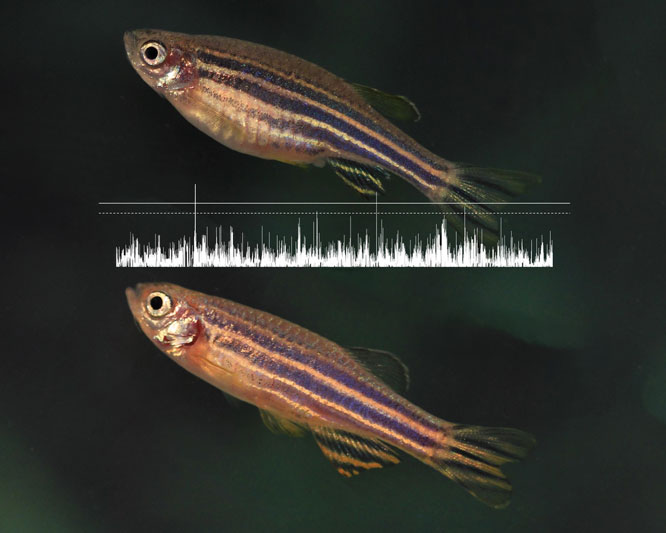
      These remarkable fish are the topic of many research projects throughout the world, including at Smith College in Northampton, MA, USA. They are used in researching cancer, spinal cord development, sleep-related disorders, and the autism spectrum.

      "Smith Professor Mary Harrington has used the Zebrafish Research Center for her teaching and research on circadian rhythms, or sleep-wake cycles. She uses a group of specially designed zebrafish with a firefly protein attached to their circadian gene."


     "The gene causes the fish to bioluminesce each time their circadian clock turns on. Harrington and her students can add drugs to the water, then observe changes in the fish’s circadian rhythms to explore sleep-related disorders like depression."

      Zebrafish are ideal for this type of research, she explains. “They’re transparent, so light just comes right out of them.”


       The rapidity of zebrafish development makes them ideal research subjects. During the past 17 hours of this day (extremely busy for me and maybe for you, too), a zebrafish nervous system has developed!

       . . .Which could lead to this:


       Or even this. . .


Ah, the Denver Bronco-North Carolina Panther (Hello, Kitty?) hype has even gotten to Partial Ellipsis of the Sun.

{Here's some tutu fun from today at school. . .}


Any experience in Zebrafish research?
Steph

Tuesday, January 26, 2016

{Geologic!} Hotspot in Eastern Australia, Bass Strait, and Tasmania

         Hotspots within continental plates are not just for Wi-Fi ;-) or for the famous Snake River Plain-Yellowstone Caldera any more. . .


      The ages of the volcanic eruptions in the northwest U.S. range from 16.1 million years on the west end (dark green) to 0.6--2.1 million years at the east end (yellow) in Yellowstone. The continental plate records the location of the underlying hotspot and possible mantle plume as the continental plate moves generally westward.


      As reported in the September, 2015, issue of "Nature", the eastern Australia south-southwestern series of extinct volcanos extends from Queensland 


at the north end of Australia 2000 kilometers through the eastern middle of the continent toward Cosgrove volcano and southward into the Bass Strait and possibly into the island of Tasmania.


     The northernmost volcanoes are 33 million years old and the Cosgrove volcano to the south is 9 million years old. The Australian plate 


      is moving north-northeastward at a very high rate of 7 centimeters per year. Currently, the Australian plate is one of the fastest moving tectonic plates as evidenced by a span of 24 million years from north to south over a distance of 2000 kilometers.
      The "Cosgrove Track," extending the entire length of Australia is more than three times the length of the Snake River Plain-Yellowstone Caldera. That Australian plate is smoking!

       The East Australia hotspot has both explosive eruptions, as well as the pahoehoe lava flows similar to the Hawaii hotspot (located within an oceanic plate). The hotspot is explosive because basaltic magma interacts with groundwater in aquifers below the surface producing violent magmatic eruptions.


     What puzzles me most is that it took so long to connect the northern and southern Australian volcano dots. . .

Your thoughts?
Steph


Thursday, January 21, 2016

Adamant about Wit, Waters, (R) And Diamonds in Plate Tectonics Timing

      By using an ion probe to analyze the carbon and nitrogen isotope compositions of Witwatersrand, South African diamonds, which have been preserved for more than three billion years, researchers found that plate tectonics was likely in operation on earth as early as 3.5 billion years ago. 


      The location of the Witswatersrand Basin mines in South Africa is shown here: 


     In an article published this week, researchers at the University of Witswatersrand describe the diamonds as being like miniature time capsules recording information about the movement of the earth's tectonic plates on the earth's surface.


     Lead researcher Dr. Katie Smart noted, “The nitrogen isotope composition of the Witwatersrand diamonds indicated a sedimentary source (nitrogen derived from the Earth’s surface) and this tells us that the nitrogen incorporated in the Witwatersrand diamonds did not come from the Earth’s mantle, but that it was rather transported from Earth’s surface into the upper mantle through plate tectonics. This is important because the nitrogen trapped in the Witwatersrand diamonds indicates that plate tectonics, as we recognise it today, was operating on ancient Archaean Earth, and actively transported material at Earth’s surface deep into the mantle.”


     In other words, these carats are able to tell us "What's Up, Doc?" from at least 3.5 billion years ago.


Your thoughts on these carbon gems (or emeralds ;-)) and plate tectonics? 

Steph

P.S. Yes, I am all set with a costume as a tardigrade for Halloween 2016:


Wednesday, January 13, 2016

Hoo Doo, Hoo Doo You Think You're Fooling: Paint Mines Interpretive Park on the Plains of Colorado

      Hoodoo, who do you think you're fooling?! 


      A class in wild clay painting (using a mixture of native clay and wheat paste) led Maizie and me to the Paint Mines Interpretive Park, near Calhan, east of Colorado Springs, CO.


     It was a starkly beautiful, still January day in eastern Colorado. 


     We took the slightly longer, scenic route from Denver through Parker and Franktown. The Paint Mines are a wonderful surprise in the middle of miles and miles of prairie.


         The colorful clays were harvested by ancestral native people at least 9,000 years ago. The formations have been dated as 55 million years old.


The bone white clay of Paint Mines (3 minutes) is especially striking:


      Here are a few images from our clay painting class. It was great to be able to paint on a cold January day with no paint fumes, creating walls with lots of "movement" in the clay.


       Thanks to Rob Lewis of Bellingham, WA, for pointing us to the Paint Mines and for the great class on painting with all natural materials harvested in our own "backyards."

          Have you experimented with painting with clay or other natural materials? Have you heard of or been to the Paint Mines in eastern Colorado?!


Steph