Bristlecone pines have held a bit of magic and poetry for me since spending junior year "abroad" at the University of Arizona. The tree ring class at the Dendrochronology Center in Tucson introduced me to taking a closer look at how much the rings say about annual changes in rainfall and growth conditions:

The rings have both earlywood and latewood parts to each annual ring, with the center core or pith (Pith helmets are made from the wood of African trees, often covered with cloth):

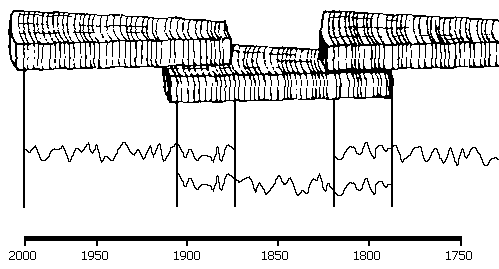
The ring patterns can be overlapped and matched to map patterns back to over 5000 years in bristlecone pines:
These majestic ancient beauties have survived in the high White Mountains of Inyo County, CA, in very harsh conditions so that the trees grow minimally every year.

Cores of trees taken with a drill or auger enable dendrochronologists to study pencil-width cores of trees without destroying them.

Methuselah Grove in eastern CA is home to these windswept bristlecones which are the oldest non-clonal organisms in the world. I was witness to "Methuselah," the then-oldest known tree.

It was quite humbling to stand before a tree that had its start in its original pith neary 4900 years ago. . . (In 2013, a slightly older tree was discovered in the same grove):

Dendrochronology is also used to date wood in buildings, paintings, furniture, tools, shoes, and other wooden structures.
As to the PEOTS and POETS part of this week's post, every time I write PEOTS, I think of one of my favorite films, Dead POETS Society, and of course, Robin Williams:

Thank you for all the laughter, tears, and joy, Robin. You were, at your pith, as beautiful and majestic as Methuselah in the harsh, windy mountains. . .

Carpe Diem,
Steph
(Word Woman)
Throwback to SEMIOTICS: How about Bolivian Ametrine for a mineral to place around nuclear waste as a warning sign:


