You may have noticed I've been a bit sand-obsessed since my trip to Great Sand Dunes National Park in Colorado in October. Discovering these individual sand grain images magnified 250 times has blown in a fresh look at sand. The sea urchin spines in the right part of the image are particularly striking in this calcium carbonate-rich sand:

The three-pronged sponge spicule in this image from a Maui beach is but one sand grain; "sand" is defined as a size of sedimentary particle ranging from 1/16 to 2 mm, rather than composition (I.e., quartz).

Sand grains may also be glacially deposited as these grains of garnet, agate, epidote, quartz, magnetite, and hematite, in Lake Winnibigoshish, WI.

Sand grains of gypsum from the White Sands area in New Mexico, are some of the most uniform in color, though they are quite soft (hardness of 2 on Moh's Hardness Scale):


And the hydraulic fracturing sands in western and southern Wisconsin are quite uniform, hard (hardness of 7 on Moh's Hardness Scale) quartz grains:


"Puffy stars," calcium carbonate forams on Okinawa beaches are quite uniform in size and have a distinctive shape:

Note the rounded, smooth shells, foraminifera, piece of coral, and the volcanic fragment (in the lower right.)
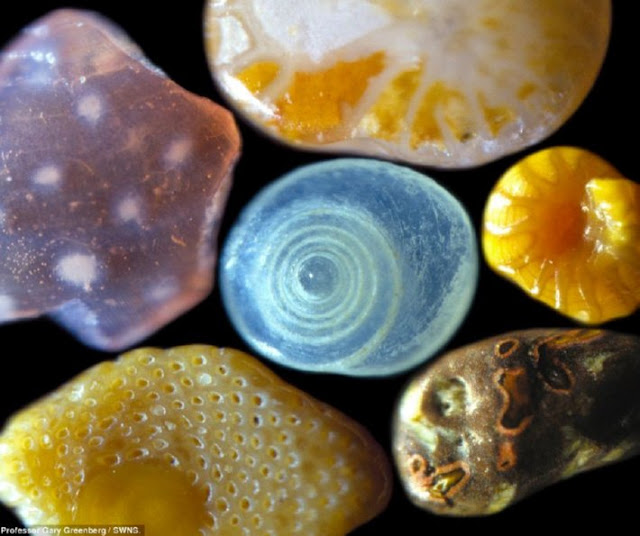
Check out these colorful, luminescent, rounded bits of foraminifera, shells, and quartz in this sand mix.


The three-pronged sponge spicule in this image from a Maui beach is but one sand grain; "sand" is defined as a size of sedimentary particle ranging from 1/16 to 2 mm, rather than composition (I.e., quartz).

Sand grains may also be glacially deposited as these grains of garnet, agate, epidote, quartz, magnetite, and hematite, in Lake Winnibigoshish, WI.

Sand grains of gypsum from the White Sands area in New Mexico, are some of the most uniform in color, though they are quite soft (hardness of 2 on Moh's Hardness Scale):


And the hydraulic fracturing sands in western and southern Wisconsin are quite uniform, hard (hardness of 7 on Moh's Hardness Scale) quartz grains:


"Puffy stars," calcium carbonate forams on Okinawa beaches are quite uniform in size and have a distinctive shape:

Note the rounded, smooth shells, foraminifera, piece of coral, and the volcanic fragment (in the lower right.)

Check out these colorful, luminescent, rounded bits of foraminifera, shells, and quartz in this sand mix.

And, to tie things back to where we started this week, here are rounded, smoothed, sea urchin sand fragments from Hawai'ian sand; these are essentially cross sections of the long, green spines seen in the first image.

Take this all with a grain of calcium car- bonate or quartz or gypsum salt or. . .
Steph
There are GLOSTA lovers in Colorado!


