An extraterrestrial empanada. . . A space ravioli. . . A planetary baguette. Some of Saturn’s moons have shapes that are strangely reminiscent of culinary creations.


Images of the oddly-shaped moons, mostly from now-defunct Cassini spacecraft, got planetary scientists wondering how these satellites ended up with such strange shapes. Now, researchers suggest that collisions between moonlets could account for these shapes according to a study published online today, May 21, 2018, in Nature Astronomy. {The original Nature article includes some of these space culinary terms.}
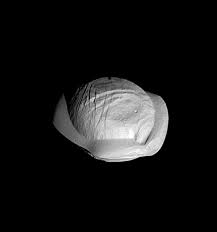

Dr. Adrien Leleu , a planetary scientist at the University of Bern in Switzerland, and colleagues developed computer simulations that let the scientists virtually smack together similar-sized moonlets at various speeds and angles. The team found that, at low angles and relative speeds of tens of meters per second (roughly equal to a car traveling on country roads), impacts can create offbeat shapes that look like the misfits around Saturn.

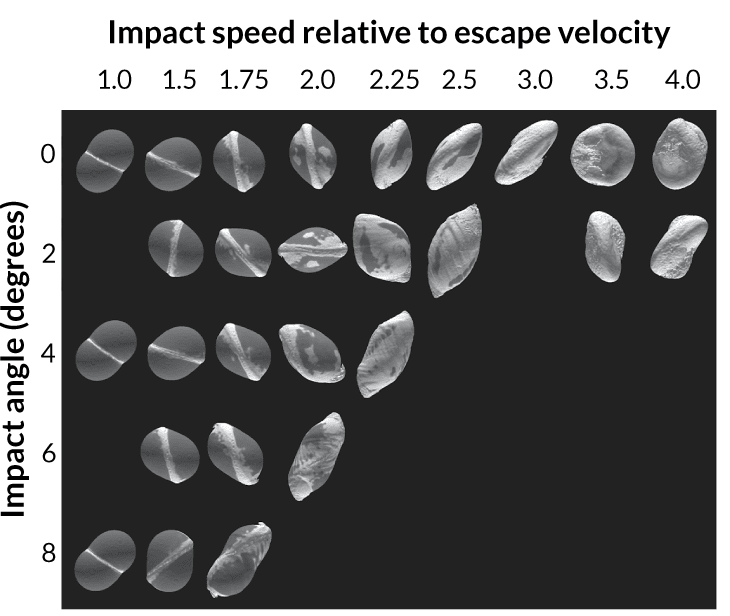
Head-on collisions result in a flattened moon like Pan, which resembles an extraterrestrial empanada. An impact angle of just a few degrees leads to an elongated satellite such as Prometheus, which looks like a French baguette.


Not all run-ins create a weird-looking moon. At higher angles, for example, moonlets might "hit and run." Or they could form highly elongated rotating moons that subsequently break apart.

Dr. Leleu and collaborators focused on the smaller moons of Saturn that orbit within the planet’s rings. But the team also found that a similar collision between two larger moonlets could also account for the odd shape of Iapetus, a more distant walnut-shaped moon with a pronounced ridge along its equator that has puzzled scientists since the belt’s discovery. Other speculative origins for the ridge include volcanoes, plate tectonics or ring debris that rained down on the moon.


I will admit that I was drawn to the odd shapes of possible moonlets because they reminded me of images of fossils like fusulinids (see below). Nature likes reusing cool shapes, I suppose.

Enjoy this planetary patisserie!
Steph

Enjoy this planetary patisserie!
Steph
