Total Pageviews

Showing posts with label fracking. Show all posts

Tuesday, December 1, 2015

The Universe Truly IS in a Grain of Sand

          You may have noticed I've been a bit sand-obsessed since my trip to Great Sand Dunes National Park in Colorado in October. Discovering these individual sand grain images magnified 250 times has blown in a fresh look at sand. The sea urchin spines in the right part of the image are particularly striking in this calcium carbonate-rich sand:


      The three-pronged sponge spicule in this image from a Maui beach is but one sand grain; "sand" is defined as a size of sedimentary particle ranging from 1/16 to 2 mm, rather than composition (I.e., quartz).


     Sand grains may also be glacially deposited as these grains of garnet, agate, epidote, quartz, magnetite, and hematite, in Lake Winnibigoshish, WI.


      Sand grains of gypsum from the White Sands area in New Mexico, are some of the most uniform in color, though they are quite soft (hardness of 2 on Moh's Hardness Scale):


      And the hydraulic fracturing sands in western and southern Wisconsin are quite uniform, hard (hardness of 7 on Moh's Hardness Scale) quartz grains:


      "Puffy stars," calcium carbonate forams on Okinawa beaches are quite uniform in size and have a distinctive shape:


     Note the rounded, smooth shells, foraminifera, piece of coral, and the volcanic fragment (in the lower right.)
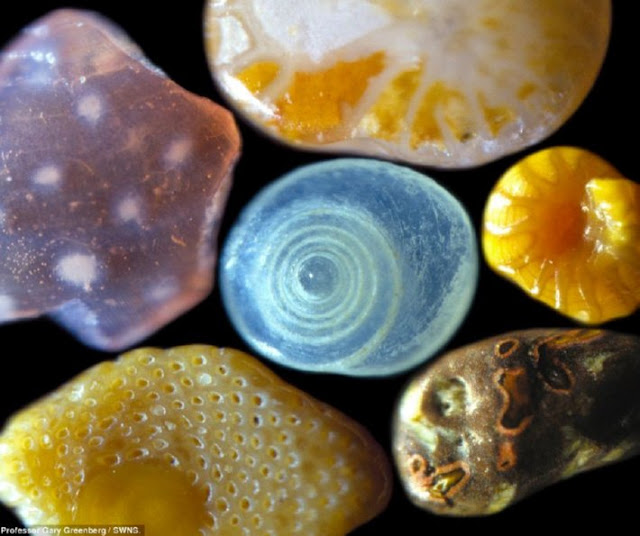


     Check out these colorful, luminescent, rounded bits of foraminifera, shells, and quartz in this sand mix.


And, to tie things back to where we started this week, here are rounded, smoothed, sea urchin sand fragments from Hawai'ian sand; these are essentially cross sections of the long, green spines seen in the first image.


Take this all with a grain of calcium car- bonate or quartz or gypsum salt or. . .

Steph

There are GLOSTA lovers in Colorado!


Tuesday, May 13, 2014

H2O, H2O, Everywhere: "Unstoppable" Glaciers and "Produced" Water

    Water, water everywhere...


                      Photo credit: M. Ruegels

     Too much, not enough, contaminated with salt and hydrocarbon extraction/fracking chemicals: water and the words associated with H2O have been spun this week, especially in two articles.
   
      The "unstoppable" movement of glaciers into the sea in western Antarctica was documented in a NASA press release yesterday:


      This NASA/JPL photo shows the Amundsen Sea on the western side of Antarctica:


        The principal researcher, Eric Rignot, spoke of unstoppable, inevitable, and irreversible processes associated with the glaciers noting that a sea level rise of 1.2 meters is eventually inevitable, yet unstoppable is the term being used in most of the day's publicity. Unstoppable is a more active adjective than irreversible or inevitable--it exudes movement.


          "Produced water" is another science spin term used locally by Colorado Public Radio (CPR) to describe water produced together with hydrocarbons:

           
            "PRODUCED WATER"

     This positively spun term denotes what's leftover after extracting hydrocarbons--water with benzene, toluene, salt, etc. which, according to the article, is responsible for tuberculosis in cattle. "Unstoppable glaciers" is a reasonable term; produced water is not. Even "connate water" is not, since, by definition, it is the water originally deposited with the rock.

       The CPR article refers to the original salt deposited with the rocks as part of the produced water or flowback and downplays the chemicals added in hydrocarbon extraction/fracking. Produced water--really?

        Just hiked past some (quite cold) springs here in the Colorado hills. Now, those are "produced," unstoppably crystal clear waters!

Turn, turn, turn, turn,
Spin, spin, spin, spin,

Looking forward to your liquid thoughts,

Word Woman (aka Scientific Steph)

P.S. More Water. . .

        Great morning with Al (Aluminum) and the kindergarteners today. We made boats from Aluminum foil and determined the best structure for piling on pennies til the boats sank. 

        They know H2O, CO2, NaCl, O2 and now Al. Big leap today as I asked them the chemical formula for ice. After a few guesses of I, they came round to H2O. 

        "Ok, how about steam?" 

         "H2O!" 

          It was quite a moment ;-).


Tuesday, December 17, 2013

Fracking in the New Millenium: Increase from 750 gallons to up to 8,000,000 gallons of Water to Frack a Current Well


        In continuing the discussion of hydraulic fracturing or fracking from last Tuesday,  the following words ring out the loudest to me (all the emphasis on numbers/words is mine):
       
       " A typical early fracture took 750 gallons of fluid (water, gelled crude oil, or gelled kerosene) and 400 lbm of sand. By contrast, modern methods can use up to 8 million gallons of water and 75,000 to 320,000 pounds of sand. Fracking fluids can take the form of foams, gels, or slickwater combinations and often include benzene, hydrochloric acid, friction reducers, guar gum, biocides, and diesel fuel. Likewise, the hydraulic horsepower (hhp) needed to pump fracking material has risen from an average of about 75 hhp in the early days to an average of more than 1,500 hhp today, with big jobs requiring more than 10,000 hhp."

       The full article, by Michael MacRae, of the American Society of Mechanical Engineers (ASME) explores some of the very early history of fracking (back to 1865 in PA) is linked here:

              https://www.asme.org/engineering-topics/articles/fossil-power/fracking-a-look-back


       The increase in those numbers, especially the amount of water used to frack a well is astounding: from 750 gallons to 8,000,000 gallons of water...Increasing the hydraulic horsepower from 75 to more than 10,000 hhp is a staggering increase in energy used just to pump the fracking mixture into the ground. And then, there is the issue of disposal of all that briny, chemical-filled fluid back into the earth via the over 144,000 disposal wells.

       Here in CO, an organization called Coloradans for Responsible Energy Development (CRED) is pushing the following message quite hard in tv/radio/print ads:

       "Through environmentally safe fracking, we’re tapping into Colorado’s vast shale reserves under our state. And we’re doing it responsibly. Coloradans everywhere are starting to learn that facts about fracking. That it’s safe and been a part of the American landscape since 1947. For example, in 2012 the Colorado oil and natural gas industry supported over 110,000 high-paying jobs and generated $1.6 billion in tax revenue for things that are important – like Colorado’s public schools, parks and roads."

        The italicized portion (mine) of the above quote is quite misleading. Fracking from the 1940's to the 1990's is so radically different from current fracking of shales (such as the Marcellus Shale pictured above) as to be truly considered a different process. The industry is considering fracking then and now to be the same. It is not. 

        Our governor may drink fracking fluid (only the "green" variety) but that is clearly such a small part of the fracking issue:

        http://www.rawstory.com/rs/2013/02/13/co-gov-hickenlooper-admits-to-ritual-like-drinking-of-fracking-fluid/

        Having worked on oil rigs in Texas I saw exactly the debris the oil and gas industry left above ground. Here is an aerial view of Denver City, Texas. All those white squares are oil rigs/pads:


       The debris the oil and gas industry is making below ground is not as visible. It is, however, using valuable resources (especially water) to extract fossil fuel and leaving behind chemicals.  Again, I don't have an answer. Of course, we need to transition from fossil fuel to renewable resources like wind and solar.

       On a positive note (My kids are always getting on me about being positive in any situation), I counseled a young woman today who is interested in the Picker Engineering Program at Smith College. The first graduates of the program started by Dr. Ruth Simmons are now almost ten years post graduation.  If anyone can figure it out, it'll be a Smithie. . .


        Thanks, I needed that!

        I welcome your input on fracking. Next week's post will be decidedly lighter! Have a good solstice Saturday, everyone, as the sun (sol) "stands still" (sistere).
        Word Woman (Scientific Steph) 

Tuesday, December 10, 2013

Caramel Dioxide: New Fracking Ingredient?

Caramel Dioxide: New Fracking Ingredient?

      Leave it to kindergarteners to come up with great new things. After our CO2 experiment a couple of weeks ago on Science Friday, one of the teachers left me this note about his observations at the sensory table:


     "Caramel dioxide" as a fracking ingredient does not seem all that far afield...Besides the standard water and "frac sand," fracking mixtures have been known to include corn husks, gelatin/jello (The topic of fracking or hydraulic fracturing has been described by fellow bloggers as akin to nailing jello to a tree.):


guar bean gum, benzene, naphthalene, hydrochloric acid, sodium chloride (my kindergarteners know that one), ammonium persulfate, formic acid, and quaternary ammonium chloride. (Benzene, in particular, has been linked to causing cancer). In fact, you may look up the ingredients used in the fracking fluid of over 55,000 wells here:

                            http://fracfocus.org/chemical-use/what-chemicals-are-used

     Well, well, well, I will back up to the definition of hydraulic fracturing or fracking first. If you haven't been under a rock for the past five years (pun intended again), you likely know that oil and gas companies use copious amounts of water, some sand as a proppant (to prop open pathways in the "permeability-challenged" rocks like shale)


and a mixture of chemicals used to thicken the water in order to suspend the sand in the water, eliminate bacteria in water that produces corrosive by products, and preventing corrosion of the pipe (among other things).

     The petroleum class I took in 1982 used A.I. Leverson's Petroleum Geology textbook from the 1960's. I recall still his description of petroleum geology as primarily the study of fluids. This is part of what concerns me greatly about fracking...the use of water in very large amounts to reap another fluid, especially one which is non-renewable.  Here in the arid west, where water is such a precious commodity. . .

      Petroleum Geology 101: Hydrocarbons are created in source rock (like shales), move to reservoir rock like sandstone and limestone) and are capped by impermeable cap or seal rocks:


     Note that fracking was originally used to open up permeability in sandstones and limestones (the reservoir rocks). The use of fracking to extract hydrocarbons directly from source rocks, such as shale, requires more water, sand, and chemicals under higher pressures. Fracking of shales since the 1990's is essentially hastening the movement of hydrocarbons out of source rocks without waiting for them to move to reservoir rocks (with their higher porosities and permeabilities).

       The overarching argument about fracking does distill to whether it is worth the resources and potential chemical contamination to extract hydrocarbons. In the short-term, perhaps it is, especially if it replaces coal extraction. Overall, investing in solar and wind power and other renewable resources sure makes a lot more sense in the longer term.

       This piece from the March 14, 2013 NY Times summarizes fracking issues well:

       http://www.nytimes.com/2013/03/14/opinion/global/the-facts-on-fracking.html?_r=0

      The oil and gas industry's refrain is that fracking occurs thousands of feet below the surface and that ground water is only hundreds of feet below the surface. Yet, anything injected in the earth is certainly subject to moving along fractures to eventually reach the groundwater and surface of the earth. In addition, spilling of fracking fluid at the well  or storage sites is a very real concern. Having worked on oil rigs in the 1970's, I saw firsthand how careless some folks could be with those fluids around the well bore. And in our September Colorado floods, we saw how storage of anything used in oil wells could be compromised by mother nature.

       I certainly don't have all the fracking answers and I want to explore this topic further next week. I will leave you with this photograph of a 16-page flyer a friend received about guar gum used for fracking fluid:


          The flyer describes how guar bean gum is the same stuff used in your vanilla ice cream and in your fracking fluid. I believe I will go have some vanilla ice cream (with no guar bean gum) and ponder next week's blog. Better yet, add some caramel dioxide to my scoop. . .

         I would enjoy hearing your thoughts about fracking, caramel dioxide, guar bean gum. . .

         Word Woman (Scientific Steph)


.