Total Pageviews

Showing posts with label plants. Show all posts

Saturday, December 15, 2018

Spirals: Golden or Not: Fib O’ Gnocchi?

      I attended a presentation recently that included a discussion of the Fibonacci number sequence and golden spirals. We have discussed Fibonacci numbers and golden spirals here at Partial Ellipsis of the Sun before.


        The Fibonacci number series begins as 0, 1, 1, 2, 5, 8, 13, 21, 34, 55, 89,144; each term is the sum of the previous two terms. The Golden Spiral is created using phi, the ratio of 1.6180.  In mathematics, two quantities are in the golden ratio if their ratio is the same as the ratio of their sum to the larger of the two quantities thus: 


       The illustrations in the presentation included spirals that looked like this:


      Of course, Golden Spirals look like this:


       No one else in the audience seemed bothered by equal spacing on the spiral; it drove me bonkers.  Folks commented on how beautiful the illustration was; but it was wrong!


      The Golden Spiral can be seen in the Milky Way:
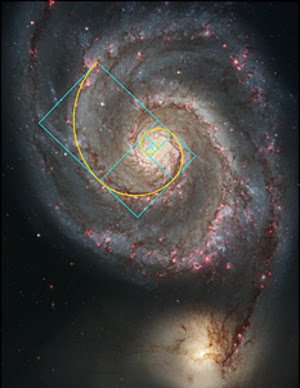


And in storm patterns:


      It can also be used in image composition:


     I brought the spiral conundrum to the kindergartners who all saw immediately that the spiral had to grow so the chambered nautilus could grow, too.


      From the mouths of babes. . .


      Speaking of babes, a shout-out to my co-teacher who turned 60 on the 6th. The Babylonians considered 60 the most sacred number and a resetting of the odometer to zero in their base-60 number system. Happy sexagesimal reset, Mary!

     Does it drive you bonkers when illustrations are wrong? 


    ^^^Thanksgiving Square Chapel, Dallas, TX

Steph

Christmas Eve at Great Sand Dunes National Park and Preserve. It was an extraordinary day shared with a herd of 30 elk. See if you can find them.


Happy Sandy Holidays!

Tuesday, November 1, 2016

Popeye's Spinach Was Never Like This: The Superfood Is Also An Explosives Detector!

     Spinach is no longer just a superfood. By embedding spinach leaves with carbon nanotubes, MIT engineers have transformed spinach plants into sensors that can detect explosives, wirelessly relaying that information to a handheld device similar to a smartphone.


     This is one of the first demonstrations of engineering electronic systems into plants, an approach that the researchers call plant nanobionics. "The goal of plant nanobionics is to introduce nanoparticles into the plant to give it non-native functions," says Dr. Michael Strano, the leader of the research team.


      A carbon nanotube is a tube-shaped material, made of carbon, having a diameter measuring on the nanometer scale. A nanometer is one-billionth of a meter or about 10,000 times smaller than a human hair. The bonds in carbon nanotubes are extremely strong.


     In this case, the plants were designed to detect chemical compounds known as nitroaromatics, which are often used in landmines and other explosives. When one of these chemicals is present in the groundwater sampled naturally by the plant, carbon nanotubes embedded in the plant leaves emit a fluorescent signal that can be read with an infrared camera. The camera can be attached to a small computer similar to a smartphone, which then sends an e-mail to the user.


     "This is a novel demonstration of how we have overcome the plant/human communication barrier," says Strano, who believes plant power could also be harnessed to warn of pollutants and environmental conditions such as drought. Strano is the senior author of a paper describing the nanobionic plants in the October 31, 2016, issue of Nature Materials

     Two years ago, in the first demonstration of plant nanobionics, Strano and others used nanoparticles to enhance plants' photosynthesis ability and to turn them into sensors for nitric oxide, a pollutant produced by combustion.


      "Plants are very good analytical chemists," Strano says. "They have an extensive root network in the soil, are constantly sampling groundwater, and have a way to self-power the transport of that water up into the leaves."


      Strano's lab has previously developed carbon nanotubes that can be used as sensors to detect a wide range of molecules, including hydrogen peroxide, the explosive TNT, and the nerve gas sarin. When the target molecule binds to a polymer wrapped around the nanotube, it alters the tube's fluorescence.


      In the new study, the researchers embedded sensors for nitroaromatic compounds into the leaves of spinach plants. Using a technique called vascular infusion, which involves applying a solution of nanoparticles to the underside of the leaf, they placed the sensors into a leaf layer known as the mesophyll, which is where most photosynthesis takes place.


      They also embedded carbon nanotubes that emit a constant fluorescent signal that serves as a reference. This allows the researchers to compare the two fluorescent signals, making it easier to determine if the explosive sensor has detected anything. If there are any explosive molecules in the groundwater, it takes about 10 minutes for the plant to draw them up into the leaves, where they encounter the detector.


     To read the signal, the researchers shine a laser onto the leaf, prompting the nanotubes in the leaf to emit near-infrared fluorescent light. This can be detected with a small infrared camera connected to a Raspberry Pi, an inexpensive credit-card-sized computer similar to the computer inside a smartphone. The signal could also be detected with a smartphone by removing the infrared filter that most camera phones have, the researchers say.


      Using this setup, the researchers can pick up a signal from about 1 meter away from the plant; they are working on increasing that distance.


      The researchers have also genetically engineered spinach plants that can detect dopamine, which influences plant root growth, and they are now working on additional sensors, including some that track the chemicals plants use to convey information within their own tissues.


     "Plants are very environmentally responsive," Strano says. "They know that there is going to be a drought long before we do. They can detect small changes in the properties of soil and water potential. If we tap into those chemical signaling pathways, there is a wealth of information to access."


     These sensors could also help botanists learn more about the inner workings of plants, monitor plant health, and maximize the yield of rare compounds synthesized by plants such as the Madagascar periwinkle, which produces drugs used to treat cancer.


     Remember all that talking to plants research in the 1970's? Well, now the plants are talking back!

What are your plants saying?
Steph 

Wednesday, August 31, 2016

One-Syllable State of Maine Rocks: Underappreciated Silurian Age Stones

     
      Take a close look at these exquisite Silurian rocks from the state of Maine, USA. (How did I just realize Maine is our only monosyllabic state?) The Silurian, an underappreciated time period, without the cachet of say, the younger Jurassic, is part of the Paleozoic era between the Ordovician and Devonian. Silurian rocks are 443 million years to 416 million years old.


A significant evolutionary milestone during the Silurian was the diversification of jawed and bony fishes. 


       Life also began to appear on land during the Silurian in the form of moss-like, vascular land plants that grew beside bodies of water. Small terrestrial arthropods also began to appear.


       These Maine rocks of the Kittery Formation are old. They show the results of millions of years of deposition, igneous activity, faulting, tectonics, and metamorphism. 


      However, in researching this week's topic, I discovered the "Silurians," a fictional race of reptile-like humanoids in the long-running British science fiction tv series Doctor Who? Those first Silurians are depicted as prehistoric and scientifically advanced sentient humanoids who predate the evolution of man.


      The creatures were called Silurians, after their supposed origins in the Silurian period. However, author John Pertwee claims that "properly speaking", the Silurians should have been called the "Eocenes" (part of the much more recent Cenozoic era.)
     Perhaps Dr. Who needed a geologic consultant to the tv show. E. O. Seen and heard? Background music by Diana Ross and the Eocenes?!

Just call me,
Silurian Steph

Bonus question: without googling or duck duck going, name all current countries of only one syllable.


Tuesday, November 19, 2013

Cheese Imitates Geology: Thin Vegetable Ash Layer and Thin Iridium-rich Clay Layer

Cheese Imitates Geology: Thin Vegetable Ash Layer and Thin Iridium-Rich Clay Layer


      There is a small, wicker cheese basket at my local grocery store filled with little snippets of cheeses--the ends of various imported wheels and logs. This one caught my eye:


          I unwrapped it last night and found this written on the wrapper (just so you know I'm not making this up):


     A hairline layer of vegetable ash?! Oh my. 

     Of course, the iridium-rich clay layer found at the boundary of the Cretaceous period (about 65 million years ago) with the overlying Paleogene sediments first documented by Luis and Walter Alvarez (shown below) in Italy, sprang to mind. The limestone layers beneath the red clay are full of numerous species of foraminifera (forams) and the thick limestone beds above contain only one foram species. In between is this iridium-rich later of clay. In Italy. In Germany. In the Netherlands. In the U.S. All over the world.


      Iridium is a rare, silvery, white transition metal of the platinum family found in meteorites. It was named for the Greek goddess Iris after the rainbow colors in its salts and less than 3 tons a year are mined world-wide:


     Iridium is associated with the massive K-Pg extinction including the non-flying dinosaurs and a huge, diverse, plant population. (The boundary was called the K-T boundary for Cretaceous-Tertiary when the Alvarezes discovered it. The International Stratigraphic Nomenclature Committee has recently deprecated the Tertiary Period though; it now must be called Paleogene.) [First Pluto is no longer a planet; now we can't call it the K-T boundary any more. Sigh...]  And the likely location of the meteorite hitting the earth in the Gulf of Mexico is also well documented.

       What strikes me (no pun intended, okay, maybe...) about naming conventions in geology and in all areas, actually, is the creativity and force in coming up with these descriptive terms. As Clementine says to Joel when talking about her newest hair color in the film Eternal Sunshine Sunshine of the Spotless Mind, "Naming hair colors. Somebody has that job. I want that job!"


        Calling the thin layer of vegetables in the Humboldt Fog Cheese "Vegetable Ash" is truly inspired to this geologist and cheese eater.

         Last week: puddingstones that look like pudding. This week: Cheese that looks like limestone layers with a hairline layer of ash. It doesn't get much better than that full circle.

        Thanks for reading. I look forward to your comments, thoughts, and cheesy ideas.


Until then, "say cheese!" (And mean it).

Humboldtly yours,
Word Woman (aka Scientific "Vegetable Ash Layer" Steph)