Total Pageviews

Tuesday, July 17, 2018

Spin This News: Parental Chromosomes Develop Apart During Embryo's First Division

       Genetic researchers at the European Molecular Biology Lab (EMDL) have shown that mammalian life begins differently than originally suspected.

     It was long hypothesized that during a mammal embryo's first cell division, one spindle is responsible for segregating the embryo's chromosomes into two cells. Researchers now show that there are actually two spindles (as shown below), one for each set of parental chromosomes, meaning that the genetic information from each parent is kept apart throughout the first division.


     The publication Science published the results (which are likely to change biology textbooks) on 7/12/18. {Are there still textbooks?!}.


     This dual spindle formation may explain the high error rate in the early developmental stages of mammals, spanning the first few cell divisions. "The aim of this project was to find out why so many mistakes happen in those first divisions," says Dr. Jan (a guy!) Ellenberg, the group leader at EMBL who led the project. "We already knew about dual spindle formation in simpler organisms like insects, but we never thought (why not?!) this would be the case in mammals like mice. This finding was a big surprise, showing that you should always be prepared for the unexpected."


     Researchers have heretofore seen parental chromosomes occupying two half-moon-shaped parts in the nucleus of two-cell embryos, but it wasn't clear how this could be explained. "First, we were looking at the motion of parental chromosomes only, and we couldn't make sense of the cause of the separation," said Dr. Judith Reichmann. "Only when focusing on the microtubules -- the dynamic structures that spindles are made of -- could we see the dual spindles for the first time. This allowed us to provide an explanation for this 20-year-old mystery."
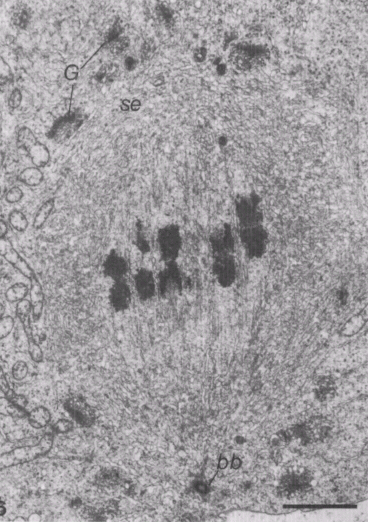


      Mitosis is the process of cell division, when one cell splits into two daughter cells. It occurs throughout the lifespan of multi-cellular organisms but is particularly important when the organism grows and develops. The key step of mitosis is to pass an identical copy of the genome to the next cell generation. For this to happen, DNA is duplicated and organised into dense thread-like structures known as chromosomes. The chromosomes are then attached to long protein fibres -- organised into a spindle -- which pulls the chromosomes apart and triggers the formation of two new cells. {The following diagram is one which will likely be updated in future embryology textbooks.}
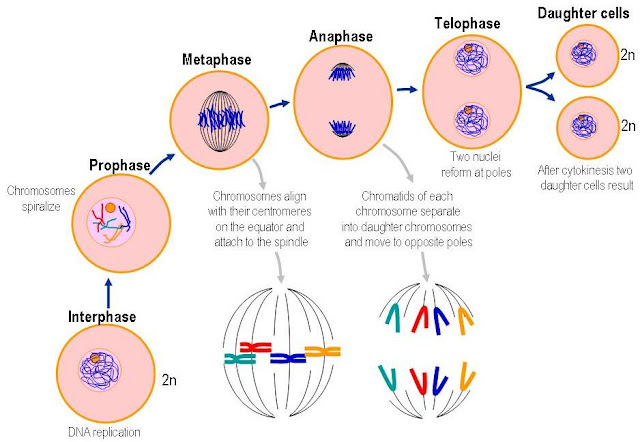


     The spindle is made of thin, tube-like protein assemblies known as microtubules. During mitosis of animal cells, groups of such tubes grow dynamically and self-organize into a bi-polar spindle that surrounds the chromosomes. The microtubule fibres grow towards the chromosomes and connect with them, in preparation for chromosome separation to the daughter cells. Normally there is only one bi-polar spindle per cell, however, this research suggests that during the first cell division there are two: one each for the maternal and paternal chromosomes.


     "The dual spindles provide a previously unknown mechanism -- and thus a possible explanation -- for the common mistakes we see in the first divisions of mammalian embryos," Dr. Ellenberg explains. Such mistakes can result in cells with multiple nuclei, terminating development. "Now, we have a new mechanism to go after and identify new molecular targets. It will be important to find out if it works the same in humans, because that could provide valuable information for research on how to improve human infertility treatment, for example."


      In addition, the knowledge from this paper might impact legislation. In some countries, the law states that human life begins -- and is thus protected -- when the maternal and paternal nuclei fuse after fertilization. If it turns out that the dual spindle process works the same in humans, this definition is not fully accurate, as the union in one nucleus happens slightly later, after the first cell division.


     This discovery would have been impossible without the light-sheet microscopy technology (as seen above) developed at EMBL, which is now available through the spin-off company Luxendo. This allows for real-time and 3D imaging of the early stages of development, when embryos are very sensitive to light and would be damaged by conventional light microscopy methods. The high speed and spatial precision of light-sheet microscopy drastically reduce the amount of light that the embryo is exposed to, making a detailed analysis of these formerly hidden processes possible.


This is one spin we can stay with for awhile.
Steph

Earthquake experiment with brownies representing the stable craton of Canada and jello representing the tectonic plate boundary in Haiti.

The kids made "earthquake-proof" structures and observed the differences of the structures on "Canada" and "Haiti."


Wednesday, June 20, 2018

Precambrian Fossil Obama coronatus: Sessile Be De Millions?

     Earth's first complex animals were an eclectic group that lived in the shallow seas between 580-540 million years ago. 


     In great geologic irony, these more complex creatures are now classified as part of the very late Precambian ("Precambrian" means "before life.").


     The iconic Dickinsonia -- large, flat animals with a quilt-like appearance -- were joined by tube-shaped organisms, frond-like organisms that looked more like plants, and several dozen other varieties already characterized by geologists and biologists.


     We can add to that list two new animals discovered by a team of researchers:

     1) Obamus coronatus, a name that honors President Barack Obama's passion for science. This disc-shaped creature was between 0.5-2 centimeters. Obama coronatus is preserved in negative hyporelief and is defined by an overall torus shape produced by a series of arch-shaped spiral grooves. 


      Obamus coronatus (see below, left) was sessile or fixed, embedded to the ocean mat, a thick layer of organic benthic material that covered the early ocean floor. 


     2) Attenborites janeae, named after the English naturalist Sir David Attenborough for his science advocacy and support of paleontology (see above, right.) This tiny ovoid, less than a centimeter across, was adorned with internal grooves and ridges giving it a raisin-like appearance.


     The discovery of Obamus coronatus was published online on June 14, 2018, in the Australian Journal of Earth Sciences, or AJES, and the Attenborites janeae paper is forthcoming in the same journal. The studies were led by Dr. Mary Droser, a professor of paleontology at UC-Riverside.


     Both papers will be included in a 2019 AJES issue focusing on South Australia's Flinders Ranges region, where the discoveries were made.


     Part of the Ediacara biota, the soft-bodied animals are visible as fossils cast in fine-grained sandstone that have been preserved for hundreds of millions of years. These Precambrian lifeforms represent the dawn of animal life and are named after the Ediacara Hills in the Flinders Ranges, the first of several areas in the world where they have been found. Another suite of similar-age fossils was discovered in Sonora, Mexico, in 1995. (an area I worked in and described here).


     In the hierarchical taxonomic classification system, the Ediacara biota are not yet organized into families, and little is known about how they relate to modern animals. About 50 genera have been described, which often have only one species.


     "The two genera that we identified are a new body plan, unlike anything else that has been described," Droser said. "We have been seeing evidence for these animals for quite a long time, but it took us a while to verify that they are animals within their own rights and not part of another animal."

     The animals were seen in a particularly well-preserved fossil bed described in another paper published by Dr. Droser's group that will be included in the Flinders Ranges issue of AJES. The researchers dubbed this fossil bed "Alice's Restaurant Bed," a tribute to the Arlo Guthrie song and its lyric, "You can get anything you want at Alice's Restaurant."


     "I've been working in this region for 30 years, and I've never seen such a beautifully preserved bed with so many high quality and rare specimens, including Obamus and Attenborites," Dr. Droser said. "The AJES issue on the Flinders Ranges will support South Australia's effort to obtain World Heritage Site status for this area, and this new bed demonstrates the importance of protecting it."


You might say Ediacaran preservation is Flinders Keepers (for all).
Steph

Sunday, May 27, 2018

"Opposite Birds:" Why Being Grounded May Have Been the Counterintuitive Key to Survival


     The asteroid impact that caused a mass extinction 66 million years probably also triggered the collapse of forests worldwide, a new investigation of the plant fossil record concludes. 


     Needing trees and extensive plant cover for nesting or food could have been a fatal drawback for winged dinosaurs, including some ancient birds.


        Here is the caption for the diagram above: 

         "Ancestral Ecological Reconstructions Reveal Bias toward Non-arboreal Birds across the K-Pg:

      Bayesian ancestral ecological reconstructions (AERs) indicate that the most deeply diverging crown bird clades, including Neornithes (all crown birds), Neognathae (Galloanserae + Neoaves), and Neoaves, were ancestrally non-arboreal (pp > 0.99 for each node), with numerous independent transitions toward arboreality arising in the early Cenozoic, presumably after global forests had recovered from the Chicxulub impact. Concentric background rings demarcate geologic periods: the inner gray circle at the center indicates the Late Cretaceous, with the K-Pg boundary (66.02 Ma) indicated by the red dashed line; the white ring indicates the Paleogene (66.02–23.03 Ma), separated from the Neogene (23.03–2.58 Ma) by the dashed blue line. Tips extend to the present. Pie charts at the nodes indicate SIMMAP posterior probabilities for ancestral ecology, under our model. Branch colors represent a single randomly sampled stochastic character map from a posterior sample of 1,000 maps. The underlying phylogeny and taxonomy follow; qualitatively identical patterns are inferred using an alternative phylogenetic hypothesis."

       Reconstructing the ecology of ancient birds suggests that modern birds descended from species that survived because they could live on the ground, a research team proposes in the June 4, 2018, Current Biology.


      “You probably would have died anyway regardless of habitat,” says study coauthor Dr. Daniel Field, an evolutionary paleobiologist at the University of Bath in England. “But if you could get along on the ground, you at least had a shot at surviving across this devastated landscape.”

     The shock wave from the strike probably flattened trees within a radius of 1,500 kilometers, Dr. Field says. Wildfires ignited around the planet and then came the acid rain. Clouds of ash and dust may have darkened the sky for several years, and researchers suspect that photosynthesis waned. Yet some lucky birds, but no other dinosaurs, survived the hellscape.


     For clues to what made a survivor, researchers turned to fossilized pollen from before and after the fiery impact. Abundant kinds of flower-bearing and cone-bearing plants left pollen just before the asteroid hit and again starting about a thousand years afterward. In between those times of diversity, however, ferns dominated, the team notes. A kind of “disaster flora,” ferns (making spores instead of flowers and seeds) do well at recolonizing land. Seed plants, however, weren’t thriving.


     Analyzing evolutionary histories of modern birds supports the idea of tree dependence as a vulnerability for the earliest fowl, the researchers say. Specialists in bird evolution now generally agree on the lowest, oldest branches of the bird family tree, Field says. The bottommost one, for instance, includes such modern species as ground-dwelling ostriches and smaller, flight-capable birds called tinamous, which might be more like the ancient birds that dodged extinction.


     Working backward along these low branches, researchers used fossils and known bird traits to reconstruct the most likely lifestyles of the earliest survivors. These probably weren’t tree-dependent birds, the researchers conclude.


     The glory days of dinosaurs had had plenty of flying tree-dwellers. So far, paleontologists have identified at least 80 kinds of what are called “opposite birds,” the Enantiornithes. “If you saw one flying around today, you’d say, ‘Well, that’s a bird,’ ” Field explains. Their feet looked like those of birds that perch on tree limbs, so he’s not surprised that a fossil of an opposite bird from this probably arboreal group has never been found in rock formed after the dinosaur doomsday.


     What did happen, however, was that when trees and forests came back after the disaster, birds quickly evolved arboreal lifestyles, the team says.


     Many people don’t realize that birds almost died off during the mass extinction, too, says paleontologist Stephen Brusatte of the University of Edinburgh who has studied bird evolution but was not involved in the new study. What let the few survivors squeak through, he says, has been a mystery for a long time. The whole scenario of a ground-dweller’s advantage and then a return to the trees “makes a lot of intuitive sense.”

     Essentially, surviving on the ground, without much flying, for awhile may be what ultimately made the later arboreal environments so rich with modern-day birds.

No, er, YES, GROUSE about it!
Steph

Monday, May 21, 2018

An Extraterrestrial Empanada, A Space Ravioli, and A Planetary Baguette: Simulating Saturn’s Moons

       An extraterrestrial empanada. . . A space ravioli. . . A planetary baguette.  Some of Saturn’s moons have shapes that are strangely reminiscent of culinary creations.


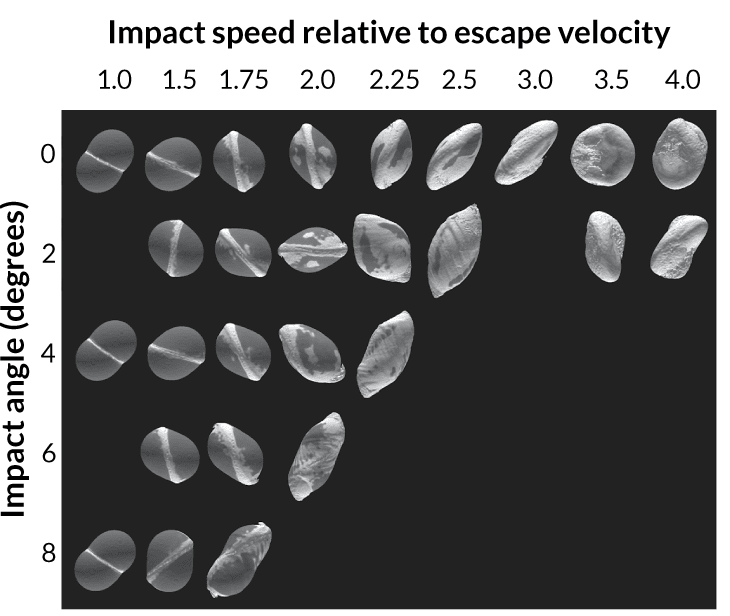
      In the image below, simulated collisions between two moonlets can lead to oddly shaped moons (bottom row) that closely resemble some of Saturn’s moons (top row; from left to right: Pan, Atlas and Prometheus).


     Images of the oddly-shaped moons, mostly from now-defunct Cassini spacecraft, got planetary scientists wondering how these satellites ended up with such strange shapes. Now, researchers suggest that collisions between moonlets could account for these shapes according to a study published online today, May 21, 2018, in Nature Astronomy. {The original Nature article includes some of these space culinary terms.}


     Dr. Adrien Leleu , a planetary scientist at the University of Bern in Switzerland, and colleagues developed computer simulations that let the scientists virtually smack together similar-sized moonlets at various speeds and angles. The team found that, at low angles and relative speeds of tens of meters per second (roughly equal to a car traveling on country roads), impacts can create offbeat shapes that look like the misfits around Saturn.


      Head-on collisions result in a flattened moon like Pan, which resembles an extraterrestrial empanada. An impact angle of just a few degrees leads to an elongated satellite such as Prometheus, which looks like a French baguette.


      Not all run-ins create a weird-looking moon. At higher angles, for example, moonlets might "hit and run." Or they could form highly elongated rotating moons that subsequently break apart.


     Dr. Leleu and collaborators focused on the smaller moons of Saturn that orbit within the planet’s rings. But the team also found that a similar collision between two larger moonlets could also account for the odd shape of Iapetus, a more distant walnut-shaped moon with a pronounced ridge along its equator that has puzzled scientists since the belt’s discovery. Other speculative origins for the ridge include volcanoes, plate tectonics or ring debris that rained down on the moon.


     I will admit that I was drawn to the odd shapes of possible moonlets because they reminded me of images of fossils like fusulinids (see below). Nature likes reusing cool shapes, I suppose.


Enjoy this planetary patisserie!
Steph


Wednesday, April 25, 2018

What Doesn't Krill Us Makes Us Stronger: Ocean Water Mixing By Tiny Organisms

        Swarms of tiny oceanic organisms known as zooplankton may have an outsized influence on their environment. New research at Stanford shows that clusters of centimeter-long individuals, each beating tiny feathered legs, can, in aggregate, create powerful currents that may mix water over hundreds of meters in depth.


     Although the work was carried out in the lab, the finding is the first to show that migrating zooplankton – or indeed any organism – can create turbulence at a scale large enough to mix the ocean’s waters. The work could alter the way ocean scientists think about global nutrient cycles like carbon, phosphate and oxygen, or even ocean currents themselves.


      A brine shrimp (below) tethered in place generates flow with its swimming motion, made visible with an overlaid time lapse of particles suspended in the water. Photo credit: Isabel Houghton.


      “Ocean dynamics are directly connected to global climate through interactions with the atmosphere,” said Dr. John Dabiri. “The fact that swimming animals could play a significant role in ocean mixing – an idea that has been almost heretical in oceanography – could therefore have consequences far beyond the immediate waters where the animals reside.”


        Dr. Dabiri, who was the senior author on the work published April 18, 2018, in Nature, added that the findings could also help scientists understand how the ocean sequesters carbon dioxide from the atmosphere and lead to updates in ocean climate models.


      “Right now a lot of our ocean climate models don’t include the effect of animals or if they do it’s as passive participants in the process,” Dabiri said.


      One of the most common zooplankton, krill are among the most abundant marine organisms and migrate daily in giant swarms, heading hundreds of meters deep by day and up to the ocean’s surface by night to feed.


      Dr. Dabiri knew that in terms of forces that drive the mixing of oceans, wind and tidal currents are thought to play the largest role. But he wondered if giant zooplankton migrations could also be involved – an idea first proposed by oceanographer Walter Munk in 1966, and since then debated but never systematically explored. {Dr. Munk, at 100 years of age, is still quite current (pun definitely intended!)}.

      Dr. Dabiri and graduate student Isabel Houghton tried to answer that question not in the ocean but in the relatively controlled environment of large water tanks in the lab. The pair worked to create flow environments that mimic the ocean with saltier water on the bottom of the tank and less salty water on the top. The resulting gradient mirrors ocean conditions that any organism would need to disrupt in order to cycle nutrients between the ocean’s surface and water deep below.


      “There’s no appreciable deep mixing of oxygen or carbon dioxide in the ocean if you can’t overcome the stabilizing influence of salinity and temperature gradients,” Dr. Koseff said.

      In the lab, the group was looking to see whether the tiny organisms they studied – mostly brine shrimp (also known as sea monkeys) as a stand-in for less lab-hardy krill – are simply churning water locally, leaving the gradient intact, or redistributing salt into a more uniform mixture. If they can mix layers in the lab, chances are they can do the same in the ocean, the group argued.


      To carry out the study, Houghton placed brine shrimp in the tank and activated laser or LED lights from either above or below, because brine shrimp are attracted to light, so they migrated toward the source. When she reversed the lights the tiny creatures scurried to the other end in a migration that lasted about 10 minutes.


      With cameras closely recording the animals’ movements, the group has been able to measure the individual water eddies surrounding each brine shrimp and the larger currents in the tank. From these, they’ve shown that turbulence from individual organisms aggregates into a much larger turbulent jet in the wake of the migration.

     What’s more, those flows were powerful enough to mix the tank’s salt gradient. “They weren’t just displacing fluid that then returned to its original location,” Houghton said. “Everything mixed irreversibly.”

     Before this work, scientists had thought that krill and other zooplankton could only create turbulence in their own size range – on the order of centimeters. That’s hardly enough to move nutrients on a meaningful scale. Now it appears that zooplankton have the capacity to mix ocean waters, at least regionally. Furthermore, Dr. Dabiri said their findings might not just apply to organisms like krill in the upper kilometer of the ocean, but also to jellyfish, squid, fish and mammals that swim even deeper, potentially churning the entire water column.


     Dr.Dabiri said his lab members need to verify their findings in the ocean, which will involve finding and following swarms of krill in locations as diverse as the California coast and frigid Antarctic waters. But if they continue to see mixing at the scales the lab work suggests, the findings could change the way ocean scientists think about the role of animals in influencing their watery environment – and potentially our climate on land.

     These ocean mixers are vastly different from the mixers we had at Smith College (or are they?)

     Did you ever order sea monkeys?
Steph