Total Pageviews

Wednesday, March 23, 2016

Shrinky Dinks: Crumpled Graphene

 
      "Brown University researchers have developed a method for making super-wrinkled and super-crumpled sheets of the nanomaterial graphene. The research shows that the topography can enhance some of graphene’s already interesting properties."


      "Crumple a piece of paper and it’s probably destined for the trash can, but new research shows that repeatedly crumpling sheets of the nanomaterial graphene can actually enhance some of its properties. In some cases, the more crumpled the better."


      "The research by engineers from Brown University shows that graphene, wrinkled and crumpled in a multi-step process, becomes significantly better at repelling water—a property that could be useful in making self-cleaning surfaces. Crumpled graphene also has enhanced electrochemical properties, which could make it more useful as electrodes in batteries and fuel cells."

        The research is published in the journal Advanced Materials.
         
       In keeping with our honey-comb theme of late, graphene is an allotrope of carbon in the form of a two-dimensional, atomic-scale, honey-comb lattice in which one atom forms each vertex. 


      It is the basic structural element of other allotropes, including graphite, charcoal, and carbon nanotubes.

      "Researchers deposited layers of graphene oxide onto shrink films—polymer membranes that shrink when heated (kids may know these as Shrinky Dinks). As the films shrink, the graphene on top is compressed, causing it to wrinkle and crumple. To see what kind of structures they could create, the researchers compressed same graphene sheets multiple times. After the first shrink, the film was dissolved away, and the graphene was placed in a new film to be shrunk again."


      "The researchers experimented with different configurations in the successive generations of shrinking. For example, sometimes they clamped opposite ends of the films, which caused them to shrink only along one axis. Clamped films yielded graphene sheets with periodic, basically parallel wrinkles across its surface. Unclamped films shrank in two dimensions, both length- and width-wise, creating a graphene surface that was crumpled in random shapes."


      "They showed that a highly crumpled graphene surface becomes superhydrophobic—able to resist wetting by water. When water touches a hydrophobic surface, it beads up and rolls off. When the contact angle of those water beads with an underlying surface exceeds 160 degrees—meaning very little of the water bead’s surface touches the material—the material is said to be superhydrophobic."


       "The team also showed that crumpling could enhance the electrochemical behaviors of graphene, which could be useful in next-generation energy storage and generation. The research showed that crumpled graphene used as a battery electrode had as much as a 400% increase in electrochemical current density over flat graphene sheets. That increase in current density could make for vastly more efficient batteries."

           Happy crumpling from blizzardy Denver!

Steph


Wednesday, March 16, 2016

Geologic Field Camp: Blooming and In Tents, Lumping and Splitting

     Ah, nostalgia for geologic field camp and geologic field work emerges in the springtime like saguaro cactus blooms and ocotillo flowers!


     Gearing up for 6-week or longer treks into Arizona, Mexico, Arkansas, and Nevada included these sorts of checklists (minus the computer in the 70's and 80's):


      We've discussed some field gear including rock hammer and Brunton compass here at PEOTS before:


         Other additions include tape measures, notebooks, chisels, rock bags, and markers. At the heart of every geologist's field record is the field notebook, made of carefully-stitched waterproof paper which notes cross-sections, sample locations, and other field observations tied to aerial photographs, LANDSAT images or Geographical Information Systems (GIS):


       It's a dense, "chucky-jam-full" source of information about every day in the field. Entering data and observations into an electronic tablet or Smartphone doesn't have the same thrill for me. I recall making every inch of every page count. . .These notes, especially cross- sections are geological works of art.


      One of my most memorable experiences was comparing my Paleozoic era cross-section with a dozen or more units to the cross-section from a geological engineer at field camp. His read "rock" or "bedrock" for the entire cross-section!

       Are you a lumper or a splitter?

Happy almost spring from the latter,
Steph

Wednesday, March 9, 2016

Diatom Beams: Naturally Strong Silicious Honeycomb Architecture Posts

     "Beams made of sawn diatom shells and poked with a diamond-tipped probe until they cracked have revealed that the microbial armor has the highest strength-to-weight ratio of any known biological material. According to the scientists who conducted the study, the remarkable toughness of this material is likely due to its honeycomb-like architecture and flawless silica build." SEM images of diatoms include ones like these:


      Diatoms are marine algae that come in a wide variety of shapes. Those with honeycomb shapes are especially strong.


     "The scientists studied the shells – called frustules – of Coscinodiscus, a hamburger-shaped diatom. Like all diatoms, it bears two frustules that fit together like the halves of a petri dish. The shells are perforated by pores."

        Further details of the study are described in this link. Some of these pores occur in Fibonacci patterns (similar to sunflower seed whorls) as in this SEM of another diatom.


        A closer look at the microstructure is seen in this diagram:


       Mighty perforated tiny organisms with great natural strength occurring in Fibonacci patterns and packed together in hexagonal groupings--anything familiar here?

          Anyone else reconcile Fibonacci numbers and hexagons by noting 6 is made of two sets of three? Other thoughts?

Diatomaceously yours,
Steph

Beware today, 3/15:


Tuesday, March 1, 2016

520-Million-Year-Old Fossils in China Have Nerve and Verve

       The fossilized remains of Chengjiangocaris kunmingensis, a crustacean-like animal that lived 520 million years ago in what is now Xiaoshiba, China, were detailed in a paper published yesterday by researchers at the University of Cambridge.


      The species’s hard exoskeleton is well-preserved and its nervous system is outlined with such intricacy that individual nerves are distinguishable.


     Note that the animal’s ventral cord, the purplish line running down its center, above, is clearly visible. In addition, the tiny fibers that comprise the animal’s bundled ganglia are also detectable with precision instruments.

     This level of soft tissue preservation is rare, especially from the Cambrian period, when life on Earth first blossomed into the rich biodiversity we know today. But the Xiaoshiba fossil deposit, located in China’s Yunnan Province, is "chucky-jam full" of these Cambrian period fossils.


     Readers of PEOTS may remember our forays into the Kunming Karst topography of the Yunnan Province, including the limestone pillars from Kunming installed in a Denver, CO, USA, park.


      “Under normal circumstances it is extremely difficult to obtain preservation of soft tissues, as these decay rapidly and lose most of the morphological information,” according to study co-author Javier Ortega-Hernández, a research fellow at the University of Cambridge.

     “However, there are cases in which the environmental conditions are more prone to produce exceptional preservation,” he said. “These include when the animals are entombed rapidly by a large amount of fine sediment, and all of this occurs in an oxygen-depleted environment. This process helps to limit the extent of decay on the carcasses and may result in the superb preservation of delicate features such as the ventral nerve cord and other parts of the internal anatomy.”


     Studying this extinct animal’s nervous system demonstrated that some of the species’s modern relatives, like velvet worms, maintain a similar internal structure.


          "Others, like the nearly indestructible tardigrades (or water bears), have done away with the complex rubric of nerve fibers found in their Cambrian forebears, in favor of more minimalistic systems. These insights capture a broader evolutionary picture through the aperture of C. kunmingensis’s fossilized nerves."

How's your nerve and verve today?
Steph

Wednesday, February 24, 2016

ATLASGAL: Celebrating Holding Up New Images AND "Cool" ACRONYMS

         Researchers associated with ATLASGAL, the APEX Telescope Large Area Survey of the Galaxy (ATLASGAL) have just released this image of the Milky Way:


      "The APEX telescope has mapped the full area of the galactic plane visible from the southern hemisphere for the first time at sub-millimeter wavelengths and in finer detail than space-based surveys. The APEX telescope allows the study of the cold universe, a few tens of degrees above absolute zero" according to an article released today.


       "APEX, the Atacama Pathfinder EXperiment telescope, is located at 5100 meters above sea level on the Chajnantor Plateau in Chile's Atacama region. The ATLASGAL survey took advantage of the unique characteristics of the telescope to provide a detailed view of the distribution of cold dense gas along the plane of the Milky Way galaxy. The new image includes most of the regions of star formation in the southern Milky Way."


       "At the heart of APEX are its sensitive instruments. One of these, LABOCA (the LArge BOlometer Camera) was used for the ATLASGAL survey. LABOCA measures incoming radiation by registering the tiny rise in temperature it causes on its detectors and can detect emission from the cold dark dust bands obscuring the stellar light." LABOCA, "the mouth" in Spanish, for measuring tiny rises in temperature? {That works, according to my endodontist ;-).}

      [La Boca is also a colorful neighborhood in Buenos Aires, Argentina. The universe is a cold, colorful place :-).]


     And Atlas, of course, was charged with holding up the universe (not the earth as often depicted):


       Wonder what ATLASGAL will hold for the universe?

   
STARRILY (Have a go at it ;-),
Steph

P.S. And, speaking of acronyms, also noted today >>> "Acronyms kill, ma'am!"


Wednesday, February 17, 2016

Asterids in Amber: "Electric" and Possibly Poisonous Fossil Flowers of the Dominican Republic

      The publication of an article in Nature Plants on 2/15/16, has resulted in some amusing autocorrect texts about this clade of flowering plants of Asteridae, (or asterids) which also includes coffee, potatoes, strychnine, and curare. Two newly discovered and very well-preserved fossil flowers (just less than 20 mm long) are believed to part of a new genus and species, Strychnos electri sp nov, which are of Tertiary age, possibly quite toxic, and exceptionally well-preserved in amber.


         The discovery of the fossils in the Dominican Republic 


by the lead author, George O. Poinar, Jr., in 1986, and subsequent study by Strychnos expert, Lena Struwe, has resulted in numerous articles citing the "asteroid" family or the genus and species name "Strychnos electricity." 


            The latter autocorrection is perhaps more forgiveable since the researchers named the new species after the Greek word for amber ("elektron"), the fossilized resin of trees. In around 600 B.C. Thales of Miletus writes about amber becoming charged by rubbing, describing static electricity.


        "The researchers had to date the flower by proxy by examining other life forms found in the amber cache, including the common single-celled organisms known as foraminifera and coccoliths. There are distinct evolutionary and population changes in foraminifera and coccoliths over time, and paleontologists often use these tiny animals to place fossils during specific geological periods."      

            The quote above from this article describes using microscopic foraminifera 


      and coccoliths (here in Scanning Electron Microscope (SEM) view


to help date the Dominican Republic amber. However, those two marine fauna are less likely to be found near flowering land plants. It is more likely, though, on a small island nation to see microscopic marine fossils together with land fossils in one amber suite.

     Amber suite, sweet amber! (ever the sap). . .

Where do your thoughts resin-ate?

Steph


Tuesday, February 9, 2016

Vindaloo? No, Vedauwoo: Please Take it for Granite in Wyoming

     A friend returned from climbing in the cracks at Vedauwoo in the Medicine Bow area of southeast Wyoming last fall. (Oops, you ought not say "fall" to a rock climber, I suppose.)


      These silicic rocks, the 1.4 billion year old Sherman Granite, hold spiritual meaning for the local Arapaho Indians who call them "bito'o'wu" meaning "earth-born".


      I've heard folks talk about visiting the hoodoos of "Vindaloo" in southeast Wyoming for many years. 


       In fact, DuckDuckGoing (or Googling) Vindaloo and Wyoming does bring one straight to Vedauwoo, affectionately also called "The Voo."


      Interestingly, the Sherman Granite is relatively young, compared to the 2.4 billion year old granite (and marine deposits) of the Great Tetons Mountains to the northwest. {Old rocks in a relatively young uplift (about 9 million years)--a great combo for striking mountain peaks}.


        Any ideas about why I chose Vedauwoo this week?


           And not the Vishnu Schist?! 


More to be revealed,
Steph

Thursday, February 4, 2016

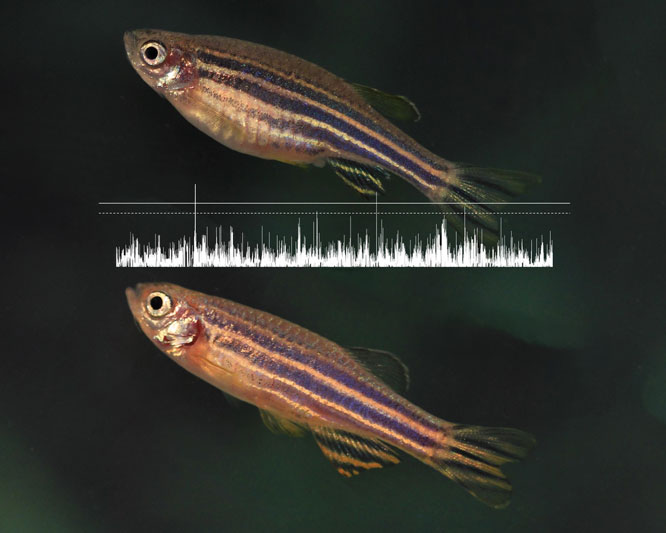
A Zebrafish Will Develop Its Nervous System in The Time You Are Awake Today (!)

      This week's post was inspired by the Zebrafish Research Center at Smith College.


       Well, that discovery, and this Scanning Electron Microscope (SEM) image of a zebrafish embryo:


      These remarkable fish are the topic of many research projects throughout the world, including at Smith College in Northampton, MA, USA. They are used in researching cancer, spinal cord development, sleep-related disorders, and the autism spectrum.

      "Smith Professor Mary Harrington has used the Zebrafish Research Center for her teaching and research on circadian rhythms, or sleep-wake cycles. She uses a group of specially designed zebrafish with a firefly protein attached to their circadian gene."


     "The gene causes the fish to bioluminesce each time their circadian clock turns on. Harrington and her students can add drugs to the water, then observe changes in the fish’s circadian rhythms to explore sleep-related disorders like depression."

      Zebrafish are ideal for this type of research, she explains. “They’re transparent, so light just comes right out of them.”


       The rapidity of zebrafish development makes them ideal research subjects. During the past 17 hours of this day (extremely busy for me and maybe for you, too), a zebrafish nervous system has developed!

       . . .Which could lead to this:


       Or even this. . .


Ah, the Denver Bronco-North Carolina Panther (Hello, Kitty?) hype has even gotten to Partial Ellipsis of the Sun.

{Here's some tutu fun from today at school. . .}


Any experience in Zebrafish research?
Steph