Total Pageviews

Thursday, November 15, 2018

Cratonically Yours: Thinner Lithosphere and Crust in Western Antarctica Than in Eastern Antarctica

        The frozen landmass of Antarctica has been studied using satellite imagery to understand some of the  earth's tectonics, revealing  several hidden structures of the least-understood continent in research published 11/5/18.


      Due to its remote location and abundance of ice, charting the geological characteristics of Antarctica is complicated, but the Gravity Field and Steady-State Ocean Circulation Explorer (GOCE) satellite can see what other satellites can't. GOCE precisely measured the pull of earth's gravity to map out hidden terrain.


     GOCE crashed out of orbit after running out of fuel in late 2013, but researchers are still poring over the data it collected. The researchers say it offers new insights into how Antarctica was formed, and how plate tectonics can function. See the colorful, newly-created video of continental movement.

      "In East Antarctica we see an exciting mosaic of geological features that reveal fundamental similarities and differences between the crust beneath Antarctica and other continents it was joined to until 160 million years ago," says one of the team, Dr. Fausto Ferraccioli from the British Antarctic Survey. The shape index, tectonic regularization, and crystal thickness were combined to create the above video.


      Antarctica was once part of the supercontinent Gondwana, which began to disintegrate about 130 million years ago, although the bond between Antarctica and Australia held together as recently as 55 million years ago.


      By combining GOCE readings with seismological data, the researchers were able to create 3D maps of Earth's lithosphere, made up of the crust and the molten mantle beneath. That lithosphere includes mountain ranges, ocean backs, and rocky zones or cratons, the leftovers of ancient continents embedded in continents as we know them today.


     "The satellite gravity data can be combined with seismological data to produce more consistent images of the crust and upper mantle in 3D, which is crucial to understand how plate tectonics and deep mantle dynamics interact," says researcher, Dr. Jörg Ebbing from Kiel University in Germany.


     The GOCE satellite circled our planet for over four years, from March 2009 to November 2013. During that time it got unusually close to Earth – an altitude of just 225 km (140 miles) – to maximize the accuracy of its measurements.


     The International Space Station, by comparison, is about two times farther away from earth's surface.


      Among the findings from the new study was the discovery of a thinner crust and lithosphere under West Antarctica compared to East Antarctica.  The latter has a mosaic of older cratons interspersed with thinner regions of rock, similar to India and Australia, to which it was once joined.


      And the data is useful for more than just tracing the remnants of ancient continents across the past 200 million years: It can be used to help figure out how ice sheets above the underlying terrain might react to warmer temperatures.


     With so many variables to consider, predicting how ice melt might progress across Antarctica is a real challenge, so any help scientists can get will be welcome. GOCE is still proving its use long after its mission ended.

Antarctically yours,
Steph

Brussels Sprouts and Heirloom Tomato Omelette


Thursday, October 18, 2018

Clock this: Dandelion Seeds Have a Vortex Floating Above Their Filaments

     "Dandelion seeds fly using a method that researchers thought would not work in the real world, according to a study published on October 17, 2018, in Nature." Here is a dandelion head, also called a dandelion clock:


     "When some animals, airplanes, or seeds fly, rings of circulating air called vortices form in contact with their wings or wing-like surfaces. These vortices can help to maintain the forces that lift the animal, machine, or seed into the air. 


     Researchers thought that an unattached vortex would be too unstable to persist in nature. Yet the light, puffy seeds of dandelions use vortices that materialize just above their surfaces and lift the seed into the air.


     Dandelion seeds bear filaments that radiate out from a central stalk like the spokes on a bicycle wheel, a feature that seems to be the key to their flight. Many insects harbor such filter-like structures on their wings or legs, suggesting that the use of detached vortices for flight or swimming might be relatively common, says study co-author Dr. Naomi Nakayama, a plant scientist at the U. of Edinburgh.


      As far as vortex rings go, the dandelion's is unusual. Normally, such air bubbles stay attached to an object or totally separate and disappear. But the dandelion’s bubble separates and hangs out above the seed. “When you show it to a fluid dynamicist, it blows their mind,” says study coauthor Dr. Cathal Cummins.


     Researchers were curious about how these bristly seeds of the pappus (the seed plus the filaments) stayed in the air because they looked so different from the wing-like seeds of other plants, such as maple trees. Those structures act like the wings of a bird or airplane, generating pressure differences above and below the wing to fly. To find the answer, Dr. Nakayama and her colleagues put dandelion seeds in a vertical wind tunnel and used a laser to illuminate particles that helped to visualize the airflow around the seed.


     That’s when they saw the vortex floating above the seeds. The amount of open space between the spokes of the seeds seems to be the key to the stability of these detached vortices, says Dr. Cummins. Pressure differences between the air moving through the spokes and the air moving around the seed creates the vortex ring.


     Previous studies have found that dandelion seeds always have between 90 and 110 bristles, says Nakayama. She described it as “extremely consistent”, and that consistency turns out to be very important.


     When the team designed small silicon discs to imitate these spokes, they produced models with a range of openings: from solid discs to ones that were 92% air, like the structures on the dandelion seeds. When the researchers tested these model seeds in their wind tunnel, they found that only the discs that best approximated dandelion seeds could maintain the detached vortex.


     If the number of openings in the discs was even 10% off of those in dandelion seeds, the vortex destabilized. The seed looks inefficient for flight because it has so much open space, says Dr. Nakayama, but these openings are what allow the unattached vortex ring to remain stable."


     “It’s great to see an analysis of something we see every day but didn’t fully understand,” says Dr. Richard Bomphrey, a comparative biomechanist at the Royal Veterinary College. “To discover that there were aerodynamic mechanisms that we didn’t already know — despite the fact that we can fly things at Mach 9 — is always exciting.”


        Wow, hanging vortices in a common flower. Nature sure is dandy!
Steph

Zoë had her Peace Corps gong out service, hitting the gong thrice to represent three years of service. Proud of her and looking ahead to what she'll do next!


Wednesday, September 19, 2018

“Permafrost” and Thermokarst

     As temperatures rise in the arctic, “permafrost,” permanently frozen ground, is defrosting at an increased rate. 


     "However, permafrost isn't the only thing in the arctic that is disappearing. Exposed rock that was once covered in ice is dissolving, eaten away by acid. The effects of this acid bath could have far-reaching impacts on global climate, according to a new study.


     Icy permafrost is rich in minerals, which are released when the ice melts. The minerals then become vulnerable to chemical weathering, or the breakdown of rock through chemical reactions. Scientists investigated areas once covered by permafrost in the western Canadian arctic, finding evidence of weathering caused by sulfuric acid produced by sulfide minerals that were released when the permafrost melted.


     Another type of naturally occurring chemical erosion is caused by carbonic acid, and it also dissolves rock. But although carbonic-acid weathering locks carbon dioxide (CO2) in place, sulfuric-acid erosion releases CO2 into the atmosphere, and it does so in quantities that were not previously accounted for, researchers described.


      Dramatic changes are underway in the Arctic, which is warming about twice as fast as any other location on earth. Sea ice is rapidly dwindling, which reduces the ocean's heat-reflecting cover, accelerating the rise of ocean temperatures. And polar bears, which depend on sea-ice cover to hunt for seals, are losing their hunting grounds, and have a harder time finding enough to eat. 


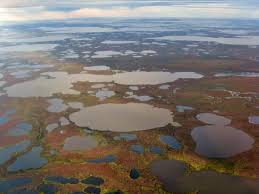
     On land, melting permafrost is shaping new landscapes, through a process called thermokarst — a term for thawing-driven erosion that originated in Russia, according to the U.S. Geological Survey (USGS).


     Thermokarst creates land formations such as lakes, pits, and sinkholes. It was not previously known how this process could affect weathering of exposed minerals, and how that might then impact CO2 release, according to the study.


     "These processes may influence the permafrost carbon-climate feedback, but have received little attention," the researchers reported.


     Over geologic time, weathering caused by carbonic acid can help to regulate climate, by trapping CO2 and restricting its transfer into the atmosphere. But the researchers found that thermokarst in regions that were rich in sulfides drove production of sulfuric acid, rather than carbonic acid, and thereby released quantities of CO2."


      These preliminary findings were published online 9/6/18 in the journal Geophysical Research Letters. (The "Plain Language" Abstract is something I've not seen before in professional journals; have you?)

       Thermokarst--easy enough for even kindergartners to understand, eh?
Steph


.

Tuesday, August 7, 2018

Forty-four More Planets Beyond Our Own Solar System: Four Have a Year of Less Than 24 Hours

Tuesday, July 17, 2018

Spin This News: Parental Chromosomes Develop Apart During Embryo's First Division

       Genetic researchers at the European Molecular Biology Lab (EMDL) have shown that mammalian life begins differently than originally suspected.

     It was long hypothesized that during a mammal embryo's first cell division, one spindle is responsible for segregating the embryo's chromosomes into two cells. Researchers now show that there are actually two spindles (as shown below), one for each set of parental chromosomes, meaning that the genetic information from each parent is kept apart throughout the first division.


     The publication Science published the results (which are likely to change biology textbooks) on 7/12/18. {Are there still textbooks?!}.


     This dual spindle formation may explain the high error rate in the early developmental stages of mammals, spanning the first few cell divisions. "The aim of this project was to find out why so many mistakes happen in those first divisions," says Dr. Jan (a guy!) Ellenberg, the group leader at EMBL who led the project. "We already knew about dual spindle formation in simpler organisms like insects, but we never thought (why not?!) this would be the case in mammals like mice. This finding was a big surprise, showing that you should always be prepared for the unexpected."


     Researchers have heretofore seen parental chromosomes occupying two half-moon-shaped parts in the nucleus of two-cell embryos, but it wasn't clear how this could be explained. "First, we were looking at the motion of parental chromosomes only, and we couldn't make sense of the cause of the separation," said Dr. Judith Reichmann. "Only when focusing on the microtubules -- the dynamic structures that spindles are made of -- could we see the dual spindles for the first time. This allowed us to provide an explanation for this 20-year-old mystery."


      Mitosis is the process of cell division, when one cell splits into two daughter cells. It occurs throughout the lifespan of multi-cellular organisms but is particularly important when the organism grows and develops. The key step of mitosis is to pass an identical copy of the genome to the next cell generation. For this to happen, DNA is duplicated and organised into dense thread-like structures known as chromosomes. The chromosomes are then attached to long protein fibres -- organised into a spindle -- which pulls the chromosomes apart and triggers the formation of two new cells. {The following diagram is one which will likely be updated in future embryology textbooks.}


     The spindle is made of thin, tube-like protein assemblies known as microtubules. During mitosis of animal cells, groups of such tubes grow dynamically and self-organize into a bi-polar spindle that surrounds the chromosomes. The microtubule fibres grow towards the chromosomes and connect with them, in preparation for chromosome separation to the daughter cells. Normally there is only one bi-polar spindle per cell, however, this research suggests that during the first cell division there are two: one each for the maternal and paternal chromosomes.


     "The dual spindles provide a previously unknown mechanism -- and thus a possible explanation -- for the common mistakes we see in the first divisions of mammalian embryos," Dr. Ellenberg explains. Such mistakes can result in cells with multiple nuclei, terminating development. "Now, we have a new mechanism to go after and identify new molecular targets. It will be important to find out if it works the same in humans, because that could provide valuable information for research on how to improve human infertility treatment, for example."


      In addition, the knowledge from this paper might impact legislation. In some countries, the law states that human life begins -- and is thus protected -- when the maternal and paternal nuclei fuse after fertilization. If it turns out that the dual spindle process works the same in humans, this definition is not fully accurate, as the union in one nucleus happens slightly later, after the first cell division.


     This discovery would have been impossible without the light-sheet microscopy technology (as seen above) developed at EMBL, which is now available through the spin-off company Luxendo. This allows for real-time and 3D imaging of the early stages of development, when embryos are very sensitive to light and would be damaged by conventional light microscopy methods. The high speed and spatial precision of light-sheet microscopy drastically reduce the amount of light that the embryo is exposed to, making a detailed analysis of these formerly hidden processes possible.


This is one spin we can stay with for awhile.
Steph

Earthquake experiment with brownies representing the stable craton of Canada and jello representing the tectonic plate boundary in Haiti.

The kids made "earthquake-proof" structures and observed the differences of the structures on "Canada" and "Haiti."