Tsingy de Bemaraha Strict Nature Reserve in Madagascar

is an example of extreme karst topography in very homogenous limestone.

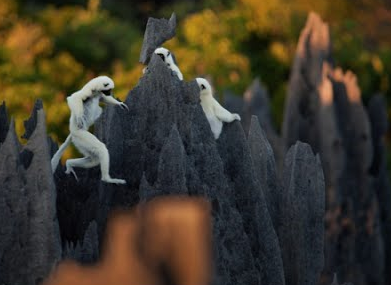
Due to the sharp nature of the limestone ledges and pinnacles ("tsingy" means "hurts to walk on in barefeet" in Malagasy), it is also home to a wide array of species endemic only to certain parts of the reserve, including a species of lemur (seen here in this 1 minute photo montage).

The UNESCO World Heritage Site includes these well-defined karst features, shaped by rain with a low pH value (acid rain). The video will also refresh your French.

The tsingy features are the sedimentary equivalent of the Hawaiian lava called aa. (Though, I can't imagine feeling very "singy" walking on those carbonate ridges, if, indeed, the Malagasy word sounds as I think it does).

Of course, much of the species diversity at the reserve is due to Madagascar's being separated from the Indian peninsula 88 million years ago (see diagram below). This fourth largest island is a "biodiversity hotspot;" over 90% of its wildlife is found nowhere else on earth due to its geographic isolation.

The microclimate of the Tsingy Nature Reserve created even further specialized plants and animals.

So, the dilemma: do Madagascans go out for Indian food or perhaps food from Mozambique?

Surely, it's a delicate balance.

And please, you must remember this. . .

Have any of you been to the Tsingy Reserve? Eaten food from Mozambique? (I am assuming Indian food is on the table already. . .)
Steph
It's all about perspective:
'


is an example of extreme karst topography in very homogenous limestone.

Due to the sharp nature of the limestone ledges and pinnacles ("tsingy" means "hurts to walk on in barefeet" in Malagasy), it is also home to a wide array of species endemic only to certain parts of the reserve, including a species of lemur (seen here in this 1 minute photo montage).
The UNESCO World Heritage Site includes these well-defined karst features, shaped by rain with a low pH value (acid rain). The video will also refresh your French.

The tsingy features are the sedimentary equivalent of the Hawaiian lava called aa. (Though, I can't imagine feeling very "singy" walking on those carbonate ridges, if, indeed, the Malagasy word sounds as I think it does).

Of course, much of the species diversity at the reserve is due to Madagascar's being separated from the Indian peninsula 88 million years ago (see diagram below). This fourth largest island is a "biodiversity hotspot;" over 90% of its wildlife is found nowhere else on earth due to its geographic isolation.

The microclimate of the Tsingy Nature Reserve created even further specialized plants and animals.

So, the dilemma: do Madagascans go out for Indian food or perhaps food from Mozambique?

Surely, it's a delicate balance.

And please, you must remember this. . .

Have any of you been to the Tsingy Reserve? Eaten food from Mozambique? (I am assuming Indian food is on the table already. . .)
Steph
It's all about perspective:
'


