Total Pageviews

Showing posts with label Paleozoic. Show all posts

Tuesday, August 8, 2017

Crinoids for Cri-nerds

     We discussed crinoids,
also known as sea "lilies," here at Partial Ellipsis of the Sun in April. This extraordinarily well-preserved Paleozoic crinoid fossil sample (below) inspired another look at this animal that looks like a plant.


      Compare the sample above to the "Smarties" stem pieces we found in northern Arkansas in April. The disarticulated crinoid stems or stalks are relatively common, but the delicate, lacy crown pieces are much rarer.


      Modern day crinoids and the fossil animals are quite similar, hence they are often referred to by the non-scientific term "living fossils."


       The parts of crinoid animals are labelled below, though the terms are quite plant-based:


I guess you could say I'm a bit of a cri-nerd ;-).


     How about you?
     Steph


Thursday, March 23, 2017

Smoking Smoke Rings: Mount Etna, Sicily, Italy, and More

      This week, Partial Ellipsis of the Sun presents a photo collection of spectacular geological and meteorological images. Firstly, smoke rings from Mount Etna in Sicily, Italy. These images are from Andrew Rader. Mount Etna is erupting for the second time this month. Wow, huh?


     Next, this pyroclastic flow deposit is located in "Poseidon's Gardens" on the island of Ischia, Italy. Ischia, just off the coast from Naples and Mount Vesuvius, is dominated by Mount Epomeo. This deposit shows the violent nature of pyroclastic flows and the turbulence and deformation possible within these volcanic features. These volcanic layers were deposited about 10,000 years ago. The layers were deformed as the flow slid down the side of the mountain, or possibly, as the soft sediments were covered by a more viscous lava flow during the same eruption. Oooh la la! {Photos by Drew Patrick.}


      From Poseidon's Gardens to "Poseidon's Fury" in these gargantuan crashing waves around Bell Rock lighthouse in Angus, Scotland (photographer unknown). . .Whoa.


      And, lastly, from much calmer seas, a large slab of extinct Paleozoic ammonites and belemnites from Morocco (photos by me).


Have you seen a spectacular geologic or meteorologic image this week? Please share a link!

Steph


Friday, March 10, 2017

Conodonts or "Cono-dos:" Odd Index Fossil Elements Belonged to Extinct Eel-Like Animals

      Conodont elements are microfossils made of phosphate or apatite; they are some of the planet's most useful index fossils. {Index fossils are those found in a narrow time range and wide spatial distribution that are used in the identification of related geologic formations.}


     Conodonts (Greek kōnos, "cone", + odont, "tooth") are extinct agnathan chordates resembling eels, classified in the class Conodonta. 


      For several decades, conodonts were known only from odd, wildly and disparately shaped, tooth-like microfossil assemblages found in isolation; these microfossils are now called conodont elements.


     However,  texts published before the early 1980's refer to the teeth-like assemblages as the actual conodonts (see below).
      

        The conodont animal's soft parts were finally discovered in a lagerstätte (fossil bed of extraordinary preservation) in the Bear Gulch Limestone in Montana.


     The discovery led to the eventual recreation of what these agnathan chordates, who lived mostly during the Paleozoic, looked like.


       The conodont elements are widely used not only to define a time period of deposition but also as paleothermometers which record the degree to which sediments have been "cooked." This characteristic is quite useful to oil and gas paleontologists.
            

     The conodont elements may readily be removed from their calcium carbonate sediments by using a mild acid to dissolve the CaCO3, leaving a suite of conodont elements. My micropaleontology project at the U. of Arizona yielded a conodont suite using this method of dissolution.


        How suite it is! Though, I must say, the conodont assemblages were rather a wonderful mystery until recently. . .


          The Conodonta creatures did not have jaws but had these odd assemblages at the "mouth" ends of their bodies.


      By the way, the inspiration for this week's post was, oddly enough, limestone outcrops at the Tsingy Nature Reserve in Madagascar that we discussed last week. (All about scale, once again. . .).

Have you encountered conodont elements before? Do you have any Conodon'ts or Cono-dos? ;-)
Steph

☆☆☆☆☆☆☆☆☆☆☆☆☆☆☆☆☆

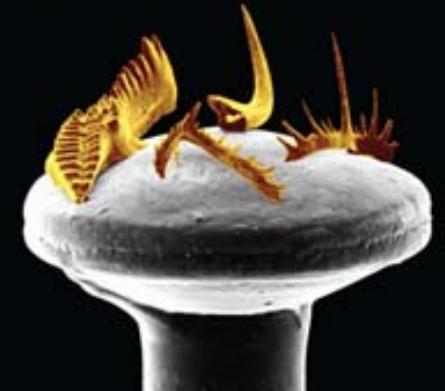
Bonus images: Conodont elements on the head of a nail in a Scanning Electron Microscope (SEM) image:


And, with a bit of gold:


Happy pi day!


Wednesday, June 10, 2015

Trilobite Bottoms: Molting, Molting, Molting

      Trilobite bottoms (or pygidia) are found in sedimentary rocks, evidence of the molting life cycle of these intriguing fossils.


      The fossilized remains of these primarily Paleozoic fossils sometimes show the molting process quite distinctly:


     Rather than finding the whole fossil with its namesake distinct three parts


sometimes only the trilobite bottoms are found:


      Molting, molting molting. . .


      When first searching the web for trilobite bottoms here's the image that popped up first:


      Trilobite bottoms came up as a topic for this week's PEOTS as I was planting artichoke plants (nasty, spiky, weedy looking things):


        It was a small leap from artichoke bottoms (which are, of course, also known as hearts)


to trilobite bottoms. . . .

Looking forward to Tri lo bite of the artichoke bottoms soon!

Steph

And for those science grads:


Tuesday, May 27, 2014

Trilobite Eyes, Pixels, Surgery, and your Smart Phone

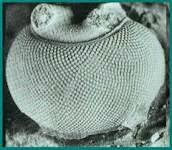
      Trilobite compound eyes have always intrigued me. The calcium carbonate of the eyes of these Paleozoic-aged marine arthropods (similar to those of horseshoe crabs and insects) are often well-preserved:


     These extinct creatures have a three-lobed body:


     Their eyes contain many individual lenses (akin to each one creating a pixel) 


unlike those of humans, which is a useful adaptation used in laparoscopy and which may be used in Smart Phones, if/when the technology gets small enough:


Surgery, Smart Phones, and Compound Eyes


     Compound eyes are especially useful in low light situations and in order to be able to see 360 ° to be aware of predators:


     Experience seeing like an insect (it's NOT what you think)


      A recent paper describes discovery of the not-usually-fossilized soft parts of the trilobite eyes as flower like:


          Discovery of trilobite eye soft parts


     I think it might make me see a little buggy though.


     To end today: Tri a lo' bite of this quote: 


     "I cannot stress often enough that what science is all about is not proving things to be true but proving them to be false." -Lawrence M. Krauss, theoretical physicist (b. 1954) 


What do you think?


Steph

(aka Word Woman)