Conodont elements are microfossils made of phosphate or apatite; they are some of the planet's most useful index fossils. {Index fossils are those found in a narrow time range and wide spatial distribution that are used in the identification of related geologic formations.}

Conodonts (Greek kōnos, "cone", + odont, "tooth") are extinct agnathan chordates resembling eels, classified in the class Conodonta.

For several decades, conodonts were known only from odd, wildly and disparately shaped, tooth-like microfossil assemblages found in isolation; these microfossils are now called conodont elements.

However, texts published before the early 1980's refer to the teeth-like assemblages as the actual conodonts (see below).

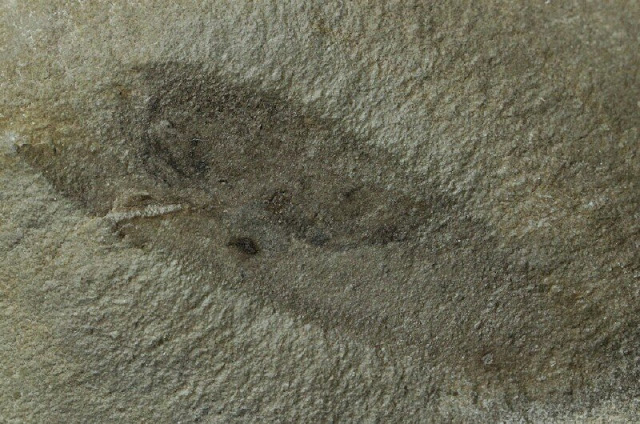
The conodont animal's soft parts were finally discovered in a lagerstätte (fossil bed of extraordinary preservation) in the Bear Gulch Limestone in Montana.

The conodont elements are widely used not only to define a time period of deposition but also as paleothermometers which record the degree to which sediments have been "cooked." This characteristic is quite useful to oil and gas paleontologists.


For several decades, conodonts were known only from odd, wildly and disparately shaped, tooth-like microfossil assemblages found in isolation; these microfossils are now called conodont elements.

However, texts published before the early 1980's refer to the teeth-like assemblages as the actual conodonts (see below).

The conodont animal's soft parts were finally discovered in a lagerstätte (fossil bed of extraordinary preservation) in the Bear Gulch Limestone in Montana.

The discovery led to the eventual recreation of what these agnathan chordates, who lived mostly during the Paleozoic, looked like.

The conodont elements are widely used not only to define a time period of deposition but also as paleothermometers which record the degree to which sediments have been "cooked." This characteristic is quite useful to oil and gas paleontologists.

The conodont elements may readily be removed from their calcium carbonate sediments by using a mild acid to dissolve the CaCO3, leaving a suite of conodont elements. My micropaleontology project at the U. of Arizona yielded a conodont suite using this method of dissolution.

How suite it is! Though, I must say, the conodont assemblages were rather a wonderful mystery until recently. . .

The Conodonta creatures did not have jaws but had these odd assemblages at the "mouth" ends of their bodies.

By the way, the inspiration for this week's post was, oddly enough, limestone outcrops at the Tsingy Nature Reserve in Madagascar that we discussed last week. (All about scale, once again. . .).
Have you encountered conodont elements before? Do you have any Conodon'ts or Cono-dos? ;-)
Steph
☆☆☆☆☆☆☆☆☆☆☆☆☆☆☆☆☆
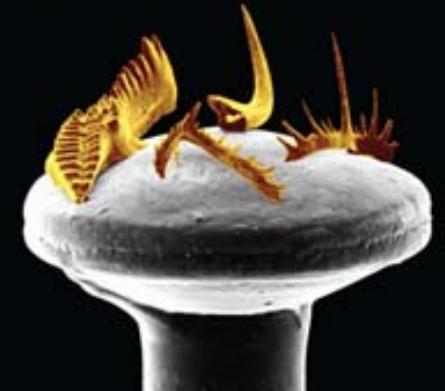
Bonus images: Conodont elements on the head of a nail in a Scanning Electron Microscope (SEM) image:

And, with a bit of gold:
Happy pi day!

