This week's post was inspired by the Zebrafish Research Center at Smith College.

Well, that discovery, and this Scanning Electron Microscope (SEM) image of a zebrafish embryo:

These remarkable fish are the topic of many research projects throughout the world, including at Smith College in Northampton, MA, USA. They are used in researching cancer, spinal cord development, sleep-related disorders, and the autism spectrum.
"Smith Professor Mary Harrington has used the Zebrafish Research Center for her teaching and research on circadian rhythms, or sleep-wake cycles. She uses a group of specially designed zebrafish with a firefly protein attached to their circadian gene."

"The gene causes the fish to bioluminesce each time their circadian clock turns on. Harrington and her students can add drugs to the water, then observe changes in the fish’s circadian rhythms to explore sleep-related disorders like depression."
Zebrafish are ideal for this type of research, she explains. “They’re transparent, so light just comes right out of them.”

The rapidity of zebrafish development makes them ideal research subjects. During the past 17 hours of this day (extremely busy for me and maybe for you, too), a zebrafish nervous system has developed!
. . .Which could lead to this:

Or even this. . .


Well, that discovery, and this Scanning Electron Microscope (SEM) image of a zebrafish embryo:

These remarkable fish are the topic of many research projects throughout the world, including at Smith College in Northampton, MA, USA. They are used in researching cancer, spinal cord development, sleep-related disorders, and the autism spectrum.
"Smith Professor Mary Harrington has used the Zebrafish Research Center for her teaching and research on circadian rhythms, or sleep-wake cycles. She uses a group of specially designed zebrafish with a firefly protein attached to their circadian gene."
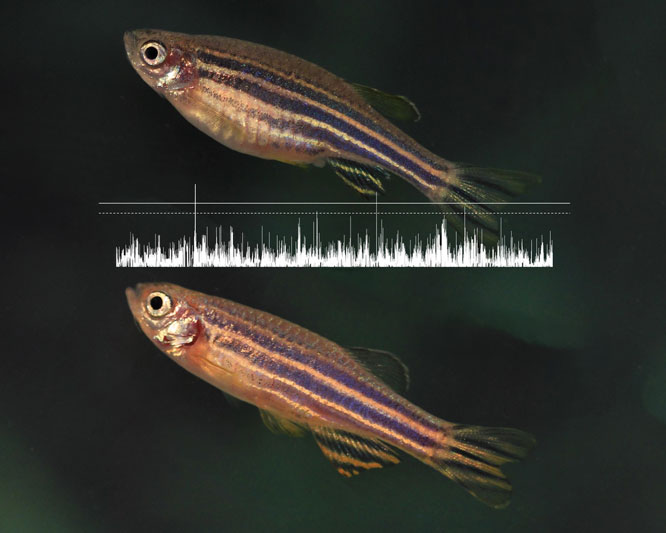
"The gene causes the fish to bioluminesce each time their circadian clock turns on. Harrington and her students can add drugs to the water, then observe changes in the fish’s circadian rhythms to explore sleep-related disorders like depression."
Zebrafish are ideal for this type of research, she explains. “They’re transparent, so light just comes right out of them.”

The rapidity of zebrafish development makes them ideal research subjects. During the past 17 hours of this day (extremely busy for me and maybe for you, too), a zebrafish nervous system has developed!
. . .Which could lead to this:

Or even this. . .

Ah, the Denver Bronco-North Carolina Panther (Hello, Kitty?) hype has even gotten to Partial Ellipsis of the Sun.
{Here's some tutu fun from today at school. . .}

Any experience in Zebrafish research?
Steph


