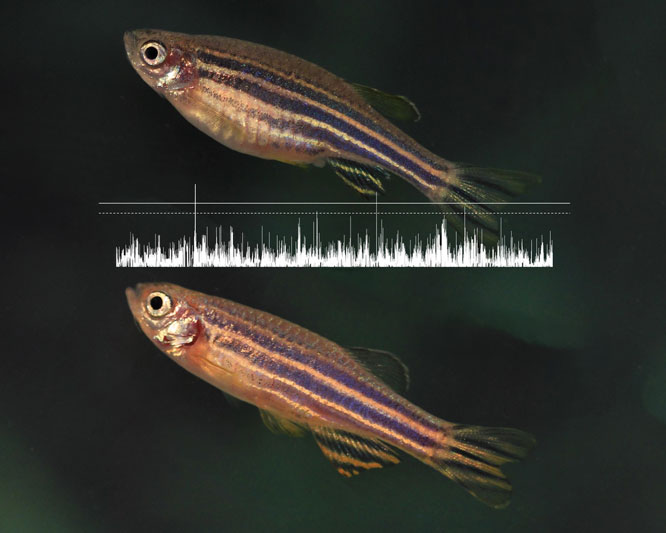
One of the major transformations required for the descendants of fish to become creatures that could walk on land was the replacement of long, elegant fin rays by fingers and toes. In the August 17, 2016, issue of Nature, scientists from the U. of Chicago show that the same cells that make fin rays in fish play a central role in forming the fingers and toes of four-legged creatures.


After 3 years of experiments using new gene-editing techniques and sensitive mapping to label and track developing cells in fish, the researchers describe how the small flexible bones found at the ends of fins are related to fingers and toes, which are more suitable for life on land.

"When I first saw these results you could have knocked me over with a feather," said the study's senior author, Dr. Neil Shubin, an authority on the transition from fins to limbs.

"For years," he said, "scientists have thought that fin rays were completely unrelated to fingers and toes, completely dissimilar because one kind of bone is initially formed out of cartilage and the other is formed in simple connective tissue. Our results change that whole idea. We now have a lot of things to rethink."

To unravel how fins might have transformed into wrists and fingers, the researchers worked mostly with standard zebrafish.

Dr.Tetsuya Nakamura, used a gene-editing technique, CRISPR/Cas, in zebrafish to delete important genes linked to limb-building, and then selectively bred zebrafish with multiple targeted deletions. He cross bred the fish mutants, a project that began at Woods Hole, Massachusetts.

The researchers simultaneously refined cell-labeling techniques to map out when and where specific embryonic cells migrated as the animals developed.
"It was one of those eureka moments," Dr. Andrew Gehrke said. "We found that the cells that mark the wrists and fingers of mice and people were exclusively in the fin rays of fish."

The team focused on Hox genes, which control the body plan of a growing embryo along the head-to-tail, or shoulder-to-fingertip, axis. Many of these genes are crucial for limb development.
They studied the development of cells, beginning soon after fertilization and followed them as they became part of an adult fin. Previous work has shown that when Hox genes, specifically those related to the wrists and digits of mice (HoxD and HoxA), were deleted, the mice did not develop those structures. When Nakamura deleted those same genes in zebrafish, the long fins rays were greatly reduced.

"What matters is not what happens when you knock out a single gene but when you do it in combination," Dr. Nakamura explained. "That's where the magic happens."
The researchers also used a high-energy CT scanner to see the minute structures within the adult zebrafish fin. These can be invisible, even to most traditional microscopes. The scans revealed that fish lacking certain genes lost fin rays, but the small bones made of cartilage fin increased in number.

The authors hypothesize that the mutants that Nakamura made caused cells to stop migrating from the base of the fin to their usual position near the tip. This inability to migrate meant that there were fewer cells to make fin rays, leaving more cells at the fin base to produce cartilage elements.
"It really took the combination of labeling and knockouts to convince us that this cellular relationship between fins and limbs was real," Dr. Gehrke said.
Future research includes new expeditions to find more fossil intermediates -- such as Tiktaalik, a link between primitive fish and the first four-legged animals, discovered by Shubin and others in 2006 -- in the transition from fins to limbs.

The researchers are also planning experiments with Hox genes to learn how a common population of cells can form such different structures in fish and humans.
Anything fishy about this story? It's certainly not fin-ished yet. . .
Steph
Happy 23rd birthday today, Zoë (8/20/16)! Photo of Zoë in northern Ethiopia, safe and sound.


After 3 years of experiments using new gene-editing techniques and sensitive mapping to label and track developing cells in fish, the researchers describe how the small flexible bones found at the ends of fins are related to fingers and toes, which are more suitable for life on land.

"When I first saw these results you could have knocked me over with a feather," said the study's senior author, Dr. Neil Shubin, an authority on the transition from fins to limbs.

"For years," he said, "scientists have thought that fin rays were completely unrelated to fingers and toes, completely dissimilar because one kind of bone is initially formed out of cartilage and the other is formed in simple connective tissue. Our results change that whole idea. We now have a lot of things to rethink."

To unravel how fins might have transformed into wrists and fingers, the researchers worked mostly with standard zebrafish.

Dr.Tetsuya Nakamura, used a gene-editing technique, CRISPR/Cas, in zebrafish to delete important genes linked to limb-building, and then selectively bred zebrafish with multiple targeted deletions. He cross bred the fish mutants, a project that began at Woods Hole, Massachusetts.

The researchers simultaneously refined cell-labeling techniques to map out when and where specific embryonic cells migrated as the animals developed.
"It was one of those eureka moments," Dr. Andrew Gehrke said. "We found that the cells that mark the wrists and fingers of mice and people were exclusively in the fin rays of fish."

The team focused on Hox genes, which control the body plan of a growing embryo along the head-to-tail, or shoulder-to-fingertip, axis. Many of these genes are crucial for limb development.
They studied the development of cells, beginning soon after fertilization and followed them as they became part of an adult fin. Previous work has shown that when Hox genes, specifically those related to the wrists and digits of mice (HoxD and HoxA), were deleted, the mice did not develop those structures. When Nakamura deleted those same genes in zebrafish, the long fins rays were greatly reduced.

"What matters is not what happens when you knock out a single gene but when you do it in combination," Dr. Nakamura explained. "That's where the magic happens."
The researchers also used a high-energy CT scanner to see the minute structures within the adult zebrafish fin. These can be invisible, even to most traditional microscopes. The scans revealed that fish lacking certain genes lost fin rays, but the small bones made of cartilage fin increased in number.

The authors hypothesize that the mutants that Nakamura made caused cells to stop migrating from the base of the fin to their usual position near the tip. This inability to migrate meant that there were fewer cells to make fin rays, leaving more cells at the fin base to produce cartilage elements.
"It really took the combination of labeling and knockouts to convince us that this cellular relationship between fins and limbs was real," Dr. Gehrke said.
Future research includes new expeditions to find more fossil intermediates -- such as Tiktaalik, a link between primitive fish and the first four-legged animals, discovered by Shubin and others in 2006 -- in the transition from fins to limbs.

The researchers are also planning experiments with Hox genes to learn how a common population of cells can form such different structures in fish and humans.
Anything fishy about this story? It's certainly not fin-ished yet. . .
Steph
Happy 23rd birthday today, Zoë (8/20/16)! Photo of Zoë in northern Ethiopia, safe and sound.