This week's Partial Ellipsis of the Sun will focus on the ellipsis in our blog title as well as the upcoming solar eclipse, visible in the U.S. on August 21, 2017.

I discovered this week that three dots on clothing labels signifies hot, hot, hot (ok, truly just "hot," but you get the idea)

. . .and look at our logo!

Ellipsis, from the Ancient Greek: ἔλλειψις, élleipsis, "omission" or "falling short") is a series of three dots that usually indicates an intentional omission of a word, sentence, or whole section from a text without altering its original meaning (Look! A typewriter!)

Depending on their context and placement in a sentence, ellipses can indicate an unfinished thought, a slight pause, an echoing voice, a leading statement, or a nervous or awkward silence.

Aposiopesis is the use of an ellipsis to trail off into silence, for example: "I wonder about where to go to view the August 2017 eclipse. . ." When placed at the beginning or end of a sentence, the ellipsis can also inspire a feeling of wonder, sadness, or imagining.

The most common form of an ellipsis is a row of three periods or full stops (. . .)

or a precomposed triple-dot glyph (…). The triple-dot punctuation mark is also called a suspension point, points of ellipsis, periods of ellipsis, or colloquially, framed as "dot-dot-dot".

In Anne Toner's book on the ellipsis, Ellipsis in English Literature: Signs of Omission she suggests that the first use of the punctuation in the English language dates to a 1588 translation of Terence's Andria, by Maurice Kyffin. In that case, however, the ellipsis consists not of dots but of short dashes.

There are numerous widely acknowledged types of ellipsis. Nine of them are: 1) gapping, 2) stripping, 3) VP-ellipsis, 4) pseudogapping, 5) answer fragments, 6) sluicing, 7) N-ellipsis, 8) comparative deletion, and 9) null complement anaphora. However, rather than getting into further discussion of these nine types of ellipses. . .

let's move on to the solar eclipse of August 21, 2017.

The eclipse has its own website. Maizie and I are already planning a camping trip with friends to Wyoming to view the eclipse. How about you? Will your path cross with the solar eclipse. . .?
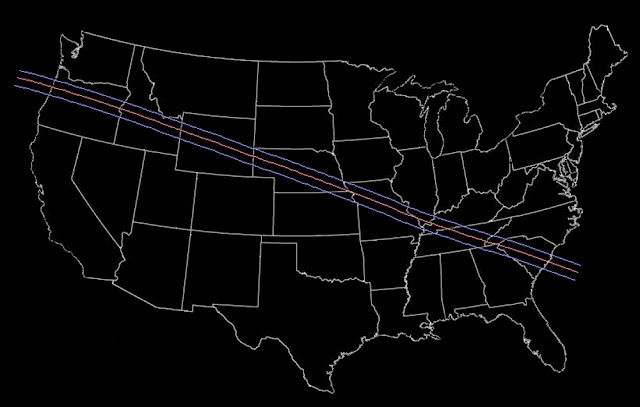
Only 219 days to go!
Steph

Wow! { { { Photograph by Walker Berg, Oregon: CROWS ON SNOW} } }


I discovered this week that three dots on clothing labels signifies hot, hot, hot (ok, truly just "hot," but you get the idea)

. . .and look at our logo!

Ellipsis, from the Ancient Greek: ἔλλειψις, élleipsis, "omission" or "falling short") is a series of three dots that usually indicates an intentional omission of a word, sentence, or whole section from a text without altering its original meaning (Look! A typewriter!)

Depending on their context and placement in a sentence, ellipses can indicate an unfinished thought, a slight pause, an echoing voice, a leading statement, or a nervous or awkward silence.

Aposiopesis is the use of an ellipsis to trail off into silence, for example: "I wonder about where to go to view the August 2017 eclipse. . ." When placed at the beginning or end of a sentence, the ellipsis can also inspire a feeling of wonder, sadness, or imagining.

The most common form of an ellipsis is a row of three periods or full stops (. . .)

or a precomposed triple-dot glyph (…). The triple-dot punctuation mark is also called a suspension point, points of ellipsis, periods of ellipsis, or colloquially, framed as "dot-dot-dot".

In Anne Toner's book on the ellipsis, Ellipsis in English Literature: Signs of Omission she suggests that the first use of the punctuation in the English language dates to a 1588 translation of Terence's Andria, by Maurice Kyffin. In that case, however, the ellipsis consists not of dots but of short dashes.

There are numerous widely acknowledged types of ellipsis. Nine of them are: 1) gapping, 2) stripping, 3) VP-ellipsis, 4) pseudogapping, 5) answer fragments, 6) sluicing, 7) N-ellipsis, 8) comparative deletion, and 9) null complement anaphora. However, rather than getting into further discussion of these nine types of ellipses. . .

let's move on to the solar eclipse of August 21, 2017.

The eclipse has its own website. Maizie and I are already planning a camping trip with friends to Wyoming to view the eclipse. How about you? Will your path cross with the solar eclipse. . .?

Only 219 days to go!
Steph

Wow! { { { Photograph by Walker Berg, Oregon: CROWS ON SNOW} } }