Total Pageviews

Showing posts with label Iceland. Show all posts

Thursday, April 7, 2016

Revisiting Iceland: A Kentucky-Sized Place Where Geology is in Your Face at Every Turn

         A friend's trip to Iceland the past two weeks has reinspired a look at this Kentucky-sized land. My friend's description of her trip included words about geology staring one in the face at every turn. Young, changing, extraordinary geology is located next to the much older geology of Greenland.


     "Iceland is a manifestation of plate tectonic activity along a 10,000-mile underwater mountain range called the Mid-Atlantic Ridge. The island, which is about the size of the state of Kentucky, is only 15-20 million years old, making it one of the youngest landmasses of its size in the world, according to Ari Trausti Guðmundsson, a geophysicist, poet, and former Iceland presidential candidate."


     “If you hop over to Greenland, the bedrock is over 3,000 million years old,” says Guðmundsson, who guided Pitcairn during his expedition to Bárðarbunga and wrote the text, including 120 poems, in his book. “In comparison, Iceland is an infant.”


     "The Mid-Atlantic Ridge gives rise to Iceland’s volcanoes, one of its signature geological features. The country boasts 30 volcanic systems, which contain hundreds of active volcanoes. The natural upwelling of magma from beneath the ridge, as well as a mantle plume located almost right under the middle of the country, send billions of tons of lava surging through the bedrock annually, causing the country to expand about one inch per year, on average, according to Guðmundsson.


       Additional information about this geologist's dream country is located at this link. Hoping to get to Iceland before too many of the glaciers have melted.

        I am also fascinated by the unusual diacritical marks in the place and author names. It's also fun to see a geologist poet who ran for the presidency of Iceland! With a small population, I guess residents wear many hats. . .

        How about you; what about Iceland fascinates you?

Steph

Tuesday, October 27, 2015

Columnar Joints: No, NOT in Colorado, But in Svartifoss, Devil's Tower, and Giant's Causeway

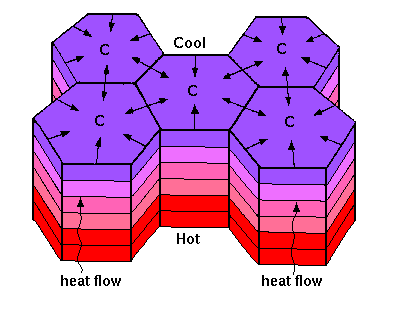
     Columnar joints are spectacular, often very long, hexagonal features found in igneous basalts (that's basalts not bathsalts!). Three particularly well-preserved examples are in Svartifoss, Iceland,


Devil's Tower, Wyoming, USA,


and the Giant's Causeway in far northeastern Ireland.


       [To clarify, there are columnar joints in Colorado; they are just not as spectacular as in those three places.]

        The mechanism for creating these six-sided features is seen here where 'C' represents the center of each hexagon:


      This two-minute geology video shows columnar jointing from the side and from the top in eastern Washington, USA. The accompanying one minute video shows what happened to a rock hammer atop those hexagonal features!

        The columnar joints in Iceland have inspired architecture for a local church. I still think our first PEOTS field trip ought to be to Iceland.


         More information about this hexagonal packing structure, including T- and Y- junctures, points toward a similarity to the optimally-packed honeycomb:


. . .and to mud cracks. . .


and to carbon rings in chemistry (benzene here):


and to . . .


      Isn't nature mesmerizing?! And more than she's cracked up to be!?

Steph

P.S.

Hmmm, Ethiopia is likely ahead of Iceland in my travel plans, but Iceland is a close second. . .


Tuesday, February 11, 2014

Icelandic Plate Tectonics: No Scree-ching Halt: Give It an Inch and It'll Take A Year


     At long last, we are ready for the trip to Iceland now that the Viking Sunstone (optical Iceland spar or calcite) has been found:


     Optical calcite is rhombohedral and refracts light in a way that Norse explorers of 900-1200 A. D. were likely able to locate the sun even after sunset and on cloudy days. In those pre-GPS days, the calcite rhomb was accurate to within 1 degree:


     Optical calcite is found in abundance in the scree of Iceland, though it is now a protected resource since Icelandic tourism has recently blossomed. You may read more about calcite here, but I want to get us to Iceland, the only place on earth (currently) where a mid-oceanic ridge occurs on land:


     To repeat, Iceland is the ONLY place on our planet where one may actually witness oceanic crust being created on land. All other parts of the global mid-oceanic ridges are deep beneath the surface of the ocean. These folks are walking between two tectonic plates, the North American plate and the Eurasian plate, in Iceland:


     The theory of plate tectonics
describes the large-scale motions of the lithosphere. A good, general overview of the theory may be found here:


     The divergent boundaries between plates, known as mid-oceanic ridges, are the places where oceanic crust is created. There is a particularly good color, animated graphic in the link below (and shared here) which shows the new basalt (nicknamed MORB for Mid-Oceanic Ridge Basalt) or gabbro being created:


     Oceanic crust is richer in iron and magnesium making it heavier than continental crust, which is richer in lighter silica. The very newest "skin of the earth"  is created at mid-oceanic ridges. As one moves away from the center of the ridge, the oceanic crust is progressively older on mirroring sides of the ridge. Almost all oceanic crust is 200 million years old or younger, fairly young in geologic terms. Then, at the margins with lighter continental crust, the oceanic crust dives beneath the lighter continental crust and is essentially recycled. The major plates and their current movements are shown below:


     In Iceland, one may witness this new "baby earth skin" creation directly. In the land of fire and ice, you can actually touch this brand new earth as the mid-oceanic Atlantic ridge runs right through Iceland:


       The Eurasian and North American plates are moving apart at the rate of about an inch a year. There is no scree-ching halt to the oceanic plate movement due to the convection currents in the earth. The convection is akin to heating up pudding on the stove. The rising hot pudding comes to the surface then plunges back down again as it cools at the surface. 

        To witness new earth being created is, for me, amazing. After seeing the volcanos, ice, spar, and other Icelandic delights, here's that optional side trip to the Lucky Leif bridge in southwestern Iceland. It's a moment to ponder the earth's dynamic nature while straddling the two tectonic plates. Our trip would have been unabridged without it. :-) Enjoy!

        I welcome your comments, insights, and any sparring. 


      Here's to MORB excitement with all of you gab-BRO and SIS enthusiasts,

      Word Woman (aka Scientific Steph)