Total Pageviews

Showing posts with label fossils. Show all posts

Wednesday, May 15, 2019

April Arkansas Gems, Fossils, and Meanderings

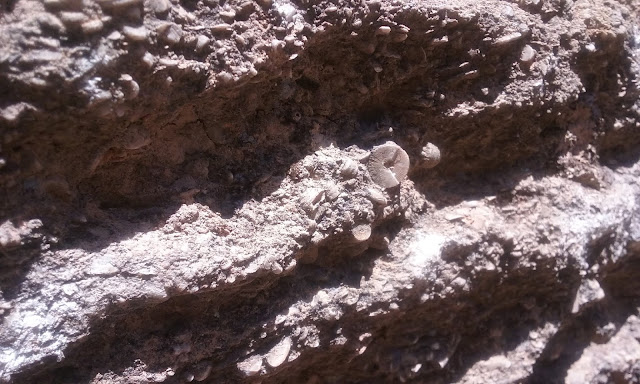
       A post about Arkansas gems, fossils, and rocks is overdue. This crinoid piece is especially well-preserved. Here is a bit more information about crinoids.


     We spent many hours sorting and breaking apart Mississippian and Ordovician rocks. What joy!


Quartz crystals: 


Crinoid stalk or stem pieces:


     This sample was not available to bring home :-(.


But, this brachiopod sample  was: 


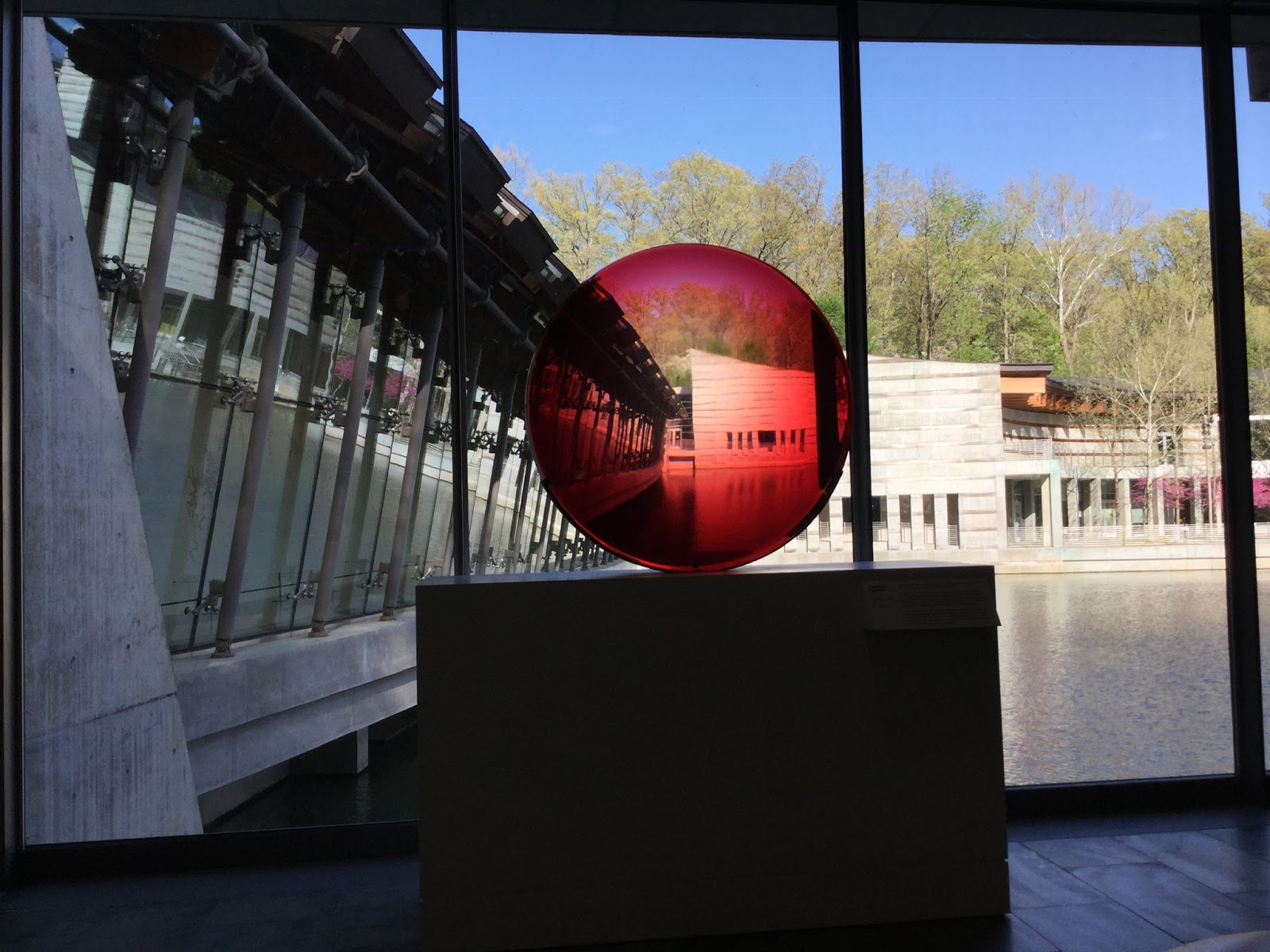
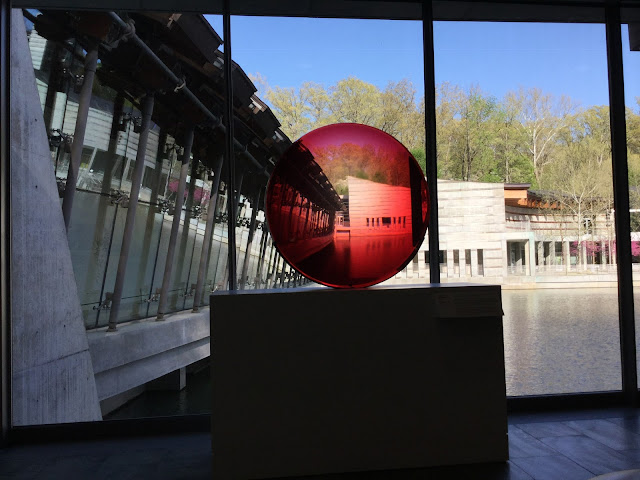
       My Mom, Smith College friend, Karen, and I had a great time exploring northwest Arkansas.We found brachiopods, crinoids, quartz crystals, and explored Crystal Bridges Art Museum, Thorncrown Chapel, the Ozark Folk Center and Blanchard Springs Caverns located in Fifty-Six, AR. Little Rock Central High School was the last stop before dropping Karen at her aunt's home in Hot Springs and heading back to Bentonville.


     We almost missed the road to Thorncrown Chapel, even though we were expressly looking for it. It was worth the trek!


        The outdoor artwork and plantings are some of my favorite parts of Crystal Bridges.


     Pappy and Lightning entertained us at the Ozark State Park Folklore Center.
   

     More highlights:


      Mom and Maizie were big fans of the Frank Lloyd Wright home:


      We enjoyed the geodesic dome:


       Alas! I left my iPad atop my trusty Subaru at one of the last overlooks on the way from Hot Springs to Bentonville. I saw it fly off in the rear view mirror. The photos were not in the cloud. So, a few photos from my friend and from my phone remain. It was most memorable and mom can now answer the question “Why are you going to Arkansas?” with some of these images. 


      Mom liked the half-mile trek through Blanchard Springs Caverns in Fifty-Six, especially.

        And we all really liked the giant bronze spider, Maman, holding her marble eggs protectively over the main entryway at Crystal Bridges.


        [I am writing this on my phone without a 'u' key so the photos will do most of the talking this timaround.]


        Hope you'll have a chance to make Arkansas plans some time. It is The Natural State and it is a Gem!

Steph


Monday, January 1, 2018

2017: 74 Interesting Science, Technology, and Health Links

     Here are 74 interesting science, technology, and health stories in this 2017 year-end article from The Atlantic. Enjoy all the links from how flamingos easily stand on one leg (#2). . .


in formation. . .


to a large waterfall in Antarctica where the Nansen Ice Shelf meets the sea (#19). . .


to the way hummingbirds drink nectar using tongues that are so long that, when retracted, they coil up inside the birds’ heads, around their skulls and eyes (#59). . .


to genetically distinct uptown versus downtown rats in New York City (#60). . .


to the oldest rocks on earth (4 billion years old having fossil traces in them in the Torngat Mountains in Canada (#67) to. . . wherever the links take you.


      Which links were most intriguing for you? Which did you skip past quickly (#13 for me)?

      I'll leave the mole rats and their oxygen needs for you to discover (#74).


All the best for a healthy, happy, and scientifically stimulating 2018!
Steph


Tuesday, May 30, 2017

Track Lighting: Dinosaur "Dance Floor" in Bolivia -- Over 5,500 Footprints


       These late Cretaceous dinosaur footprint fossils on a near-vertical outcrop in Bolivia represent at least 294 different dinosaurs (and, at least 8 species) with over 5,500 footprints.


       The paleontological site, known as Cal Orck'o, is located a few kilometers south of Bolivia's Sucre city center.


       Although, I imagine there was more chasing than dancing on this "Dinosaur Dance Floor," it is an exquisite find, uncovered in 1994, in a cement quarry. Both carnivores and herbivores are represented. This longest set of tracks is over 350 footprints! Parco Cretacio is now open to the public; 68 million years in the making!


     The tracks were likely created by a juvenile Tyrannosaurus rex, nicknamed Johnny Walker ;-).


     And these footprints were likely made by an Iguanodon.


      The extent of dinosaur footprints on over 25,000 square meters is being studied by Christian Myer and Martin Lockley (of Colorado Morrison Dinosaur Ridge footprint fame). The largest prints are 3 feet long.


     Tectonic uplift moved these fossil footprints to a 70 degree plus angle. Pretty wild dance party ;-).

Have you been to see the Bolivian dinosaur footprints? Have you seen dino tracks in the Connecticut River Valley or elsewhere?

Steph


{The Colorado Dinosaur Ridge footprints are quite spectacular, but are not nearly as extensive as the Bolivian tracks.}


Wednesday, June 29, 2016

Mammals Evolved Three Times Faster after Dinosaur Extinction

     Our ancestors evolved three times faster in the 10 million years after the extinction of the dinosaurs than in the previous 80 million years, according to University College of London researchers.


     The research team found the speed of evolution of placental mammals (a group that today includes about 5000 species including humans) was constant before the extinction event but exploded after, resulting in the varied groups of mammals we see today.


     Lead (not lead ;-)) researcher, Dr. Thomas Halliday said: "Our ancestors, the early placental mammals, benefitted from the extinction of non-avian dinosaurs and dwindling numbers of competing groups of mammals. Once the pressure was off, placental mammals suddenly evolved rapidly into new forms."


     "In particular, we found a group called Laurasiatheria quickly increased their body size and ecological diversity, setting them on a path that would result in a modern group containing mammals as diverse as bats, cats, rhinos, whales, cows, pangolins, shrews and hedgehogs."

        Laurasiatheria is a superorder of placental mammals believed to have originated on the northern supercontinent of Laurasia. Thus it was the northern landmasses that produced much of the mammal explosion.


     The team found that the last common ancestor for all placental mammals lived in the late Cretaceous period, about three million years before the non-avian dinosaurs became extinct 66 million years ago. This date is about 20 million years younger than suggestions from previous studies which used molecular data from living mammals and assumed a near-constant rate of evolution.


     In this study the researchers analysed fossils from the Cretaceous to the present day, and used the dates of their occurrence in the fossil record to estimate the timing of divergences based on an updated tree of life. The new tree was released in 2015 and has the largest representation of Paleocene mammals to date.


     The scientists measured all the small changes in the bones and teeth of 904 placental fossils and mapped the anatomical differences between species on the tree of life. From measuring the number of character changes over time for each branch, they found the average rate of evolution for early placental mammals both before and after the dinosaur extinction event. They compared the average rate of evolution over the geological stages before the extinction and the geological stages after to see what impact it had.


     Senior author, Professor Anjali Goswami said, "Our findings refute those of other studies which overlooked the fossils of placental mammals present around the last mass extinction. Using rigorous methods, we've successfully tracked the evolution of early placental mammals and reconstructed how it changed over time. While the rate differed between species, we see a clear and massive spike in the rates of evolution right after the dinosaurs become extinct, suggesting our ancestors greatly benefitted from the demise of the dinosaurs. The huge impact of the dinosaur extinction on the evolution of our ancestors really shows how important this event was in shaping the modern world."


      Professor Paul Upchurch, co-author of the study, added: "Our large and refined data set allows us to build a clearer picture of evolutionary history. We plan on using it to study other large-scale evolutionary patterns such as how early placental mammals dispersed across the continents via land bridges that no longer exist today."


       I'd like to take that land bridge from South America to Africa in the southern land masses of Gondwanaland. 

      How about you? Does "Reunite Gondwanaland!" ring true to you?

Steph

Tuesday, December 16, 2014

Clam to Clam: "Don't Make Me Put My Foot Down!" or "Bivalve, Will Travel"

          Part of today's True North map looked like an open clamshell:


          [Maizie and I have been putting in extra semi-circular walks gearing up for watching a friend's energetic dog over Solstice-Christmas.]


          And then, just like that, the tide and other things nautical, such as puns, came in: "Don't make me put my foot down!" 

           These molluscs were likely quite similar to the clams which first appeared 510 million years ago during the Cambrian period.


            Some clams were opalized (or replaced with hydrated silica), as in these particularly magnificent Australian specimens:


                 The gemmy clams and other molluscs are full of fire, 


though, lately, I've been thinking of having a few of these ON the fire:


          Hmmmm, an ocean trip with some clammy companions?! That's my idea of steamy ;-). Would enjoy your clam tales of any sort. I am putting my foot down about putting my feet up. . .


Clamming up now (it's almost Wednesday here),

Steph