Total Pageviews

Showing posts with label puddingstones. Show all posts

Tuesday, June 17, 2014

The "Proof" is in the Puddingstone: Theories are Malleable, but not Infinitely So


     This post is dedicated to my Smith geologist friend, Dot, on her birthday. We surely enjoyed many a puddingstone outcrop in New England! Here is a thin section of the Roxbury Conglomerate, informally known as the Roxbury puddingstone: 


Last fall's puddingstone post remains the most popular at PEOTS so a tangential revisit to these conglomerates is in order:


     The article linked below discusses proof (but not necessarily in the puddingstone) and theory as being two of the most misunderstood and misused words regarding science:

MISUSED SCIENTIFIC WORDS: FROM THEORY TO PROOF TO ORGANIC

      It's a good list. Ten items is a reasonable number to absorb--like the 10 items at the fast line at the grocery store or David Letterman's top 10 list. It's a catchy way to get the general public thinking about scientific vocabulary. It's not perfect but it'll do.

      I'd like to focus on the first two words, proof and theory, but the other eight words/phrases are worth a look also.

      The phrase "Theories are malleable, but not infinitely so" resonated with me. We know plate tectonics is essentially the way features on the earth's surface are formed, but it is the constant refining and sculpting with more and more data that makes the theory malleable and testable (since Alfred Wegner proposed it in 1939). The defining characteristic of all scientific knowledge, including theories, is the ability to make falsifiable or testable predictions (as we've discussed earlier).
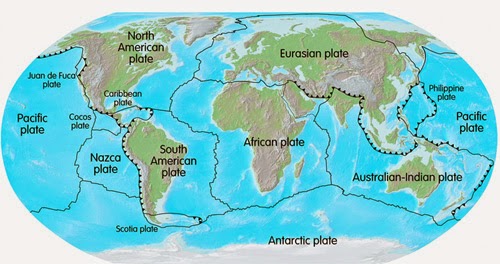


       "The fact that science never really proves anything, but simply creates more and more reliable and comprehensive theories of the world that nevertheless are always subject to update and improvement, is one of the key aspects of why science is so successful." We don't really "prove" things. We refine, bolster, add to a mountain of evidence. . .but scientific proof is different from that "proof is in the pudding(stone)." We can't taste the fruits of our research and get the "proof" as we can in cooking.

     The hot, steamy cooking of the earth like this Fly Geyser in Nevada, remains part of the theory of plate tectonics. We just can't consume it or prove it:


     Do any of the top ten words resonate with you?

Here's to another great trip around the sun,

Steph (Word Woman)

Tuesday, November 12, 2013

Puddingstones: Plum Wonderful!

Puddingstones: Plum Wonderful Stones filled with "Berries & Currants" of Jasper & other Pebbles


     For some reason, all sorts of stones have been on my mind the past few weeks, including the wonderful Michigan puddingstones pictured above. Their name comes from the resemblance to English suet or pudding filled with berries and currants, and, well, they do look good enough to eat!

      Puddingstone, or  plum-pudding stone, is the name given to conglomerates (of different origins, compositions, and locations) that consists of distinctly rounded pebbles whose colors (in this case, Jasper chalcedony red) contrast greatly with the color of the finer-grained matrix (or cement) surrounding the pebbles. The Michigan puddingstones pictured above are likely associated with glacial activity of fairly recent origin.

     In contrast, I cut my geologic teeth in the Northampton and Boston, Massachusetts, area where we drove miles and miles from little scraps of outcrops to other little scraps of outcrops to look at the Roxsbury Conglomerate of the Boston Basin:


     Originally thought to be associated with shallow river and lake basins, the prevailing hypothesis is that these puddingstones or conglomerates are associated with very deep marine basins in a suite of rocks known as turbidites, associated with deep-sea submarine fans. They are also much, much older (and they look it!), dating from 570 to 595 million years ago.

      There are other puddingstones, such as the Hertfordshire Conglomerate in merry old England :


     And the Jelly Bean Conglomerate of Arizona and the western United States:


      I had the good fortune of attending geologic field camp in Arizona where we could see the Jelly Bean comglomerate stretching out for long distances (no driving needed, it was strictly a walk in the geologic park).

      Naming stones or rock formations based on their similarities to foods we eat is decidedly more fun than the geologic convention of naming formations based on the locale where they were first discovered. It is a sense of whimsy I shared with Robert W. Hickman, my first geologist boss, amazing teacher, and good friend. I am also writing Bob's eulogy today. Bob would have enjoyed this:


     Thanks for all you comments and suggestions. I look forward to a bit of puddingstone discussion with you. If you don't eat your meat, you can't have any pudding (Pink Floyd), but you may surely have some puddingstones.

Dessertedly,

Word Woman (aka Scientific Steph)