Total Pageviews

Showing posts with label dinosaurs. Show all posts

Tuesday, May 30, 2017

Track Lighting: Dinosaur "Dance Floor" in Bolivia -- Over 5,500 Footprints


       These late Cretaceous dinosaur footprint fossils on a near-vertical outcrop in Bolivia represent at least 294 different dinosaurs (and, at least 8 species) with over 5,500 footprints.


       The paleontological site, known as Cal Orck'o, is located a few kilometers south of Bolivia's Sucre city center.


       Although, I imagine there was more chasing than dancing on this "Dinosaur Dance Floor," it is an exquisite find, uncovered in 1994, in a cement quarry. Both carnivores and herbivores are represented. This longest set of tracks is over 350 footprints! Parco Cretacio is now open to the public; 68 million years in the making!


     The tracks were likely created by a juvenile Tyrannosaurus rex, nicknamed Johnny Walker ;-).


     And these footprints were likely made by an Iguanodon.


      The extent of dinosaur footprints on over 25,000 square meters is being studied by Christian Myer and Martin Lockley (of Colorado Morrison Dinosaur Ridge footprint fame). The largest prints are 3 feet long.


     Tectonic uplift moved these fossil footprints to a 70 degree plus angle. Pretty wild dance party ;-).

Have you been to see the Bolivian dinosaur footprints? Have you seen dino tracks in the Connecticut River Valley or elsewhere?

Steph


{The Colorado Dinosaur Ridge footprints are quite spectacular, but are not nearly as extensive as the Bolivian tracks.}


Tuesday, January 3, 2017

Clutch Problem: Dinosaur Hatchlings Took Too Long to Incubate

     The mystery of why the dinosaurs became extinct after a Cretaceous meteor strike, while birds and mammals thrived, may have been solved.


     Paleontologists have discovered that dinosaur young took so long to hatch and mature into adulthood that populations failed to recover quickly enough after the devastating impact 65 million years ago.


     In contrast, birds and small mammals took only a few weeks for their offspring to emerge giving them a distinct advantage.


     The discovery was made by researchers at Florida State University and the University of Calgary, who realized it was possible to calculate how long it took for dinosaurs to hatch based on marks on the teeth of embryos and babies.


     Similar to tree rings growing a new layer each year, teeth grow a new layer each day, which is seen in microscopic lines in the dentine. By counting the daily lines of Von Ebner, scientists found it took dinosaurs between three and six months to hatch.


     The lengthy incubation period in the clutches of dinosaur eggs, in comparison to small mammals, made the hatchlings, and their parents, vulnerable to predators and left them struggling to re-establish their species.


     “Some of the greatest enigmas about dinosaurs pertain to their embryology; virtually nothing is known,” Dr. Gregory Erickson of FSU said. “We suspect our findings have implications for understanding why dinosaurs went extinct at the end of the Cretaceous period, whereas amphibians, birds, mammals and other reptiles made it through and prospered.” 


     Because birds are in the same clade with dinosaurs, scientists have long assumed that the duration of dinosaur incubation was similar to birds, whose eggs hatch within 11 to 85 days.


     However, similar-sized reptilian eggs typically take twice as long to hatch, ranging from several weeks to many months. To find out where dinosaurs fit in, the team studied the fossils of dinosaur embryos.


     “Time within the egg is a crucial part of development, but this earliest growth stage is poorly known because dinosaur embryos are rare,” said Dr. Darla Zelenitsky of the U of Calgary. “Embryos can potentially tell us how dinosaurs developed and grew very early on in life and if they are more similar to birds or reptiles in these respects.”


     The two types of dinosaur embryos researchers examined were those from a Protoceratops, (seen below) a goat-sized dinosaur found in the Gobi Desert of Mongolia whose eggs were chicken-egg-sized and Hypacrosaurus, a gigantic duck-billed dinosaur found in Alberta, Canada, with eggs weighing 4 kilograms (9 pounds.)


      The researchers ran the embryonic jaws through a CT scanner to visualize the forming dentition. Then, they extracted several of the teeth to examine with a Scanning Electron Microscope (SEM).


     Their results showed nearly three months incubation for the small Protoceratops embryos and six months for the embryos from the giant Hypacrosaurus (below).


       Dental battery (the complex set of six-layered dinosaur teeth including replacement teeth) and von Ebner lines in fossil dinosaur teeth were first observed and illustrated over 150 years ago by Richard Owen (shown below), the scientist who coined the term Dinosauria or "Terrible Lizard."


      I wonder if Dr. Owen would have given his eye teeth to change that moniker to Dinopoulia, Greek for "Terrible Bird."


It's Clutch Time, in more ways than one!
Steph


Tuesday, June 17, 2014

The "Proof" is in the Puddingstone: Theories are Malleable, but not Infinitely So


     This post is dedicated to my Smith geologist friend, Dot, on her birthday. We surely enjoyed many a puddingstone outcrop in New England! Here is a thin section of the Roxbury Conglomerate, informally known as the Roxbury puddingstone: 


Last fall's puddingstone post remains the most popular at PEOTS so a tangential revisit to these conglomerates is in order:


     The article linked below discusses proof (but not necessarily in the puddingstone) and theory as being two of the most misunderstood and misused words regarding science:

MISUSED SCIENTIFIC WORDS: FROM THEORY TO PROOF TO ORGANIC

      It's a good list. Ten items is a reasonable number to absorb--like the 10 items at the fast line at the grocery store or David Letterman's top 10 list. It's a catchy way to get the general public thinking about scientific vocabulary. It's not perfect but it'll do.

      I'd like to focus on the first two words, proof and theory, but the other eight words/phrases are worth a look also.

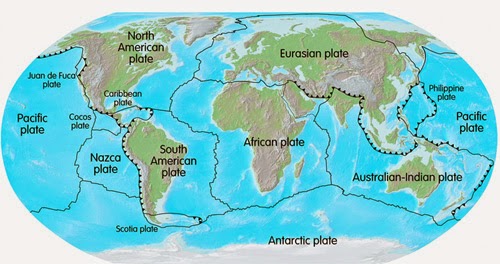
      The phrase "Theories are malleable, but not infinitely so" resonated with me. We know plate tectonics is essentially the way features on the earth's surface are formed, but it is the constant refining and sculpting with more and more data that makes the theory malleable and testable (since Alfred Wegner proposed it in 1939). The defining characteristic of all scientific knowledge, including theories, is the ability to make falsifiable or testable predictions (as we've discussed earlier).


       "The fact that science never really proves anything, but simply creates more and more reliable and comprehensive theories of the world that nevertheless are always subject to update and improvement, is one of the key aspects of why science is so successful." We don't really "prove" things. We refine, bolster, add to a mountain of evidence. . .but scientific proof is different from that "proof is in the pudding(stone)." We can't taste the fruits of our research and get the "proof" as we can in cooking.

     The hot, steamy cooking of the earth like this Fly Geyser in Nevada, remains part of the theory of plate tectonics. We just can't consume it or prove it:


     Do any of the top ten words resonate with you?

Here's to another great trip around the sun,

Steph (Word Woman)

Tuesday, November 19, 2013

Cheese Imitates Geology: Thin Vegetable Ash Layer and Thin Iridium-rich Clay Layer

Cheese Imitates Geology: Thin Vegetable Ash Layer and Thin Iridium-Rich Clay Layer


      There is a small, wicker cheese basket at my local grocery store filled with little snippets of cheeses--the ends of various imported wheels and logs. This one caught my eye:


          I unwrapped it last night and found this written on the wrapper (just so you know I'm not making this up):


     A hairline layer of vegetable ash?! Oh my. 

     Of course, the iridium-rich clay layer found at the boundary of the Cretaceous period (about 65 million years ago) with the overlying Paleogene sediments first documented by Luis and Walter Alvarez (shown below) in Italy, sprang to mind. The limestone layers beneath the red clay are full of numerous species of foraminifera (forams) and the thick limestone beds above contain only one foram species. In between is this iridium-rich later of clay. In Italy. In Germany. In the Netherlands. In the U.S. All over the world.


      Iridium is a rare, silvery, white transition metal of the platinum family found in meteorites. It was named for the Greek goddess Iris after the rainbow colors in its salts and less than 3 tons a year are mined world-wide:


     Iridium is associated with the massive K-Pg extinction including the non-flying dinosaurs and a huge, diverse, plant population. (The boundary was called the K-T boundary for Cretaceous-Tertiary when the Alvarezes discovered it. The International Stratigraphic Nomenclature Committee has recently deprecated the Tertiary Period though; it now must be called Paleogene.) [First Pluto is no longer a planet; now we can't call it the K-T boundary any more. Sigh...]  And the likely location of the meteorite hitting the earth in the Gulf of Mexico is also well documented.

       What strikes me (no pun intended, okay, maybe...) about naming conventions in geology and in all areas, actually, is the creativity and force in coming up with these descriptive terms. As Clementine says to Joel when talking about her newest hair color in the film Eternal Sunshine Sunshine of the Spotless Mind, "Naming hair colors. Somebody has that job. I want that job!"


        Calling the thin layer of vegetables in the Humboldt Fog Cheese "Vegetable Ash" is truly inspired to this geologist and cheese eater.

         Last week: puddingstones that look like pudding. This week: Cheese that looks like limestone layers with a hairline layer of ash. It doesn't get much better than that full circle.

        Thanks for reading. I look forward to your comments, thoughts, and cheesy ideas.


Until then, "say cheese!" (And mean it).

Humboldtly yours,
Word Woman (aka Scientific "Vegetable Ash Layer" Steph) 


Tuesday, October 22, 2013

SHOW, not tell; Bird and Dinosaur chromosomes; and To(o) funny

         SHOW, not tell; Bird and Dinosaur chromosomes; and To(o) funny


    NPR's Science Friday discusses the art of displaying data in a user friendly and fascinating way in the article "Show, not Tell." The "infographic age" is here.


     http://sciencefriday.com/blogs/10/18/2013/show-not-tell-the-rise-of-the-infographic.html?series=20


     Above, New York's carbon emissions are shown in real time. Clear, dramatic, understandable: data you can sweep right up ;-). 

     And 85 dog breeds are shown below based on four categories of herder, hunter, mastiff-like or wolf-like. Showing large amounts of data in a way that is quickly understandable has moved leaps and bounds from bar graph and pie chart days.


      On Fridays I leave the fascinating world of oil and gas and environmental geology for a few hours to work with 14 brilliant kindergarteners doing hands-on science. We made giant dinosaur nests and edible coconut bird nests and talked about clades. We made our own infographics last week showing bird and dinosaurs differing by a chromosome (simplified but effective as the kids ran around on the playground after looking at the chromosome bracelets saying "You're a bird!" or "You're a dinosaur!")


      If a had a really good infographic person I'd make these data into a fascinating SHOW:

 Organism                                   Number of Chromosomes


  Adder's Tongue (plant)                                   1260              
  Dogs                                                               78               
  Cats                                                                38               
  Birds                                                               78 - 80              
  Humans                                                           46               


    ...And tell you that none of the kids were at all concerned that the plant has so many chromosomes and that, (whew!) no one asked HOW the mom gives the X chromosome to her kid or the dad gives the X or Y to his kid.

       The kids in kindergarten don't do show and tell any more. They just DO.

       And finally, I believe I will need to sign off now. I am on a quest to find funny:


As always (4 whole weeks!), I enjoy hearing from you.

On the Quest,

Word Woman (aka Scientific Steph)

Tuesday, October 1, 2013

Welcome to Partial Ellipsis of the Sun...

               Welcome to Partial Ellipsis of the Sun! 


Hello fellow scientists, writers, countrymen and countrywomen, lend me your years…years of experience of enjoyment of both science and writing. Both sides of your brain are…well, developed. :-)

You are the geologist who offers to write the reports accompanying exploration proposals because the proposed solution to the puzzle without commentary is only half of the story. You know that yes, a picture is worth a thousand words, but if you place well a mere seven words and just a comma or ellipsis, it can tell a remarkable story. 

You are the writer fascinated by every new development and discovery. Plate tectonics, older bristlecone pines, clades, dinosaurs with feathers discovered in China send you into orbit—perhaps to a partial ellipsis of the sun…Yes, ellipsis, eclipse, it’s all part of the story…

 I welcome your ideas for topics and commentary. I welcome input on how to make a blog fun and lively. I even welcome different ideas for the name (I’m not married to it)…Maybe just a tad too obscure? 

Next up: Volkswagen Bus to Smiley Face to Rubik’s Cube to Cell Phones to iPods to Smart Phones: What is wrong/right with this progression of decade avatars from the 1960’s to the 2010’s?! 

 I hope to post on Tuesdays. We’ll see how it goes. Happy belated National Punctuation Day…and Happy October! What an amazing month in which to launch a blog! 

Thanks for checking in… 

Word Woman (aka Scientific Steph)