Total Pageviews

Showing posts with label red. Show all posts

Thursday, October 13, 2016

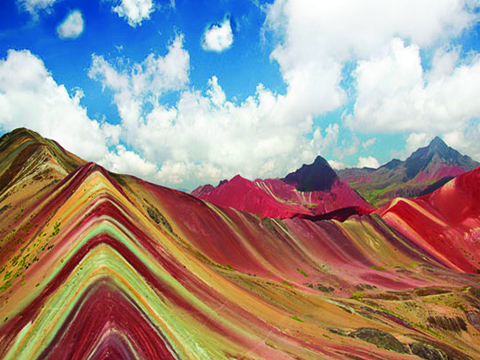
Vinicunca Rainbow Mountain in the Andes of Peru: Dr. Seussian Stripes

      The "Rainbow in the Mountain" of Vinicunca in the Andes in Peru is so remote, it is hard to locate on Peruvian maps. Vinicunca doesn't yet have a Wikipedia page (as of today). But, the rainbow will blow you away.


       Located in a remote part of the Andes, somewhere near Cusco, (or Cuzco), Peru, the magical sedimentary layers appear unreal.


      I looked at a few blogs and guided trips to convince myself it really is real.


 From the little geologic research I could find about the area, the Permian formations with their distinct colors of red, ochre, and turquoise sandstones and (possibly) overlying Cretaceous, limestone layers create a wondrous landscape for alpaca, llamas, and horses.


The herding communities in the region constitutes one of the few remaining pastoralist societies in the world. High mountain trails are used by these herders to trade with agricultural communities at lower elevations.


I will see if I can locate the Rainbow Mountain of Vinicunca on Google Earth in the morning. 


Have a go if you'd like!

{It's been a long day. The state of emergency declared in Ethiopia means Zoƫ will likely be coming stateside in the next 30 days. We just don't know when.}

One more look at the Seussical stripes of Rainbow Mountain in Peru!


Steph

Update: Google Earth view of Rainbow Mountain or Vinicunca


Tuesday, November 17, 2015

Red Ember Mine in Massachusetts: "Gar"-net Almandine Versus Trout Almondine

     Red Ember Mine garnets were discovered in the last six years in the town of Erving in Franklin County in western Massachusetts.


     The spectacular gems are highlighted and backlit in the surrounding black graphite matrix in the above image. Without the backlighting they appear more purplish in color:


         Garnets are a group of nesosilicate minerals that are used both as gemstones and as abrasives. The 6 different types of garnets are pyrope, almandine, spessartine, grossular, uvarovite and andradite. The Red Ember Mine garnets are primarily almandine (hence "gar" (the fish) net almandine.) No, no fishnets are involved. ;-)


      The first three garnet types are in one solid solution series and the last three are in another. Neither series is associated with trout almondine :-).


      The word garnet is derived from its color. The deep red color of some garnets reminded the French of a red-skinned fruit. In early French, the fruit was called pomme grenate or "seedy apple." This later became pomegranate in English.


      The early French word grenate, meaning "seedy," is the source of the adjective grenat, meaning "red like a pomegranate." This word was then used as a noun to refer to the deep-red gemstone. When transferred into English, grenat became garnet. 

         As we've discussed here at PEOTS before, color is not a reliable mineral characteristic. Garnet actually occurs in a variety of colors from red to orange to yellow to green to indigo to violet. Blue garnets are extremely rare and tend toward indigo:


             A black to gray graphite matrix for garnets, as in western Massachusetts, 


shows off the garnets extraordinarily:


       Have you seen garnets in colors other than pomegranate? Or, perhaps, have you seen the Red Ember Mine garnets? I sense another field trip in our future. . .

        And here's an image of the "Subway Garnet" (or whatever you'd like to call it) found in Manhattan, NYC, and housed at the American Museum of Natural History:


Emberly yours,
Steph


P.S. Speaking of field trips, here are a few images of cryptobiotic soil from David in Utah as well as one bodacious cairn:


And multiple multiple cairns:


Tuesday, November 18, 2014

Biogeography: From Penguin Rovers to Declining Polar Bears

  1.            Biogeography is the study of the distribution of species and ecosystems in geographic space and through geological time. Organisms generally vary along geographic gradients of latitude, elevation, isolation and habitat. Incorporating the theory of plate tectonics and fossil evidence helps explain both similar and dissimilar flora and fauna.
  1.             Biogeography helps explain why penguins are found in the Antarctic and polar bears are found in the Arctic. But what explains this emperor penguin decoy rover?!


       This National Geographic article about sending in penguin rovers describes the lower stress the penguins exhibit at having a cute penguin rover rather than a human collect data.


         Emperor penguins are quite shy so studying them by sending in humans tends to raise anxiety levels and heart rates when researchers step in to study the penguins and climate change. 

         Back to biogeography: the location of penguins in the southern hemisphere is correlated with those areas being connected through geologic time:


         Likewise, polar bears' habitats in the northern hemisphere are correlated with areas which were once or are currently connected tectonically. 


     The location of the continents as one super landmass known as Pangaea up until about 200 my ago is illustrated here:


        Then, about 200 million years ago, Laurasia drifted northward from Gondwanaland (surely you've seen "Reunite Gondwanaland!" tee-shirts):


           Polar bears' decline by almost 50 percent in research presented this week doesn't include rolling or swimming polar bear rovers. It does show alarming drops in the polar bear population due to thinning sea ice and concomitant inability to hunt for seals, a key part of their diet.


      This article from Brown University ties together clade and cladograms and Biogeography


      Still scratching my head about alligator distribution in the southeastern U.S. and easternmost China (as discussed briefly last week). The time frame of alligator distribution only from Pleistocene to Recent likely explains part of it. But part is still a mystery.

         Red rover, red rover, let the alligators come over and explain their distribution.
Biogeographically,
Steph

           P.S. My friend, Cat, so adores penguins her personal email address includes gentoo. She and I were in the same plate tectonics class senior year at Smith so we go back tectonically as well as penguinally. Cat, this one is for you! 
           The transformation gets me every time. . .