Total Pageviews

Tuesday, January 28, 2014

Petrographic Thin Sections, Deadlines, and Nature's Stained Glass


     Deciding on this week's Partial Ellipsis of the Sun topic was harder than usual. The genetically modified organisms (GMOs) we saw on the western side of Kaua'i, guarded by several people, trucks and barbed wire, was an option. I decided that topic needed more research than driving past miles of corn (in various developmental stages) where sugar cane and pineapples used to grow ten years ago and reading a few articles. I will also read Frankenstein's Cat: Cuddling up to Biotech's Brave New Beasts by Emily Anthes before addressing this topic. (Great suggestion, Jan).

     So...deadlines to deadliness :-), on this Tuesday I decided to write about petrographic thin sections because they are something I know and they are amazing beautiful.

      Here's a piece of olivine, a magnesium iron silicate (called peridot when of gem quality):


     Amazingly beautiful, right? How about cutting a nice, clean, thin slice of this and attaching it to a glass slide. And then, how about looking at this thin slice of rock (or thin section) under a petrographic microscope? Still not impressed?


      Well, how about under crossed Nicols filters (see below) under a petrographic microscope, in thin section?


      The  two polarizing filters on a petrographic microscope work similarly to polarizing sunglasses. Each filter allows light vibrating at one particular orientation to pass through. One of the two filters is fixed. The other can be moved in and out of the light path. That filter's  polarizing direction is perpendicular to the fixed filter. 

      If you put a thin section of a rock in between the two polarizing filters (referred to as looking at the section under "crossed Nicols") it creates the stunningly beautiful portraits we see above of olivine and below of  zircon: 


     The uncrossed filter photograph of zircon, a nesosilicate, is below:


       Here's one more crossed Nicols thin section of basalt, a fast-cooling, fine-grained volcanic rock from Thailand with two large spectacular olivine crystals in the center.


       And, for completeness, a sample of basalt:


           I will end this week's illustration-rich blog with a photo of one of my favorite thin sections of gabbro, coarser-grained (i.e. slower cooling), intrusive igneous rock found near mid-oceanic rift zones (under crossed Nicols):


         The brightly colored orthopyroxene crystals are surrounded by striped plagioclase feldspar. Slower cooling produces some amazing crystals.

          Stained glass: made by nature.

          Enjoy! Next stop, a field trip to Iceland to see the mid-Atlantic ocean ridge on land to see that basalt and gabbro up close!


Petrographically yours,

Word Woman (Scientific Steph)


Tuesday, January 21, 2014

Fossilized Jurassic Spiders, Other Chelicerata, and Impractical Jokes


     Two weeks ago the horseshoe crab, a marine arthropod, was the topic of Partial Ellipsis of the Sun. This week, another member of the Chelicerata, the spider,  will be the focus.

      Besides the smooth transition from one arthropod to another, I was entranced by this recent large spider discovery from fine volcanic ash beds in Daohugou, China (in Inner Mongolia):


      The giant Jurassic (201-145 million years ago) male spider's body length is 1.65 centimeters long, and its first leg length is 5.82 centimeters, the largest fossilized spider found to date (as of January 8, 2014).  It was significantly different, according to researchers from the University of Kansas, from the female of the species, Nephila jurassica, to warrant an entirely new genus and family. Lots of room for discussion there! :-)

      The researchers believe that this male spider is one of the first orbweaver spiders after a detailed look at foot claws, hairs and genital organs, using a Scanning Electron Microsope (SEM). 

       The full article featuring Paul Selden of the U of Kansas is linked here:

                                     GIANT JURASSIC SPIDER IN VOLCANIC ASH

      So, how to get to impractical jokes from this giant Jurassic spider? Via the Jumping Spider, of course:


     Jumping spiders make up 13 percent of the entire air-breathing chelicerates. While the marine horseshoe crabs rely on external fertilization, air-breathing spiders use internal (but usually indirect) fertilization. 

      The jumping spider is likely the closest to what I was like after a very impractical joke involving the Jurassic time period.

       I worked on an extensive project using aerial photography and Landsat imagery for one of our biggest clients, Amoco Oil Corporation. I wrote a very detailed 200-page, single-spaced, report on the geologic basin (in the days where we had secretaries to type everything from scratch, no computers of course, and no global replace feature).


       The President of our company, Chuck, called me in one day and showed me a letter, written on very fancy, thicker-than-regular-paper AMOCO Oil Company letterhead. It was addressed to him and said something like: "On page 143 of your report we have just received, I see that Jurassic is misspelled as Jurrassic. Jurassic does not have two r's in it. I cannot believe such unprofessional work is coming to us from your company."

       I was a bit concerned, as a newly-minted 23-year-old geologist.

       "What should we do about this, Steph?" asked my boss, looking very serious. "Termination?"  

       It was only then that I heard the crowd of geologists laughing outside Chuck's door. One of my fellow geologist's girlfriend had gotten the AMOCO stationery from her work there and helped with the elaborate impractical joke.

       Jumping Spider indeed!


        How about you? What are some of the best practical or impractical jokes ever played on you? Did any of them involve words, spiders, or other arachnids?

Jurassically Yours,

Word Woman (Scientific Steph)


Tuesday, January 14, 2014

Kaua'i, Okina, A'a

     Aloha from Hanalei Bay in Kaua'i.

     Due to technical difficulties, Partial Ellipsis of the Sun will be taking the week off.

     There were wonderful things about the okina (the unicameral glottal stop of a "backward apostrophe"), the original unicase or unicameral Hawaiian language (ron, jan---you were made for Hawaiian), and the a'a lava here... but my iPad is not cooperating and will only work in HTML mode. Also, I've been swimming with large sea turtles, fish and eels and need to get back there for the afternoon Anini swim ;-).

     However, there is an interesting NPR story link on the first land-walking fish, Tikaalik (which does incorporate that a'a). :

http://www.npr.org/blogs/thetwo-way/2014/01/14/262464764/first-land-walking-fish-looks-like-it-had-all-wheel-drive?utm_content=socialflow&utm_campaign=nprfacebook&utm_source=npr&utm_medium=facebook


    Until next week, I shall try to embed a few photographs here. We'll see how it goes.


                                                           Hanalei Bay "downtown" 


                                                              Hibiscus flower


                                                           Anini (not Wanini) Beach


                                                   Hanalei Bay, dragon head to tail...


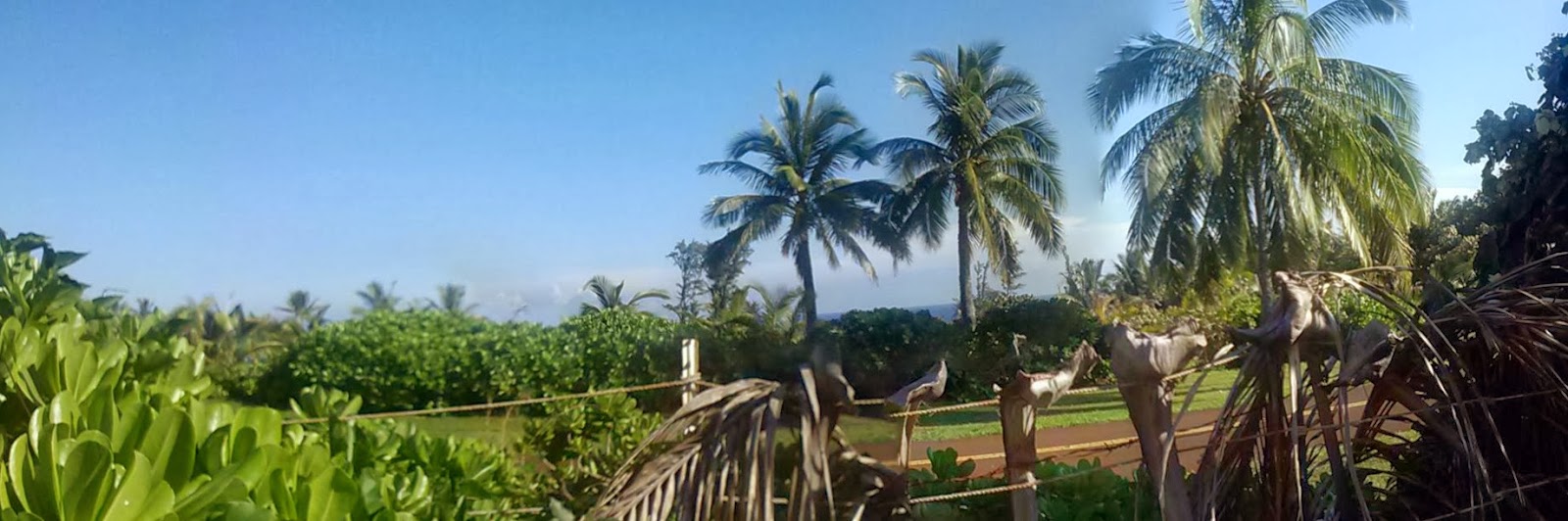
                                                                  Palm trees, of course


   View from our lanai. . .


  And, lastly, wild roosters everywhere on the island:


Mahalo,

Word Woman (Scientific Steph)

Tuesday, January 7, 2014

Blue-blooded Horseshoe Crabs, Hemocyanin, and Kenneth Marshall Gordon


     The blood of horseshoe crabs (as well as cuttlefish, squid, lobster, and a variety of other marine animals) contains hemocyanin, which is copper-based, rather than hemoglobin, which is iron-based. They are the blue-bloods of the animal kingdom and their blood has amazing anti-bacterial properties. The blood sloshes around in their bodies, rather than being carried in veins and arteries.


        And their blood has powerful acti-bacterial properties that release a mass of blood-clotting granules that instantaneously clot to seal out the bad bacteria, preventing further infection. It is so valuable that pharmaceutical companies are harvesting the horse shoe crabs, removing some of their blood,


and then returning them to the sea. The link to the full NPR article (including a video of the process) is here: 


http://www.npr.org/blogs/krulwich/2012/05/31/154095868/what-the-vampire-said-to-the-horseshoe-crab-your-blood-is-blue
 

     Paleontologist Richard Fortey describes the 450,000,000-year-old creatures as being akin to a Volkswagen Beetle:
 
"I saw a damaged horseshoe crab still trundling gamely onwards, even with a great hole punched right though its head. Looking over the beach more carefully, I noticed a lot of these war veterans; lumps out of the thorax, broken tail spikes — clearly, it must take a lot to finish these creatures off."


      Indeed, the amazing blue-blood properties of these relatives of trilobites are what have likely kept the horseshoe crab around for so many millions of years. They have lasted through the massive extinctions at the end of the Paleozoic, Mesozoic, and Cenozoic eras when massive extinctions wiped out large, sweeping amounts of their cousins.

       I don't have a wonderful segue to this next portion. We are all still a bit in shock here in Colorado about Ken Gordon's death last month.

       Today was the memorial service for Kenneth Marshall Gordon, one of Colorado's most respected members of the Colorado House for 8 years and then the Senate for another 8 years. 


     Ken was our neighbor when he first ran in Colorado in 1992 and my son and I put up yard signs for him. Ken introduced my then three-year-old son to then Governor Romer. Ken took no PAC money--ever. He was respected, well-liked, and he listened to everyone. He believed in the power of every voice. The Temple was packed with over 500 people from both sides of the political aisle, with friends, family, and our current Governor Hickenlooper. Ken was one of the really, really good guys.

     I learned at the service today that Ken was from a somewhat "blue-blood" Michigan family but that he preferred to make his own way, working long hours in a meat-packing plant, before he became a lawyer. He did not want help from his family. And, sadly, rather than asking his family for help to get medical care, he drove himself to the local hospital and died, of a massive heart attack, in the parking lot. Ken was 63 years old.

      This is the way I'll remember Ken--out there walking, like the horseshoe crabs. Ken walked across the state of Colorado in support of referenda for education.  If only he'd had the staying power of the horseshoe crab to be able to work more on his life's work, to love and be a loved a little more...and to walk a little further.


And the walking man walks (James Taylor),

Word Woman (aka Scientific Steph)


Tuesday, December 31, 2013

Into Every Life A Little Fertile Bird Poop Must Fall. . .

      A bird let loose a fine, fertile mixture of urine and feces from its cloaca onto my head on Christmas Day. Yes, a bird pooped on me.

       I expect my face looked similar to this house finch:


      The Italian (and other cultures') superstitions of a bird pooping on you being good luck is even mentioned in the Cornell Lab of Ornithology Web page:
 
"Flying Poop"

"Q: I have been asked to find out if Canada Geese, um, poop while they fly. I'm sure you have more important issues, but this is very important to the seven-year-old who goes to the driving range with me.

A: Birds are certainly capable of pooping while flying. They often poop just before taking off, perhaps to lighten their load. Although this might not reassure your seven-year-old, you might also mention that in some cultures people believe that is very good luck to be hit by bird poop."

       Having been through the experience of being "one in a million," I can tell you it sure doesn't feel so lucky, being a ways from home on a sunny Colorado day. . .as I passed fellow merry, well-wishing, chatty walkers with black-gray goo running from my hair down the side of my face. But, with a shower and some retrospective, I do realize how lucky I am. A friend reassured me with this photo of an egret (look at those ruffled neck feathers ;-)) and a nice landing:


     I am especially lucky because this is the second time I have been pooped on.The first was outside an Italian (maybe the birds knew?)  restaurant in downtown Denver. We stood outside the restaurant looking at the menu posted on the exterior wall when, sure enough, a pigeon let loose on my head and clothing. When I went into the restaurant to get cleaned up, the waiter laughed and said "Oh, yeah, they do it all the time with people standing there looking at the menu." Ha! Funniest Home Videos for Birds. I did think I heard the other pigeons cavorting afterward. It's good to know they have a sense of humor.

     I am also lucky and grateful for family, friends, fellow bloggers, and National Public Radio (and for the serial comma). The recent Science Friday rebroadcast on Temple Grandin, the autism spectrum, and her description of seeing life in pictures rather in words (as she proposes animals also do) struck me (post the recent avian experience):


      With the recent advent of increasing photographs and images on social media (Facebook, Instagram, SnapChat, and the like), we are all seeing life in more and more pictures. Though, being such a word lover, I truly hope we never go completely to a world of all images. What would I do with these thousand words I have stored up ready to go? All the puns waiting to be launched?

       Wishing you all a happy, safe, fertile year for 2014. The Christmas bird has deposited lots of seeds for blog topics for 2014 (the milky blue blood of horseshoe crabs, squid, and cuttlefish, "expanding" chickadee brains, as well as trilobite eyes and modern photography). Here's a preview of a majestic trilobite eye:


     Are there other topics that Partial Ellipsis of the Sun (PEOTS) might explore next year? I look forward to your ideas, suggestions, and seeds of thought. And, thanks for swooping on by.

Fertile Crescently,

 Word Woman (Scientific Steph)


Monday, December 23, 2013

In the Mobius Strip of Life, A Little Twist is Needed


     This is Math Month with 14 brilliant kindergarteners. We've gone from Fibonacci Numbers to Golden Spirals to Mobius Strips. The kids watched the following jaw-dropping, 3-minute video linking a Mobius Strip to the music of J. S. Bach:


     They watched the Jos Leys video transfixed. I heard more than one soft "Whoa!"


      The kids then drew on and cut their pre-made Mobius strips in half length-wise to learn more about the amazing looping properties of the Mobius strip. Then I created one more extra-long Mobius strip, expecting to cut one-third of the way into the strip creating one long loop intersecting with a shorter loop.

     I got two disconnected loops of green construction paper.

     Hysterical laughter ensued as Ms. Steph had forgotten to twist the loop. 

     It was GREAT!

     It looped perfectly into a discussion of scientists making mistakes and to the wonderful book I am reading (thanks, Jan!): Brilliant Blunders by Mario Livio (2013).


      In the preface, Livio starts by noting his standard answer to what his book was about: "It is about blunders, and it is not an autobiography." So far, it is a finely-woven quintuple helix of the biggest mistakes of Charles Darwin, Albert Einstein, Fred Hoyle, William Thomson (Lord Kelvin) and Fred Hoyle. Rosalind Franklin (see October 29, 2013 Partial Ellipsis of the Sun blog post here:  Rosalind Franklin: DNA Photograph 51) and her contribution to the discovery of the DNA double helix (not triple helix as Pauling hypothesized) are discussed in great detail. There are photos, letters, journal notes, and diagrams detailing the errors of these scientists. One reviewer wrote, "Even Einstein was no Einstein sometimes."  

      The word "blunder" according to Merriam Webster is from the  Middle English blundren, probably of Scandinavian origin; akin to Old Norse blunda to shut one's eyes, doze, Norwegian dialect blundra.Here's hoping that you will open your eyes to the beauty of these holiday Mobius strips:


and to this very creative person, Jos Baldwin, who blended (and surely blundered along the way) to this creation of 36 Mobius strips creating a Chambered Nautilus:


There are more photographs of this Mobius Nautilus here: Mobius Nautilus

      My world is looping back on itself as I remember the thrill of reading a first-year (ok, we called it freshman) English book that connected with my Geology 101 textbook. A chambered nautilus made of Mobius strips? W h o a . . .
 

     Wishing you all a good holiday (whichever you celebrate--or not) and winter filled with colossal mistakes, many children, and much laughter. . .and, perhaps, a Mobius tree:


 I look forward to our loopy conversation. (Sorry about the lack of an umlaut over the "o" in Mobius; I know you'll pronounce it Mer-bius not Moh-bius. . .)

Posting on a Monday this week, back to Tuesday next week,
Word Woman (Scientific Steph)


Tuesday, December 17, 2013

Fracking in the New Millenium: Increase from 750 gallons to up to 8,000,000 gallons of Water to Frack a Current Well


        In continuing the discussion of hydraulic fracturing or fracking from last Tuesday,  the following words ring out the loudest to me (all the emphasis on numbers/words is mine):
       
       " A typical early fracture took 750 gallons of fluid (water, gelled crude oil, or gelled kerosene) and 400 lbm of sand. By contrast, modern methods can use up to 8 million gallons of water and 75,000 to 320,000 pounds of sand. Fracking fluids can take the form of foams, gels, or slickwater combinations and often include benzene, hydrochloric acid, friction reducers, guar gum, biocides, and diesel fuel. Likewise, the hydraulic horsepower (hhp) needed to pump fracking material has risen from an average of about 75 hhp in the early days to an average of more than 1,500 hhp today, with big jobs requiring more than 10,000 hhp."

       The full article, by Michael MacRae, of the American Society of Mechanical Engineers (ASME) explores some of the very early history of fracking (back to 1865 in PA) is linked here:

              https://www.asme.org/engineering-topics/articles/fossil-power/fracking-a-look-back


       The increase in those numbers, especially the amount of water used to frack a well is astounding: from 750 gallons to 8,000,000 gallons of water...Increasing the hydraulic horsepower from 75 to more than 10,000 hhp is a staggering increase in energy used just to pump the fracking mixture into the ground. And then, there is the issue of disposal of all that briny, chemical-filled fluid back into the earth via the over 144,000 disposal wells.

       Here in CO, an organization called Coloradans for Responsible Energy Development (CRED) is pushing the following message quite hard in tv/radio/print ads:

       "Through environmentally safe fracking, we’re tapping into Colorado’s vast shale reserves under our state. And we’re doing it responsibly. Coloradans everywhere are starting to learn that facts about fracking. That it’s safe and been a part of the American landscape since 1947. For example, in 2012 the Colorado oil and natural gas industry supported over 110,000 high-paying jobs and generated $1.6 billion in tax revenue for things that are important – like Colorado’s public schools, parks and roads."

        The italicized portion (mine) of the above quote is quite misleading. Fracking from the 1940's to the 1990's is so radically different from current fracking of shales (such as the Marcellus Shale pictured above) as to be truly considered a different process. The industry is considering fracking then and now to be the same. It is not. 

        Our governor may drink fracking fluid (only the "green" variety) but that is clearly such a small part of the fracking issue:

        http://www.rawstory.com/rs/2013/02/13/co-gov-hickenlooper-admits-to-ritual-like-drinking-of-fracking-fluid/

        Having worked on oil rigs in Texas I saw exactly the debris the oil and gas industry left above ground. Here is an aerial view of Denver City, Texas. All those white squares are oil rigs/pads:


       The debris the oil and gas industry is making below ground is not as visible. It is, however, using valuable resources (especially water) to extract fossil fuel and leaving behind chemicals.  Again, I don't have an answer. Of course, we need to transition from fossil fuel to renewable resources like wind and solar.

       On a positive note (My kids are always getting on me about being positive in any situation), I counseled a young woman today who is interested in the Picker Engineering Program at Smith College. The first graduates of the program started by Dr. Ruth Simmons are now almost ten years post graduation.  If anyone can figure it out, it'll be a Smithie. . .


        Thanks, I needed that!

        I welcome your input on fracking. Next week's post will be decidedly lighter! Have a good solstice Saturday, everyone, as the sun (sol) "stands still" (sistere).
        Word Woman (Scientific Steph) 

Tuesday, December 10, 2013

Caramel Dioxide: New Fracking Ingredient?

Caramel Dioxide: New Fracking Ingredient?

      Leave it to kindergarteners to come up with great new things. After our CO2 experiment a couple of weeks ago on Science Friday, one of the teachers left me this note about his observations at the sensory table:


     "Caramel dioxide" as a fracking ingredient does not seem all that far afield...Besides the standard water and "frac sand," fracking mixtures have been known to include corn husks, gelatin/jello (The topic of fracking or hydraulic fracturing has been described by fellow bloggers as akin to nailing jello to a tree.):


guar bean gum, benzene, naphthalene, hydrochloric acid, sodium chloride (my kindergarteners know that one), ammonium persulfate, formic acid, and quaternary ammonium chloride. (Benzene, in particular, has been linked to causing cancer). In fact, you may look up the ingredients used in the fracking fluid of over 55,000 wells here:

                            http://fracfocus.org/chemical-use/what-chemicals-are-used

     Well, well, well, I will back up to the definition of hydraulic fracturing or fracking first. If you haven't been under a rock for the past five years (pun intended again), you likely know that oil and gas companies use copious amounts of water, some sand as a proppant (to prop open pathways in the "permeability-challenged" rocks like shale)


and a mixture of chemicals used to thicken the water in order to suspend the sand in the water, eliminate bacteria in water that produces corrosive by products, and preventing corrosion of the pipe (among other things).

     The petroleum class I took in 1982 used A.I. Leverson's Petroleum Geology textbook from the 1960's. I recall still his description of petroleum geology as primarily the study of fluids. This is part of what concerns me greatly about fracking...the use of water in very large amounts to reap another fluid, especially one which is non-renewable.  Here in the arid west, where water is such a precious commodity. . .

      Petroleum Geology 101: Hydrocarbons are created in source rock (like shales), move to reservoir rock like sandstone and limestone) and are capped by impermeable cap or seal rocks:


     Note that fracking was originally used to open up permeability in sandstones and limestones (the reservoir rocks). The use of fracking to extract hydrocarbons directly from source rocks, such as shale, requires more water, sand, and chemicals under higher pressures. Fracking of shales since the 1990's is essentially hastening the movement of hydrocarbons out of source rocks without waiting for them to move to reservoir rocks (with their higher porosities and permeabilities).

       The overarching argument about fracking does distill to whether it is worth the resources and potential chemical contamination to extract hydrocarbons. In the short-term, perhaps it is, especially if it replaces coal extraction. Overall, investing in solar and wind power and other renewable resources sure makes a lot more sense in the longer term.

       This piece from the March 14, 2013 NY Times summarizes fracking issues well:

       http://www.nytimes.com/2013/03/14/opinion/global/the-facts-on-fracking.html?_r=0

      The oil and gas industry's refrain is that fracking occurs thousands of feet below the surface and that ground water is only hundreds of feet below the surface. Yet, anything injected in the earth is certainly subject to moving along fractures to eventually reach the groundwater and surface of the earth. In addition, spilling of fracking fluid at the well  or storage sites is a very real concern. Having worked on oil rigs in the 1970's, I saw firsthand how careless some folks could be with those fluids around the well bore. And in our September Colorado floods, we saw how storage of anything used in oil wells could be compromised by mother nature.

       I certainly don't have all the fracking answers and I want to explore this topic further next week. I will leave you with this photograph of a 16-page flyer a friend received about guar gum used for fracking fluid:


          The flyer describes how guar bean gum is the same stuff used in your vanilla ice cream and in your fracking fluid. I believe I will go have some vanilla ice cream (with no guar bean gum) and ponder next week's blog. Better yet, add some caramel dioxide to my scoop. . .

         I would enjoy hearing your thoughts about fracking, caramel dioxide, guar bean gum. . .

         Word Woman (Scientific Steph)


.

Tuesday, December 3, 2013

"Styling" Stylolites. . .

"Styling" Stylolites


      It has been a long day in a big, downtown building with many stylolites:


     The official definition of a stylolite (The Free Dictionary) is: "A secondary structure found along contacting surfaces of adjacent calcareous rock layers, the contact zone appearing in cross section as a series of jagged interlocking up-and-down projections that resemble a suture or the tracing of a stylus."

     What they really are are reminders that limestone, under pressure, changes to marble and the dark bits of various insoluble minerals  like pyrite, clays, and iron oxides remain in the stylolites making them visible.  Stylolite is from two Greek words, stylos or pillar and lithos or stone. The stylolites are serrated or tooth-like surfaces at which darker minerals have been removed by pressure dissolution, in a process that decreases the total volume of rock. In other words, they are dark reminders of intense compression and stress:


     I believe it is no accident that they are found in Courtroom buildings around the world. They may look styling and cool, but they are reminders that dissolution under pressure leaves behind a dark, dark image. And, similar to the vegetable ash layer in the Humboldt Fog Cheese, (See November, 19, 2013 post)  it is that layer to which our eyes are drawn. 

     Yes, stylolites can be quite beautiful:


      I hope to remember that in decompressing this evening (pun very assuredly intended) from today's proceedings.

      Next week: I am considering writing about hydraulic fracturing or fracking. We shall see. Thoughts?

      Here's hoping your day did not include stylolites (unless you are researching or admiring them).

Stylolitically,

Word Woman (aka Scientific Steph)


Tuesday, November 26, 2013

Not "Eureka!" but "That's Funny. . ."

Not "Eureka!" but "That's Funny. . ."


     "The most exciting phrase to hear in science, the one that heralds new discoveries, is not 'Eureka!' (I found it!) but "That's funny. . ."


        Isaac Asimov's words resonate for me partly because of the humor but also because of the ellipsis at the end of his quote. It is in that space of wondering, of trailing off, of inviting discourse that is so appealing. Growing up I learned to search for the "Aha!" moment. . . when, really, leaving the space to find new discoveries in the . . . is more inviting and collaborative.

         Asimov also wrote that: "It pays to be obvious, especially if you have a reputation for subtlety." I took those words to heart in making this segue to Clarke Knight, Smith College Class of 2014 and newest Rhodes Scholar:


         Ms. Knight (Clarke Knight of the Soul :-) ), a chemistry major, crew member, and book author is pictured above in the infamous Lyman Conservatory of banana plant glass pushing fame. Ms. Knight is from Henderson, Nevada, south of the Golden E Triangle of Ely-Elko-Eureka(!), Nevada:


          It is an area of the Basin and Range where I did follow-up field-checking after photogeologic-geomorphic mapping and space imagery analysis. Tromping around in the horsts and grabens of the extensional (or pull-apart) geologic features of central and northern Nevada was a true treat. Amazing fossils and fascinating geology surrounded us. Clarence Dutton wrote of the Great Basin in 1886:
 
Whoever has examined, even cursorily, the map of Western America must have noticed the following arrangement of the mountain masses: The great belt of cordilleras coming up through Mexico and crossing into United States territory is depicted as being composed of many short, abrupt ranges or ridges, looking upon the map like an army of caterpillars crawling northward.


     Another Asimov quote: "I write for the same reason I breathe--because if I didn't, I would die." I am not sure of Ms. Knight's thoughts on writing but I share Dr. Asimov's thoughts. His personal papers take up 464 boxes or 71 meters of shelf space. He wrote over 500 books and over 90,000 letters and postcards. His books are in 9/10 of the categories of the Dewey Decimal System (just call Isaac Iceberg Writer. . . )

      Dr. Asimov's first quote above has made me quite conscious of using the exclamation point versus the ellipsis. . .I welcome your comments from New Jersey to California and Germany to Yemen (Partial Ellipsis of the Sun Blog Reader Data: That's Funny. . .")

Gratefully,

Word Woman (Scientific Steph)