Total Pageviews

Tuesday, July 29, 2014

Tardigrades: Nothing to do with Being Late

     Tardigrades have nothing to do with being late to school, though biology students often study these tiny invertebrates with a low-powered microscope. Tardigrades are also known as water bears or moss piglets:


      The critters, which average .5 mm long, were discovered in 1773 and are nick-named for their resemblance to bears, though their taxonomic name, Tardigrada, translates to "slow stepper." 


     Tardigrades thrive in moss, lichen, lakeshores, and other moist environments though they are also found in extreme environments like deserts, deep ocean trenches, and in high tree tops. Water bears have a full alimentary canal and digestive system. Mouth parts and a sucking pharynx (see Scanning Electron Microscope (SEM) image below) 


lead to an esophagus, stomach, intestine and anus. They have well-developed muscles and a single gonad. Tardigrades have a dorsal brain atop a paired ventral nervous system.

     Tardigrades can withstand temperatures from just above absolute zero to nearly 100 degrees F above the boiling point of water, pressures about 6 times greater than those found in deep ocean trenches, being plunged in rubbing alcohol, ionizing radiation at doses hundreds of times higher than the lethal dose for humans, and the vacuum of outer space:


     Water bears can go without food or water for more than ten years, drying out to the point where they are 3% or less water in a process known as cryptobiosis. It astounds me to think of something with a brain and nervous system being able to curl up into a ball for years, lose most of their water content, and still survive. They can then rehydrate and just carry on normal lives. 

     Water bears have been around since the Cambrian period, surviving major extinctions at the end of the Paleozoic and Mesozoic time periods. There are over 1000 species of tardigrades, most with 8 claws or disks:


     Bob Goldstein from the U of North Carolina, who has done SEMinal (pun intended) research on the little beasts, says of water bears, “There’s one thing that we know of, which is some animals that survive drying make a sugar called trehalose.” He continued, “And trehalose sort of replaces water as they dry down, so it will make glassy surfaces where normally water would be sitting. That probably helps prevent a lot of the damage that normally occurs when you dry something down or when you rehydrate it.” Not all of the >1,000 species of water bears produce this sugar though, he says, so there must be some other mechanism involved.

     This 3-minute clip on Water Bear Research shows the moss piglets in a state of cryptobiosis, in some of their environments, as well as disabled students climbing trees from and in wheelchairs to discover new species of tardigrades. 

    Neal DeGrasse Tyson featured tardigrades this spring on Cosmos. Are they old friends of yours or new acquaintances?


Better late to the tardi(grade) than never, 


Steph

(Word Woman)


Guess what is in these two false-colored SEM images:

                     
                SEM IMAGE 1


                 SEM IMAGE 2

And for comparison, the same thing without magnification:


Aren't fractal veggies cool?

And one more in black and white:


                        SEM IMAGE 3

Those mathematicians can be vicious:


Tuesday, July 22, 2014

When it Comes to Eclipses, Partial is the new Total

     Enjoy this remarkable video of potato-shaped Phobos, the 11.2-km-in-diameter moon of Mars passing in front of the sun taken by the robot Curiosity from the surface of Mars:


    And the image above makes a wonderful Partial Ellipsis/Eclipse of the Sun logo, methinks.

    Phobos is only 6000 km from the surface of Mars so even though it is much smaller than the Earth's moon it appears to eclipse less of the sun and does so in splendid, craggy, Mr. Potato Head detail.

     Keep your eyes on Phobos, though, because it is moving a meter or more closer to Mars every century. In 10-15 million years (though some researchers think it will be longer, up to 50 million years) it will likely be pulled into Mars by its tidal forces and break up to become just another planetary ring. Phobos orbits Mars once every 8 hours.

     This phenomenal, enhanced photo shows clearly the Stickney crater on Phobos:


     This main crater on Phobos was named by Asaph Hall in 1877 for his wife, Chloe Angeline Stickney Hall, a mathematician, abolitionist and suffragist. Note the smaller crater within the larger crater.

      The striations (see below) on Phobos were originally thought to be related to the crashing of the object which created the large Stickney crater. However, these striations are centered on the leading apex of Phobos in its orbit (which is not far from Stickney). Researchers believe that the striations have been excavated by material ejected into space by impacts on the surface of Mars. The striations thus formed as crater chains, and all of them fade away as one moves toward the trailing apex of Phobos.


        (There is also some pretty wild stuff out on the interwebs about Phobos being a space station, being formed of sedimentary rock, etc.)

      Phobos, from the Greek word for fear, is likely composed mostly of carbonaceous chondrite (or C chondrite). The carbon content is likely to be quite low, however, perhaps less than 2 percent:


      Robert Krulwich describes the Phobos partial eclipse well in today's NPR blog (and is credited for today's blog title--it was too perfect for Partial Ellipsis of the Sun to pass up). His description is spot on:


 When it Comes to Eclipses, Partial is the new Total

Enjoy!

Steph

(Word Woman)


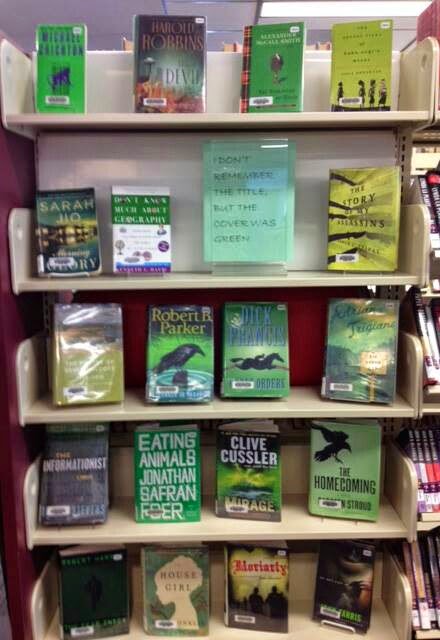
This display at the Denver Public Library titled "I don't remember the title but the cover was green" made me smile.


Monday, July 14, 2014

Your Genetic Constitution, My Genetic Constitution: Friends Sharing DNA


     The company you keep may include similar genetic material--up to 1 percent shared DNA amongst your friends--according to a new study from scientists at the University of California--San Diego and Yale University published in the Proceedings of the National Academy of Sciences.


     "Looking across the whole genome," co-author James Fowler said, "we find that, on average, we are genetically similar to our friends. We have more DNA in common with the people we pick as friends than we do with strangers in the same population."


     The researchers focused on 1,932 subjects from the Framingham Heart study; they compared pairs of unrelated friends against pairs of unrelated strangers. The same people, who were neither biologically related nor spouses, were used in both types of samples. The only thing that differed between them was their social relationship.
 
   The study controlled for ancestry (see study link below) and is a genome-wide analysis of nearly 1.5 million markers of gene variation. The researchers concluded that friends have similar genetic material to 4th cousins and that the shared genetic material is statistically significant.

    The strongest correlation between friends was sense of smell and the least correlated was resistance to diseases.

     The study is described in the 7-14-14 edition of Science Daily:

GENOME ANALYSIS AMONG FRIENDS

     So, mes amis, what are your favorite smells?! Least favorite smells? Do you suppose the study would be valid for on-line friends?

      My favorites smells are petriclor, lilacs, lemon, coffee, newly mown grass, pine trees, cinnamon, and baby-head smell. Least favorites? Mold, old sour milk, and ammonia.


      The paper also lends support to the view of human beings as 'metagenomic,'" co-author Nicholas Christakis said, "not only with respect to the microbes within us but also to the people who surround us. It seems that our fitness depends not only on our own genetic constitutions, but also on the genetic constitutions of our friends."
 
      So how's your genome profile? We all depend on each other, after all. . .


     And lastly, this misspelling of Quatorze de Juillet was too good to pass up. Happy Bastille Day, Julliet, Juliette, Julius, et al! 


Vive mes amis,

Steph
(Femme des Mots)

Any guesses as to what these are?


Monday, July 7, 2014

Take a good look at Kyanite, Andalusite, and Sillimanite: Aluminosilicate Polymorphs!

Take a good look at these three minerals:


Kyanite
Al2SiO5


Andalusite
Al2SiO5


Sillimanite Al2SiO5 (in                                                 schist)


    Would you have guessed that these three disparate minerals all have the same chemical formula? The three minerals are all polymorphs of Al2SiO5. They exhibit the widely varied forms, dependent on the temperature (x axis) and pressure (y axis) at formation.


       The crystal systems of the minerals vary from kyanite's triclinic to andalusite and sillimanite's orthorhombic crystals. In particular a variety of andalusite called chiastolite shows these marked crosses:


    The distinctive blue of kyanite, from the Greek meaning "deep blue" shows different hardnesses in different directions. 

     And sillimanite occurs in metamorphic schists formed at relatively high temperatures and pressures.

      A Plume friend was wearing a "kyanite" necklace which brought back my final mineralogy project on the KAS polymorphs...and reminded me of our final exam. We were all given different pieces of wallpaper and were to describe the symmetry of the design. It was quite a surprise and one of the exams from which I learned the most!

     Your swatches of wallpaper (not the computer kind) will be winging their way to you soon:


And for extra credit, 2 advanced wallpapers 


1


2


Looking forward to mineralogy, petrology, and symmetry discussions with you,

Steph
(Word Woman)
  
Whoa--check out this visual representation of the first 1000 digits of pi after the decimal point. That's YOUR WALLPAPER to analyze ;-


Gotta love Wyoming, where the signs point out geologic formations and their ages:


Does your state do this?!

Tuesday, July 1, 2014

Rudist Colonies: Fun, Wild Index Fossils

     Rudists are some of my favorite fossils, not just because it's a fun word to say, but because they are quite useful index fossils from the Jurassic and Cretaceous:


    Index fossils are the forms of life which existed during limited periods of geologic time and thus are used as guides to the age of the rocks in which they are preserved. John McPhee's analogy from Basin and Range  (1981) describes the concept well:

     "Imagine an E.L. Doctorow novel in which Alfred Tennyson, William Tweed, Abner Doubleday, Jim Bridger, and Martha Jane Canary sit down to a dinner prepared by Rutherford B. Hayes. ... a geologist could quickly decide -- as could anyone else -- that the dinner must have occurred in the middle 1870s, because Canary was 18 when the decade began, Tweed became extinct in 1878, and the biographies of the others do not argue with these limits."

    These marine bivalves were one of the main components of the widespread Tethys Sea between Laurasia and Gondwana about 200 million years ago as Pangaea was breaking up:


     Rudists were one of the main components  of the reefs that formed then:


      Rudists were widespread and had very different shapes making them excellent index fossils for fairly narrow time periods:


     The earlier forms were elongate, with both valves being similarly shaped, often pipe-shaped, while the later, reef-building Cretaceous forms had one valve that become a flat lid, with the other valve becoming an inverted spike-like cone. The size of these conical forms ranged widely from just a few centimeters to over a meter in length.


     Rudists' morphology consisted of a lower, roughly conical valve that was attached to the seafloor or to neighboring rudists, and a smaller upper valve that served as a kind of lid for the animal. The small upper valve could take a variety of different forms, including: a simple flat lid, a low cone, a spiral, and a star-shape.

     The earlier forms tended to be more solitary but the Cretaceous forms were generally more colonial. Rudist colony: they started it millions of years ago. The first naturists died off at the major Cretaceous-Paleogene extinction about 65 million years ago.

     Looking forward to your tales of nudist, er, rudist colonies. ;-)

Indexedly,

Steph
(Word Woman)

Holiday Hummer in the Colorado Mountains 7/3/14 (photo by C. Fiss)


     First clue (these are my photos) to location in the CO mts. See if you can win the geography quiz, at least a bit of a challenge this Sunday morning ;-):


Second clue:


More to come (if needed). Clue number three. Hint: It's very, very clear.


Monday, June 23, 2014

Cool Antipodes Tool and Earthquakes in Alaska and New Zealand

     Today two high Moment Magnitude Scale* earthquakes in Alaska (8.0)


              and New Zealand (7.0)


sent me looking for a tool to see if the two quakes were antipodal (on the other side of the earth) to/from each other. This site is quite fun and useful:

                ANTIPODAL TOOL


     What would you guess is antipodal to each location? Have a look. I was a bit surprised.

       The New Zealand quake is described in this USGS link :

 6/23/14 NEW ZEALAND QUAKE

         And the Alaskan earthquake here:

 6/23/14 ALASKAN ALEUTIAN ISLANDS QUAKE

        Both areas are tectonically quite active. I currently have a friend in both locations so have been paying particular attention to the tsunami warnings in the Aleutian Islands.

         Discussion of antipodal earthquakes is mostly anecdotal but this scientific paper looks at antipodal earthquakes as a way of determining that the earth's core is anisotropic:

         ANISOTROPIC EARTH CORE AND EARTHQUAKES


          *Here's a link to our earlier Richter Scale vs Moment Magnitude Scale discussion (if you need a review):

            Moment Magnitude Scale vs. Richter Scale


           And a bonus photograph of spectacular orthorhombic cornetite crystals: (take a close look at the color and crystal shape of this secondary copper mineral):


            Any thoughts on Antipodal Earthquakes? Cornetite? 

Whole lotta quaking' going on,

Steph
(Word Woman)

Antipodal Map (in case the tool isn't working):


Beach time at Medano Creek in The Great Sand Dunes, CO. And reading is fundamental...


Tuesday, June 17, 2014

The "Proof" is in the Puddingstone: Theories are Malleable, but not Infinitely So


     This post is dedicated to my Smith geologist friend, Dot, on her birthday. We surely enjoyed many a puddingstone outcrop in New England! Here is a thin section of the Roxbury Conglomerate, informally known as the Roxbury puddingstone: 


Last fall's puddingstone post remains the most popular at PEOTS so a tangential revisit to these conglomerates is in order:


     The article linked below discusses proof (but not necessarily in the puddingstone) and theory as being two of the most misunderstood and misused words regarding science:

MISUSED SCIENTIFIC WORDS: FROM THEORY TO PROOF TO ORGANIC

      It's a good list. Ten items is a reasonable number to absorb--like the 10 items at the fast line at the grocery store or David Letterman's top 10 list. It's a catchy way to get the general public thinking about scientific vocabulary. It's not perfect but it'll do.

      I'd like to focus on the first two words, proof and theory, but the other eight words/phrases are worth a look also.

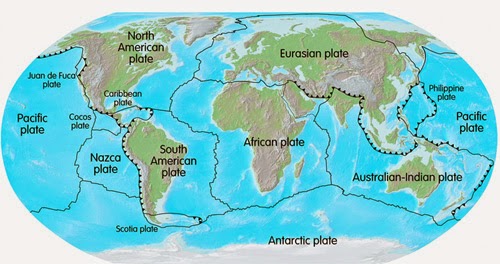
      The phrase "Theories are malleable, but not infinitely so" resonated with me. We know plate tectonics is essentially the way features on the earth's surface are formed, but it is the constant refining and sculpting with more and more data that makes the theory malleable and testable (since Alfred Wegner proposed it in 1939). The defining characteristic of all scientific knowledge, including theories, is the ability to make falsifiable or testable predictions (as we've discussed earlier).


       "The fact that science never really proves anything, but simply creates more and more reliable and comprehensive theories of the world that nevertheless are always subject to update and improvement, is one of the key aspects of why science is so successful." We don't really "prove" things. We refine, bolster, add to a mountain of evidence. . .but scientific proof is different from that "proof is in the pudding(stone)." We can't taste the fruits of our research and get the "proof" as we can in cooking.

     The hot, steamy cooking of the earth like this Fly Geyser in Nevada, remains part of the theory of plate tectonics. We just can't consume it or prove it:


     Do any of the top ten words resonate with you?

Here's to another great trip around the sun,

Steph (Word Woman)