Total Pageviews

Showing posts with label extinct. Show all posts

Thursday, March 23, 2017

Smoking Smoke Rings: Mount Etna, Sicily, Italy, and More

      This week, Partial Ellipsis of the Sun presents a photo collection of spectacular geological and meteorological images. Firstly, smoke rings from Mount Etna in Sicily, Italy. These images are from Andrew Rader. Mount Etna is erupting for the second time this month. Wow, huh?


     Next, this pyroclastic flow deposit is located in "Poseidon's Gardens" on the island of Ischia, Italy. Ischia, just off the coast from Naples and Mount Vesuvius, is dominated by Mount Epomeo. This deposit shows the violent nature of pyroclastic flows and the turbulence and deformation possible within these volcanic features. These volcanic layers were deposited about 10,000 years ago. The layers were deformed as the flow slid down the side of the mountain, or possibly, as the soft sediments were covered by a more viscous lava flow during the same eruption. Oooh la la! {Photos by Drew Patrick.}


      From Poseidon's Gardens to "Poseidon's Fury" in these gargantuan crashing waves around Bell Rock lighthouse in Angus, Scotland (photographer unknown). . .Whoa.


      And, lastly, from much calmer seas, a large slab of extinct Paleozoic ammonites and belemnites from Morocco (photos by me).


Have you seen a spectacular geologic or meteorologic image this week? Please share a link!

Steph


Friday, March 10, 2017

Conodonts or "Cono-dos:" Odd Index Fossil Elements Belonged to Extinct Eel-Like Animals

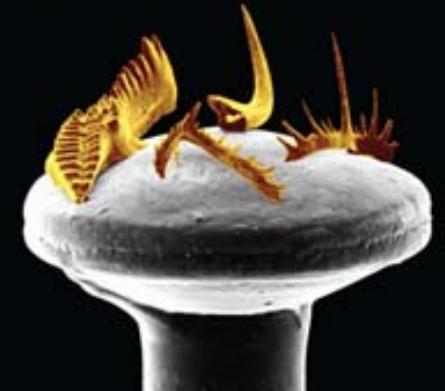
      Conodont elements are microfossils made of phosphate or apatite; they are some of the planet's most useful index fossils. {Index fossils are those found in a narrow time range and wide spatial distribution that are used in the identification of related geologic formations.}


     Conodonts (Greek kōnos, "cone", + odont, "tooth") are extinct agnathan chordates resembling eels, classified in the class Conodonta. 


      For several decades, conodonts were known only from odd, wildly and disparately shaped, tooth-like microfossil assemblages found in isolation; these microfossils are now called conodont elements.


     However,  texts published before the early 1980's refer to the teeth-like assemblages as the actual conodonts (see below).
      

        The conodont animal's soft parts were finally discovered in a lagerstätte (fossil bed of extraordinary preservation) in the Bear Gulch Limestone in Montana.


     The discovery led to the eventual recreation of what these agnathan chordates, who lived mostly during the Paleozoic, looked like.


       The conodont elements are widely used not only to define a time period of deposition but also as paleothermometers which record the degree to which sediments have been "cooked." This characteristic is quite useful to oil and gas paleontologists.
            

     The conodont elements may readily be removed from their calcium carbonate sediments by using a mild acid to dissolve the CaCO3, leaving a suite of conodont elements. My micropaleontology project at the U. of Arizona yielded a conodont suite using this method of dissolution.


        How suite it is! Though, I must say, the conodont assemblages were rather a wonderful mystery until recently. . .


          The Conodonta creatures did not have jaws but had these odd assemblages at the "mouth" ends of their bodies.


      By the way, the inspiration for this week's post was, oddly enough, limestone outcrops at the Tsingy Nature Reserve in Madagascar that we discussed last week. (All about scale, once again. . .).

Have you encountered conodont elements before? Do you have any Conodon'ts or Cono-dos? ;-)
Steph

☆☆☆☆☆☆☆☆☆☆☆☆☆☆☆☆☆

Bonus images: Conodont elements on the head of a nail in a Scanning Electron Microscope (SEM) image:


And, with a bit of gold:


Happy pi day!


Tuesday, January 3, 2017

Clutch Problem: Dinosaur Hatchlings Took Too Long to Incubate

     The mystery of why the dinosaurs became extinct after a Cretaceous meteor strike, while birds and mammals thrived, may have been solved.


     Paleontologists have discovered that dinosaur young took so long to hatch and mature into adulthood that populations failed to recover quickly enough after the devastating impact 65 million years ago.


     In contrast, birds and small mammals took only a few weeks for their offspring to emerge giving them a distinct advantage.


     The discovery was made by researchers at Florida State University and the University of Calgary, who realized it was possible to calculate how long it took for dinosaurs to hatch based on marks on the teeth of embryos and babies.


     Similar to tree rings growing a new layer each year, teeth grow a new layer each day, which is seen in microscopic lines in the dentine. By counting the daily lines of Von Ebner, scientists found it took dinosaurs between three and six months to hatch.


     The lengthy incubation period in the clutches of dinosaur eggs, in comparison to small mammals, made the hatchlings, and their parents, vulnerable to predators and left them struggling to re-establish their species.


     “Some of the greatest enigmas about dinosaurs pertain to their embryology; virtually nothing is known,” Dr. Gregory Erickson of FSU said. “We suspect our findings have implications for understanding why dinosaurs went extinct at the end of the Cretaceous period, whereas amphibians, birds, mammals and other reptiles made it through and prospered.” 


     Because birds are in the same clade with dinosaurs, scientists have long assumed that the duration of dinosaur incubation was similar to birds, whose eggs hatch within 11 to 85 days.


     However, similar-sized reptilian eggs typically take twice as long to hatch, ranging from several weeks to many months. To find out where dinosaurs fit in, the team studied the fossils of dinosaur embryos.


     “Time within the egg is a crucial part of development, but this earliest growth stage is poorly known because dinosaur embryos are rare,” said Dr. Darla Zelenitsky of the U of Calgary. “Embryos can potentially tell us how dinosaurs developed and grew very early on in life and if they are more similar to birds or reptiles in these respects.”


     The two types of dinosaur embryos researchers examined were those from a Protoceratops, (seen below) a goat-sized dinosaur found in the Gobi Desert of Mongolia whose eggs were chicken-egg-sized and Hypacrosaurus, a gigantic duck-billed dinosaur found in Alberta, Canada, with eggs weighing 4 kilograms (9 pounds.)


      The researchers ran the embryonic jaws through a CT scanner to visualize the forming dentition. Then, they extracted several of the teeth to examine with a Scanning Electron Microscope (SEM).


     Their results showed nearly three months incubation for the small Protoceratops embryos and six months for the embryos from the giant Hypacrosaurus (below).


       Dental battery (the complex set of six-layered dinosaur teeth including replacement teeth) and von Ebner lines in fossil dinosaur teeth were first observed and illustrated over 150 years ago by Richard Owen (shown below), the scientist who coined the term Dinosauria or "Terrible Lizard."


      I wonder if Dr. Owen would have given his eye teeth to change that moniker to Dinopoulia, Greek for "Terrible Bird."


It's Clutch Time, in more ways than one!
Steph


Tuesday, May 27, 2014

Trilobite Eyes, Pixels, Surgery, and your Smart Phone

      Trilobite compound eyes have always intrigued me. The calcium carbonate of the eyes of these Paleozoic-aged marine arthropods (similar to those of horseshoe crabs and insects) are often well-preserved:


     These extinct creatures have a three-lobed body:


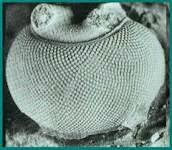
     Their eyes contain many individual lenses (akin to each one creating a pixel) 


unlike those of humans, which is a useful adaptation used in laparoscopy and which may be used in Smart Phones, if/when the technology gets small enough:


Surgery, Smart Phones, and Compound Eyes


     Compound eyes are especially useful in low light situations and in order to be able to see 360 ° to be aware of predators:


     Experience seeing like an insect (it's NOT what you think)


      A recent paper describes discovery of the not-usually-fossilized soft parts of the trilobite eyes as flower like:


          Discovery of trilobite eye soft parts


     I think it might make me see a little buggy though.


     To end today: Tri a lo' bite of this quote: 


     "I cannot stress often enough that what science is all about is not proving things to be true but proving them to be false." -Lawrence M. Krauss, theoretical physicist (b. 1954) 


What do you think?


Steph

(aka Word Woman)